
Why This SOP Matters (The Real Talk)
Let me be brutally honest with you:
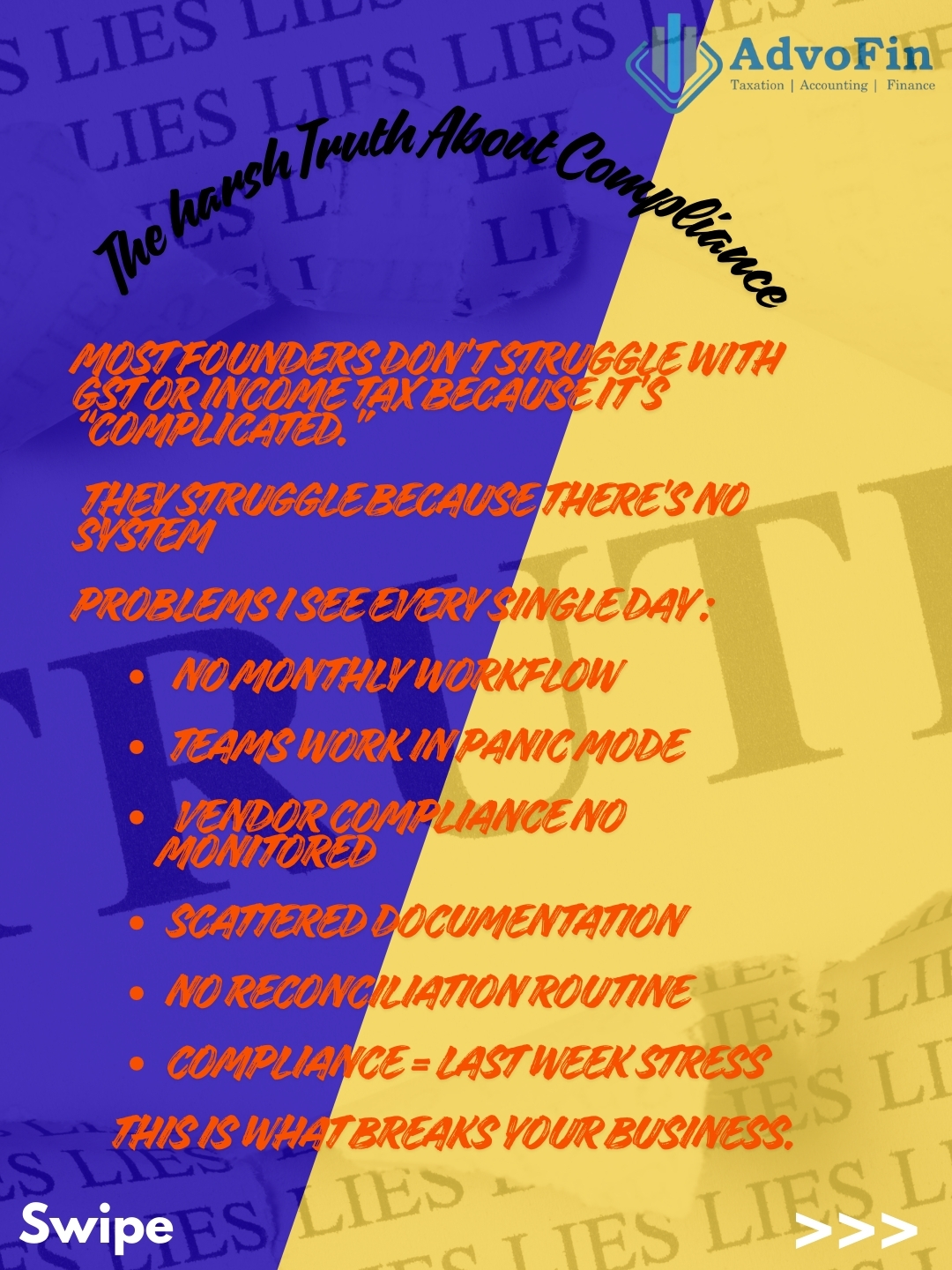
Most founders don’t struggle with compliance because GST or Income Tax is “too complicated.”
They struggle because there is no system.
Here’s what I see every single day:
❌ No fixed monthly workflow (everyone does things differently each time)
❌ Team works in reactive mode (deadline panic, then silence)
❌ Vendor compliance is not monitored (surprises in GSTR-2B every month)
❌ No documentation discipline (invoices scattered in WhatsApp, email, physical files)
❌ No reconciliation calendar (annual exercise, not monthly habit)
❌ Compliance becomes “last week ka tension” (rush, stress, mistakes)
What This Creates:
❌ GST mismatches (GSTR-1 vs 3B doesn’t align)
❌ ITC losses (₹50K-5L blocked because vendor didn’t file)
❌ Late fees accumulating (₹100/day × 6 months = ₹18,000 wasted)
❌ Constant return revisions (time waste + confusion)
❌ Notices from department (stress + legal fees)
❌ Cash flow leakage (unnecessary penalties, blocked refunds)
❌ Audit nightmares (can’t find documents, scrambling for weeks)
But here’s the good news:
A single Monthly Compliance SOP solves all of this.
One documented system. One monthly routine. One source of truth.
This is the exact blueprint AdvoFin recommends to every SME, startup, and growing business.
It’s the system we’ve refined over hundreds of implementations.
And today, I’m giving it to you completely.
Let’s dive in.
THE COMPLETE MONTHLY COMPLIANCE SOP
This SOP is organized by timeline (what to do when) and responsibility (who does what).
Follow this system, and compliance becomes automatic, not accidental.
1️⃣ Finance Team Routine (Day 1-5 of Every Month)
Objective: Lock all transaction data for the previous month.
Owner: Finance/Accounts team
✔ Step 1 – Collect ALL Vendor Invoices (Day 1-3)
What to collect:
📄 GST tax invoices (all purchases)
📄 Debit notes and credit notes
📄 Transport bills and freight charges
📄 B2B purchase bills
📄 Expense invoices (software, rent, utilities, professional services)
📄 Import Bills of Entry (BOEs) if applicable
📄 Professional service bills (CA, legal, consultants)
📄 Freelancer invoices
Critical verification (do this before accepting any invoice):
✅ Correct GSTIN (verify on GST portal)
✅ HSN/SAC codes mentioned
✅ Place of Supply correctly stated
✅ Tax breakup clear (CGST/SGST or IGST)
✅ Billed to correct legal entity (company name, address, GSTIN match)
✅ Invoice number sequential (no duplicates, no gaps)
✅ Date within the month (no backdating issues)
Why this matters:
80% of ITC problems start with bad invoice acceptance.
If you accept a non-compliant invoice:
ITC will be rejected
Vendor may not be able to correct it later
You lose money permanentl
Invoice sanity check = Foundation of clean compliance.
✔ Step 2 – Sales Data Lock (Day 1-4)
Sales team must provide and lock:
Monthly revenue (invoice-wise breakup)
Cash sales (if any, with proper documentation)
E-commerce platform reports (Amazon, Flipkart, etc.)
Delivery challans (proof of goods delivery)
Export documentation (if applicable, LUT compliance)
Payment collection data (invoice vs realization matching)
Rules:
No editing after Day 5 (data frozen for month-end closing)
Maker-Checker process (one person creates, another verifies)
E-invoice IRN confirmation (all e-invoices generated and uploaded)
Why this matters:
Sales data drives your entire GSTR-1.
If sales team keeps “adjusting” data till the 11th:
You can’t close books properly
GSTR-1 filing becomes rushed
Errors multiply
Lock it early. Stick to it.
✔ Step 3 – Books Entry Discipline (Day 1-5)
Accountant’s daily task list:
Enter all purchases in accounting software
Enter all sales transactions
Record all expense payments
Update asset register (any new purchases)
Record all bank transactions (receipts, payments)
Post journal voucher entries (adjustments, provisions)
Process payroll and TDS deductions
Quality check:
By Day 5, books should be 80-90% complete for the previous month.
Not 50%. Not “we’ll finish by month-end.”
80-90% by Day 5.
This gives you sufficient time for reconciliation and filing.
Pro tip:
Don’t wait for “all invoices” to arrive before starting entry.
Enter what you have. Flag what’s missing. Follow up aggressively.
2️⃣ GST Compliance SOP (Day 6-11)
Objective: File GST returns accurately and on time.
Owner: Accountant + CA (review)
✔ Step 4 – GSTR-2B Download + Vendor Reconciliation (Day 12-13)
As soon as GSTR-2B is available (12th of the month):
Step-by-step process:
Download GSTR-2B from GST portal (PDF + JSON)
Import into reconciliation sheet (Excel or software tool)
Match with purchase register line by line
Identify and categorize discrepancies
Create vendor follow-up list (priority-wise)
Mandatory flags to mark:
Vendor hasn’t filed GSTR-1 (invoice not in 2B)
Tax amount mismatch (invoice value doesn’t match)
Wrong GSTIN mentioned (typo or incorrect number)
Invoices in books but not in 2B (vendor filed wrong data or didn’t file)
Blocked ITC items (motor vehicles, food, etc. under Section 17(5))
Vendor GSTIN suspended/cancelled (cannot claim ITC)
Reconciliation output:
Create three buckets:
✅ Bucket 1: Matched (claim ITC confidently)
⚠️ Bucket 2: Mismatch (follow up with vendor, decide on claiming)
❌ Bucket 3: Missing (don’t claim, move to deferred ITC)
Why this matters:
Claiming ITC without 2B verification = Guaranteed notice.
The GST system auto-flags mismatches within seconds.
Do this reconciliation every single month without exception.
✔ Step 5 – Finalize GSTR-1 (Day 10-11)
Lock your monthly outward supplies:
B2B invoices:
All tax invoices issued to registered buyers
Verify: Invoice number, GSTIN, value, ta
B2C invoices:
Sales to unregistered buyers (state-wise summary)
E-commerce sales (if applicable)
Credit/Debit notes:
All issued during the month
Link to original invoice
Exports:
With LUT (Letter of Undertaking)
Export invoice details
Shipping bill reference
RCM (Reverse Charge Mechanism):
Services from unregistered vendors
Import of services
GTA services (if applicable)
Critical quality check before filing GSTR-1:
All e-invoices generated and uploaded
Invoice sequence verified (no gaps)
HSN codes correct (4-digit minimum, 6-digit if >₹5 crore)
Place of Supply correctly marked
Tax rates applied correctly (5%, 12%, 18%, 28%)
Export documentation complete
Why this matters:
GSTR-1 errors create 90% of downstream GST compliance issues.
Because:
Your customer claims ITC based on your GSTR-1
GSTR-1 data flows into your customer’s GSTR-2B
Mismatches create notices for both parties
Correcting GSTR-1 after filing is painful
File it right the first time.
✔ Step 6 – Prepare GSTR-3B Working Sheet (Day 14-18)
This is your most important monthly reconciliation.
Create detailed working for:
ITC Calculation:
Total ITC available (from GSTR-2B)
Less: Ineligible ITC (blocked credit, personal use, etc.)
Less: Deferred ITC (vendor not filed yet)
Add: Previous month deferred ITC (now available)
Less: ITC reversal (Rule 37 – 180-day payment rule)
Less: ITC reversal (Rule 42/43 – ratio calculations)
= Net ITC to be claimed
Tax Liability Calculation:
Output tax (from GSTR-1)
Add: RCM liability
Add: Interest (if any previous shortfall)
Less: ITC utilized = Cash tax payable
Final checks:
GSTR-1 turnover = GSTR-3B turnover (Table 3.1)
ITC claimed ≤ ITC in 2B
All calculations cross-verified
Interest and late fee calculated (if applicable)
Pro tip:
Always prepare this working in Excel BEFORE entering data in GST portal.
Review it. Get it approved. Then file.
Never directly enter in portal without a working sheet.
3️ ITC Control SOP (Founder-Level Discipline)
Objective: Maximize legitimate ITC, minimize compliance risk.
Owner: Founder (policy) + Accountant (execution)
✔Step 7 – Adopt “Deferred ITC Ledger” System
The Rule:
Any invoice NOT appearing in GSTR-2B → Move to Deferred ITC
Do not claim it in current month’s GSTR-3B.
How it works:
Month 1:
Vendor invoice: ₹1 lakh + ₹18K GST
Check 2B on 12th: Invoice NOT present
Action: Don’t claim ₹18K ITC
Book it in “Deferred ITC Ledger”
Follow up with vendor
Month 2:
Vendor finally files GSTR-1
Invoice appears in your Month 2 GSTR-2
Action: Claim ₹18K ITC in Month 2 GSTR-3B
Remove from Deferred ITC Ledger
Why this system is critical:
This approach saves you from:Audit issues (claimed ITC you shouldn’t have)
✅ Department notices (auto-flagged mismatches)
✅ Penalties (claiming ineligible ITC)
✅ SCN (Show Cause Notices)
✅ GST portal alerts and blocks
✅ Stress and time waste
Conservative? Yes.
Safe? Absolutely.
Worth it? 1000%.
✔Step 8 – 180-Day Payment Rule Monitoring (Monthly Check)
The Law:
If you don’t pay a vendor within 180 days of invoice date:
You must reverse the ITC you claimed
You can reclaim it when you finally pay
Section: Rule 37 of CGST Rules
Monthly SOP:
Create a report:
“ITC Auto-Reversal List – 180 Day Rule”
Columns:
Invoice date
Vendor name
Invoice amount
ITC claimed
Payment due date (Invoice date + 180 days)
Payment status
Action required
On Day 15 of every month, flag:
Invoices approaching 180-day mark (165-180 days old)
Invoices crossed 180 days (reverse ITC immediately)
Action:
Either:
Pay the vendor immediately (before crossing 180 days), or
Reverse the ITC in current month’s GSTR-3B
Why this matters:
Failure to reverse = Penalty + Interest + Notice
This is auto-detected by the system.
Step 9 – Blocked ITC Check (Section 17(5) Compliance)
The Law:
Even if you have a valid invoice and vendor filed returns, ITC is blocked on certain expenses.
Create and maintain a separate ledger:
“Section 17(5) – Blocked ITC Ledger”
Items that never qualify for ITC:
❌ Motor vehicles (except specific business use)
❌ Food, beverages (unless you’re in food business)
❌ Outdoor catering
❌ Club memberships
❌ Health services, cosmetics (for employee welfare)
❌ Rent-a-cab services (except specific conditions)
❌ Life insurance, health insurance premiums
❌ Travel benefits to employees (on vacation)
❌ Works contract for immovable property (under construction)
❌ Goods/services for personal consumption
❌ Gifts, free samples (not exceeding ₹50,000/year have some eligibility, but complicated)
Monthly process:
Review all expense invoices
Identify any falling under Section 17(5)
Do NOT claim ITC on these
Book GST as expense (not ITC)
Document the reasoning
Why this matters:
Claiming blocked ITC = 100% penalty + demand + interest
Plus reputation damage (suggests you don’t know basic rules).
4 Income Tax Compliance SOP (Monthly Discipline)
Objective: TDS compliance + advance tax planning
Owner: Accountant + CA
Step 10 – TDS Monthly Checklist (By 7th of Next Month)
TDS-applicable transactions:
📋 Professional fees (Section 194J) – >₹30,000
📋 Contractor payments (Section 194C) – >₹30,000 (individual), >₹1,00,000 (others)
📋 Rent payments (Section 194-I / 194-IB) – >₹2,40,000/year
📋 Salary (Section 192) – as per slabs
📋 Commission (Section 194H) – >₹15,000
📋 Freelancer payments (Section 194J)
📋 Director remuneration (Section 192)
📋 Interest payments (Section 194A) – if applicable
📋 Cloud/SaaS (Section 194J or 194C, depending on nature)
Monthly SOP (Every month, without fail):
Step 1: Identify (by Day 5)
Review all payments made during the month
Tag TDS-applicable transactions
Verify threshold limits crossed
Step 2: Calculate (by Day 6)
Apply correct TDS section
Use correct rate
Calculate TDS amount
Verify if already deducted
Step 3: Deposit (by 7th of next month)
Generate Challan 281 on IT portal
Pay via net banking
Download challan PDF
Update TDS ledger
Step 4: Track (by Day 10)
Update TDS register
Prepare for quarterly return
Issue acknowledgment to vendor (if requested)
Consequences of late/wrong TDS:
❌ 30% of expense disallowed (if TDS not deducted)
❌ Interest @ 1-1.5% per month (on late payment)
❌ Late fee ₹200/day (for late return filing)
❌ Vendor cannot claim TDS credit (relationship damage)
Why monthly discipline matters:
TDS is not a year-end activity.
It’s a transaction-by-transaction discipline.
Miss one month = Penalty accumulates.
✔Step 11 – Monthly Profitability Snapshot (Management Dashboard)
Finance team must deliver a Founder Dashboard by Day 15:
Financial Metrics:
💰 Total sales (month + YTD)
💰 Gross profit (sales – COGS)
💰 Gross margin % (benchmark vs last month/year)
💰 Operating expenses (category-wise breakup)
💰 Net operating profit
💰 EBITDA (if relevant)
Working Capital:
📊 Receivables aging (0-30, 31-60, 61-90, 90+ days)
📊 Payables aging (same buckets)
📊 Inventory status (if applicable)
📊 Cash conversion cycle (trend analysis)
Compliance Status:
✅ GST filing status (filed on time?)
✅ TDS payment status (paid by 7th?)
✅ Vendor compliance issues (how many?)
✅ ITC claimed vs available (utilization %)
Tax Estimates:
📈 GST liability trend
📈 Advance tax projection (quarterly)
📈 Effective tax rate (actual vs planned)
Cash Flow:
💵 Opening cash balance
💵 Cash inflows (collections)
💵 Cash outflows (payments)
💵 Closing cash position
💵 Next 30-day projection
Why this matters:
This dashboard enables:
✅ Financial discipline (you see patterns, not just transactions)
✅ Cash flow predictability (no surprises)
✅ Founder visibility (make decisions based on data, not gut feel)
✅ Early problem detection (receivables building up? Address it NOW)
If you can’t see it, you can’t manage it.
5️ Documentation SOP (Your Legal Defense Shield)
Objective: Be audit-ready always.
Owner: Accountant (maintenance) + Founder (enforcement)
Step 12 – Maintain Digital Compliance Folder (Cloud-Based)
Folder structure (mandatory standard):
Compliance Master Folder
FY 2024-25
GST
GSTR-1 (monthly, acknowledgments)
GSTR-3B (monthly, payment challans)
GSTR-2B (monthly downloads)
E-Way Bills (monthly, organized)
E-Invoices (IRN, QR codes)
Reconciliations (2B vs Books, monthly)
Income Tax
TDS (challans, certificates, returns)
Advance Tax (quarterly payments)
ITR (final return + computation)
Invoices
Purchase Invoices (month-wise)
Sales Invoices (month-wise)
Credit-Debit Notes
Payment Proofs
Bank Statements (month-wise)
Payment Receipts
UPI Screenshots (if applicable)
ROC
Board Resolutions
Annual Filings (AOC-4, MGT-7)
Statutory Registers
Agreements
Vendor Agreements
Customer Contracts
Service Agreements
MIS
Monthly Dashboard (founder reports)
Quarterly Reviews
Annual Financials
File naming convention:
Format: Type_Date_Party_Amount.pdf
Examples:
Invoice_20250115_VendorABC_50000.pdf
GSTR3B_202412_Filed_Challan.pdf
TDS_Q3FY25_Challan_281.pdf
Agreement_20241001_ClientXYZ_Annual.pdf
Why this matters:
During scrutiny, audit, or notice response:
❌ Without organized docs: 2-3 weeks scrambling, incomplete responses, penalties
✅ With this system: Produce any document in under 5 minutes, complete responses, confidence
This folder is your insurance policy.
One folder. Saves your business.
6️⃣ Audit-Readiness SOP (Quarterly Deep-Dive)
Objective: Stay perpetually audit-ready.
Owner: CA / Finance Head
Frequency: Quarterly (every 3 months)
✔ Step 13 – Quarterly Internal Review Checklist
Q1 (Apr-Jun), Q2 (Jul-Sep), Q3 (Oct-Dec), Q4 (Jan-Mar)
Within 15 days of quarter-end, conduct:
1. Vendor Compliance Score Review
List all vendors
Check filing consistency
Calculate vendor risk score (% of non-filing)
Flag high-risk vendors
Plan vendor replacement/diversification
2. ITC Mismatch Trend Analysis
Review last 3 months of 2B reconciliations
Identify recurring mismatch patterns
Calculate ITC claim efficiency (claimed/available %)
Estimate deferred ITC amount
Action plan to reduce mismatch
3. Notice History & Response Status
List all notices received (if any)
Status of responses
Pending actions
Lessons learned
Preventive measures implemented
4. Financial Ratio Analysis
📊 Current ratio (liquidity)
📊 Quick ratio (immediate liquidity)
📊 Debt-to-equity ratio
📊 Return on assets
📊 Receivables turnover
📊 Payables turnover
5. Books Hygiene Check
📊 Are all months closed?
📊 Bank reconciliations current?
📊 Any long-outstanding reconciling items?
📊 Ledger accuracy verification
📊 Trial balance review
6. Ledger Cleanup Exercise
📊 Identify dormant accounts
📊 Clear old outstanding balances
📊 Write off uncollectible amounts
📊 Reclassify misposted entries
📊 Update chart of accounts
7. Annual Filing Dependencies
📊 What data is needed for GSTR-9?
📊 Is reconciliation current?
📊 Audit requirements (if applicable)
📊 ITR preparation timeline
📊 ROC filing readiness
Output: Quarterly Audit Report
Present to founder with:
Status summary
Red flags identified
Action items
Timeline for resolution
Resource requirements (if any)
7️⃣ Management SOP (Founder Oversight)
Objective: Founder stays informed, not involved.
Owner: Founder
Time investment: 2 hours/month
✔Step 14 – 2-Hour Monthly Founder Review Meeting
Schedule: First Saturday of every month, 10 AM – 12 PM
Non-negotiable. Block calendar. Protect this time.
Attendees:
Founder / CEO
Accountant / Finance Manager
CA / Tax Consultant (retainer)
COO / Operations Head (optional, if compliance-heavy operations)
Meeting Structure (Strict Agenda):
First 30 minutes: GST + ITC Review
Questions to ask:
✅ “Were all returns filed on time last month?”
✅ “What’s our ITC claim efficiency? (claimed/available ratio)”
✅ “Any vendor compliance issues?”
✅ “Any notices or alerts from GST portal?”
✅ “GSTR-1 vs 3B – any mismatches?”
✅ “Deferred ITC amount and trends?”
Deliverable: GST Compliance Report (1-page summary)
Next 30 minutes: Accounting & TDS
Questions to ask:
✅ “Books closed for last month?”
✅ “Bank reconciliation complete?”
✅ “Any long-pending reconciling items?”
✅ “TDS paid on time?”
✅ “Any TDS errors or missed deductions?”
✅ “Documentation up to date?”
Deliverable: Books Health Report + TDS Status
Next 30 minutes: Financial Dashboard
Review the monthly dashboard from Step 11:
✅ Sales trends
✅ Profitability analysis
✅ Cash flow position
✅ Receivables aging
✅ Payables aging
✅ Key ratio changes
Focus on exceptions and trends, not individual transactions.
Final 30 minutes: Future Planning + Corrective Actions
Discuss:
✅ Upcoming tax liabilities (next 30-60 days)
✅ Cash flow forecast
✅ Any process improvements needed
✅ Vendor issues requiring management escalation
✅ Technology/automation opportunities
✅ Team training needs
✅ Action items from this meeting (assigned, with deadlines)
Deliverable: Action Tracker (who, what, by when)
Why this meeting is non-negotiable:
This 2-hour monthly ritual gives you:
✅ Total visibility (you know exactly what’s happening)
✅ No surprises (issues caught early)
✅ No last-minute running (everything planned)
✅ Predictability (tax, compliance, cash flow)
✅ Team accountability (everyone knows founder reviews monthly)
✅ Confidence (you’re in control)
2 hours/month = 24 hours/year
ROI: Avoiding ₹5-10 lakh in penalties + Peace of mind
Worth it? Absolutely.
8️ Year-End Prep SOP (Every Month, Not Just March)
Objective: Make year-end closing feel like any other month.
Philosophy: “Clean Books Every Month” Principle
✔ Step 15 – The “No March Panic” System
Traditional approach (chaos):
January-February: Relaxed, no urgency
March: Sudden panic, everyone working overtime
March 25-31: Total chaos, stress, errors
April: Exhausted team, incomplete work
AdvoFin approach (calm):
Every month: Close books completely
Every quarter: Internal review
March: Just another month (slightly more comprehensive, but no panic)
April: Ready for audit, ITR filing, no stress
How to achieve this:
✅ Never skip monthly closing (even if small errors remain, close and note exceptions)
✅ Maintain rolling checklist (what’s needed for year-end? Track monthly progress)
✅ Quarterly provisions (depreciation, accruals, estimates)
✅ Vendor confirmations (every 6 months, not at year-end)
✅ Stock reconciliation (quarterly, if applicable)
✅ Asset verification (half-yearly)
Result:
Year-end feels like any other month.
No chaos. No tension. No fire-fighting.
Just systematic completion of annual requirements.
Monthly SOP = No March nightmare.
Founder Summary – The 5 Golden Rules of Monthly Compliance
If you remember nothing else from this entire SOP, remember these 5 rules:
1️ Reconcile Monthly (Not Annually)
Every month, without exception
Bank reconciliatio
GSTR-2B reconciliation
Books vs returns reconciliation
Monthly reconciliation = Clean compliance
2️ Claim ITC Only From GSTR-2B
Never claim ITC on “faith” that vendor will file.
Always verify in 2B first.
If not in 2B → Deferred ITC Ledger
This one rule prevents 80% of GST notices.
3️ Maintain Documentation Discipline
Every invoice, every challan, every agreement
Properly name
Properly file
Properly backed up
Accessible within 5 minute
Documentation = Your insurance policy
4️ Conduct Monthly Internal Audit
Don’t wait for external audit or government scrutiny.
Audit yourself every month:
What went wrong?
What needs fixing?
What process failed?
How to prevent recurrence?
Self-audit = Prevention
5️ Founder Must Review Compliance Every 30 Days
Not quarterly. Not annually.
Every. Single. Month.
2-hour meeting. Non-negotiable.
This meeting alone prevents 90% of compliance disasters.
Founder attention = Team discipline
🎯 Final Implementation Advic
Don’t try to implement all 15 steps at once
That’s overwhelming and will fail.
Instead:
Month 1: Foundation
Implement:
Step 1 (Invoice collection)
Step 4 (2B reconciliation)
Step 12 (Documentation folder)
Step 14 (Monthly review meeting)
Month 2: GST Focus
Add:
Step 5 (GSTR-1 finalization process)
Step 6 (GSTR-3B working)
Step 7 (Deferred ITC ledger)
Month 3: Full System
Add remaining:
Step 8 (180-day rule monitoring)
Step 9 (Blocked ITC check)
Step 10 (TDS checklist)
Step 11 (Monthly dashboard)
Step 13 (Quarterly review)
Step 15 (Year-end prep mindset)
By Month 4: System is running smoothl
And you’ll wonder how you ever managed without it.
Frequently Asked Questions (FAQs)
1. This SOP looks comprehensive but also time-consuming. How much time does it actually take per month?
Realistic time breakdown:
Accountant/Finance Team:
Day 1-5: Transaction entry (15-20 hours/week = ongoing work)
Day 6-11: GST compliance (8-10 hours)
Day 12-18: Reconciliations (6-8 hours)
Day 20-25: Documentation & reviews (4-5 hours)
Total: 35-45 hours/month (roughly one full-time person at 8-10 hours/week)
CA/Consultant:
Reviews and advisory: 3-4 hours/month
Monthly meeting: 2 hours
Total: 5-6 hours/month (retainer basis)
Founder:
Monthly review meeting: 2 hours
Weekly check-ins: 15 min/week = 1 hour/month
Total: 3 hours/month
Is it worth it?
Compare to:
Firefighting notices: 20-40 hours when they arrive
Penalty costs: ₹50K-5L per yea
Stress and anxiety: Priceless
Yes, absolutely worth it.
2. We’re a small startup with 3 people. Do we really need all this?
You need a scaled-down version, but yes, you need the discipline.
Small startup SOP (simplified):
Keep:
✅ Invoice collection discipline (Step 1)
✅ GSTR-2B reconciliation (Step 4)
✅ Deferred ITC approach (Step 7)
✅ TDS monthly check (Step 10)
✅ Documentation folder (Step 12)
✅ Monthly founder review – even if it’s just 30 min with your CA (Step 14)
Skip for now:
⏸️ Elaborate dashboards (Step 11) – use simpler reports
⏸️ Quarterly deep-dive (Step 13) – do half-yearly instead
⏸️ Some detailed reconciliations – do quarterly
Time investment: 10-15 hours/month
As you grow, gradually add more steps
But never skip:
Invoice discipline
2B reconciliation
Documentation
Monthly review
These are non-negotiable at any size.
3. What if our accountant says “I’ve been doing this for 10 years, I don’t need a written SOP“?
Red flag.
Experienced professionals LOVE SOPs because:
SOPs make their job easier (no remembering, just follow)
SOPs protect them from mistakes
SOPs make training assistants simple
SOPs create accountability (everyone follows same standard)
Professionals who resist SOPs usually:
❌ Have inconsistent processes (do things differently each time)
❌ Keep knowledge in their head (creates dependency)
❌ Make mistakes but hide them
❌ Feel threatened by transparency
Your response
“I’m sure you’re excellent at what you do. The SOP isn’t questioning your expertise – it’s ensuring consistency even when you’re on leave, when we hire assistants, or when we scale. Every professional organization has SOPs. This is about building systems, not doubting your skills.”
If they still resist strongly:
Consider whether this is the right person for a growing business.
Systems-first companies scale. Personality-dependent companies don’t.
4. How do we handle the transition from our current chaotic system to this SOP?
Don’t try to fix the past and implement the future simultaneously.
Transition plan:
Step 1: Draw a line (Month 0)
Pick a month (preferably start of a quarter – Apr, Jul, Oct, Jan).
Say: “From [this month], we implement the SOP. Past is past.”
Step 2: Implement going forward (Month 1-3)
Focus 100% on following the SOP for new transactions.
Don’t worry about cleaning up old mess yet.
New discipline first.
Step 3: Parallel cleanup (Month 2-6)
Once new system is running smoothly (Month 2+), allocate separate time/resources to clean up past:
Reconstruct missing reconciliations
Organize old documents
File pending corrections
Close old loops
But don’t let cleanup interfere with current SOP execution.
Step 4: Full system live (Month 4-6)
By Month 4-6, both present and past are clean.
You’re now in steady state.
Transition timeline: 3-6 months
It’s uncomfortable, but necessary.
Like cleaning a messy room – it gets messier before it gets cleaner.
5. What software/tools do we need to implement this SOP effectively?
Minimum viable tech stack:
1. Accounting Softwar
Choose one
Zoho Books (₹3-5K/year) – Best for most startups/SME
Tally Prime (₹18-54K one-time) – Best for manufacturing/tradin
QuickBooks (₹6-15K/year) – Good alternativ
Don’t use Excel as primary accounting system.
2. GST Reconciliation Too
Built-in to most accounting software
If not, use
ClearTax GST (₹10-20K/year
Tally Prime (has excellent GST recon features
Excel templates (free, but manual effort)
3. Cloud Storage
Google Drive (₹130/month for 100GB – ₹1,560/year)Or use Dropbox, OneDrive, etc.
Critical: Must be cloud, not just local storage.
4. TDS Software
Gen TDS (free from Income Tax Department
Most accounting software also has TDS module.
5. Communication/Task Management
For tracking compliance tasks:
Google Sheets (free, simple checklist)
Trello (free for basic use)
Monday.com / Asana (paid, more robust)
Not mandatory, but helpful for task tracking.
Total minimum investment
₹5-10K/year (accounting software + cloud storage
That’s ₹500-800/month
Cost of one late GST filing: ₹500+ in late fees
The software pays for itself in Month 1.
6. Our CA says they’ll handle everything – why do we need to do all this internally?
Your CA should absolutely handle compliance execution.
But YOU (founder + team) must handle:
✅ Data collection (invoices, bills, transaction info)
✅ First-level verification (invoice quality check)
✅ Internal reconciliation (books vs reality)
✅ Documentation organization (filing, storage)
✅ Vendor follow-up (for missing invoices, GSTIN issues)
✅ Monthly review (understanding what’s happening)
Your CA cannot:
❌ Collect invoices from your vendors (that’s your team’s job)
❌ Know which expenses are business vs personal (you need to tell them)
❌ Verify if goods were actually received (operational knowledge)
❌ Follow up with your vendors daily (relationship management)
Division of responsibility:
You + Team: Data collection, organization, first-level checks
CA: Compliance execution, filing, advisory, complex issues
Think of it like healthcare:
You: Maintain healthy lifestyle, regular checkups
Doctor: Diagnose, treat, prescribe
You can’t outsource health maintenance.
Similarly, you can’t outsource data quality and documentation.
7. What’s the single biggest mistake businesses make when implementing this SOP
Starting too perfectly
They think
“We’ll implement everything, document everything, train everyone, and launch perfectly on Day 1.”
Then:
Month 1 planning
Month 2 more planning
Month 3 “not ready yet”
Month 6 “we’ll start next quarter”
Never actually start
The right approach
Start imperfectly. Month 1. Today
Implement:
3 steps this month
3 more next month3 more the month after
Iterate. Improve. Refine.
Version 1.0 is better than Version Perfect that never launches.
Remember:
Done is better than perfect.
Consistent “good enough” beats occasional “perfect”.
8. How do I convince my co-founder/partners to invest time and money in this system?
Show them the two scenarios:
Scenario A: No SOP (Current State)
Year 1:
GST penalties: ₹30,000
ITC losses due to vendor issues: ₹80,000
TDS disallowances: ₹50,000
Late fees: ₹15,000
Notice response CA fees: ₹40,000
Founder time wasted: 50 hours × ₹5,000/hour = ₹2,50,000
Total Year 1 cost: ₹4,65,000
Year 2: Worse (compounding issues)
Year 3: Even worse + possible audit
Scenario B: Implement SOP
Year 1 Investment:
Accounting software: ₹10,000
CA retainer (enhanced): ₹1,50,000
Training time: ₹30,000 equivalent
System setup: ₹50,000
Total Year 1 investment: ₹2,40,000
Savings Year 1: ₹4,65,000 – ₹2,40,000 = ₹2,25,000 positive
Year 2: Almost zero penalties, smooth operations, ₹3L+ savings
Year 3: Fully optimized, investor-ready, ₹5L+ savings
Plus intangibles:
Peace of mind
Faster decision-making
Scalability readiness
Better valuation (if fundraising)
ROI: 100%+ in Year 1, 200%+ in Year 2
Ask your co-founder:
“Would you rather spend ₹2.5L building a system that protects us forever, or spend ₹4-5L every year on penalties, firefighting, and stress?”
9. We tried implementing a compliance calendar before but it failed. How is this different?
Common reasons compliance systems fail:
❌ Too complex (50-step checklist no one follows)
❌ No ownership (everyone’s responsibility = no one’s responsibility)
❌ No accountability (no one checks if it’s done)
❌ No founder involvement (team knows founder doesn’t care)
❌ All-or-nothing approach (tried to do everything, got overwhelmed, quit)
How this SOP is different:
✅ Phased implementation (3 steps/month, not 15 at once)
✅ Clear ownership (accountant does X, CA does Y, founder does Z)
✅ Monthly review meeting (founder checks progress every 30 days)
✅ Founder visibly involved (2-hour monthly meeting signals importance)
✅ Flexible but firm (can adapt steps, but can’t skip monthly review)
✅ Starts small, scales gradually (build momentum, don’t burn out)
Plus:
This SOP has been battle-tested with hundreds of businesses.
It’s not theory. It’s proven practice.
Follow it systematically, and it works.
10. After implementing this SOP perfectly, what’s the biggest ongoing risk we should watch for?
Complacency.
What happens:
Month 1-6: Team follows SOP religiously (new system, high attention)
Month 7-12: SOP becomes routine (good!)
Month 13-18: Small shortcuts start (“just this once…”)
Month 19-24: Shortcuts become normal (“it’s fine, we can catch up”)
Month 25+: Back to chaos
This is called “System Decay.”
How to prevent it:
1. Quarterly SOP review
Is everyone still following the process?
Have shortcuts crept in?
Do we need to update the SOP?
2. Never skip monthly founder review
Even when things are smooth
Even when you’re busy
Even when “nothing’s wrong”
The moment you skip = Signal to team that it’s optional
3. Tie compliance to incentives
Part of performance review
Bonus component for clean compliance
Recognition for consistency
4. External audit
Annual CA audit
Independent compliance review
Fresh eyes catch complacency
5. Celebrate milestones
“12 months zero penalties” → Team lunch
“24 months clean audits” → Bonus
Make compliance a point of pride
Remember:
Systems don’t maintain themselves.
They require ongoing leadership attention.
Monthly 2-hour review = Your insurance premium against system decay.
11. What if we’re mid-year right now? Should we wait for April to start this SOP?
No. Absolutely not.
Start TODAY.
“Best time to plant a tree was 20 years ago. Second best time is today.”
Here’s why
❌ If you wait till April
3-6 months more of penalties accumulatin
3-6 months more of ITC losse
3-6 months more of messy data
Year-end (March) will still be chaotic
✅ If you start today:
Stop the bleeding immediately
Next 3-6 months gradually improve
By April, you’re in good shape
Every month of delay = More cleanup needed later
“But won’t mid-year implementation be messy?”
Yes. And that’s okay.
Implementation plan if starting mid-year:
Month 1 (Current month):
Draw the line: “From this month forward, we follow SOP”
Implement Steps 1, 4, 12, 14
Don’t try to fix past months yet
Month 2-3:
Continue SOP for new months
Add more steps (Steps 5, 6, 7)
Still ignoring past mess
Month 4+:
SOP running smoothly for current work
Now allocate time to clean up past 6 months
Parallel tracks: maintain present + fix past
By Month 6-7:
Present clean
Past cleaned up
Ready for year-end
You’ll reach April next year in much better shape than if you waited.
12. How do we know if our SOP implementation is actually working?
Measure these metrics monthly:
Leading Indicators (Process Metrics):
✅ Books closing date (Target: by 10th of next month)
✅ GSTR-1 filing date (Target: by 10th)
✅ GSTR-3B filing date (Target: by 18th)
✅ 2B reconciliation completion (Target: by 13th)
✅ TDS payment date (Target: by 7th)
✅ Monthly review meeting held (Target: Yes/No)
Outcome Metrics
✅ ITC claim efficiency (ITC claimed / ITC available) – Target: >95%
✅ Vendor compliance score (% of vendors filing on time) – Target: >80%
✅ Late fees paid – Target: ₹0
✅ Penalties paid – Target: ₹0
✅ Notices received – Target: 0
✅ ITC blocked/reversed – Target: ₹0 (or minimal
Create a simple scorecard:
Metric | Jan | Feb | Mar | Target |
| Books closing (by 10th) | ✅ | ✅ | ❌ | 12/12 |
| GSTR-1 on time | ✅ | ✅ | ✅ | 12/12 |
| ITC efficiency | 97% | 96% | 94% | >95% |
| Late fees | ₹0 | ₹0 | ₹500 | ₹0 |
| Notices | 0 | 0 | 0 |
If metrics are improving month-over-month:
✅ Your SOP is working.
If metrics are flat or declining:
⚠️ Something’s broken. Investigate and fix.
Review quarterly: Are we hitting our targets? If not, why not?
Remember:
What gets measured gets managed.
Track these metrics. Review them monthly.
Celebrate improvements. Fix declines.
Need help implementing this Monthly Compliance SOP in your business?
AdvoFin Consulting specializes in SOP implementation, team training, and compliance system setup for SMEs and startups.
We don’t just give you the document – we help you actually implement it and make it stick.
📩 Let’s build a compliance system that runs on autopilot – so you can focus on growing your business.