
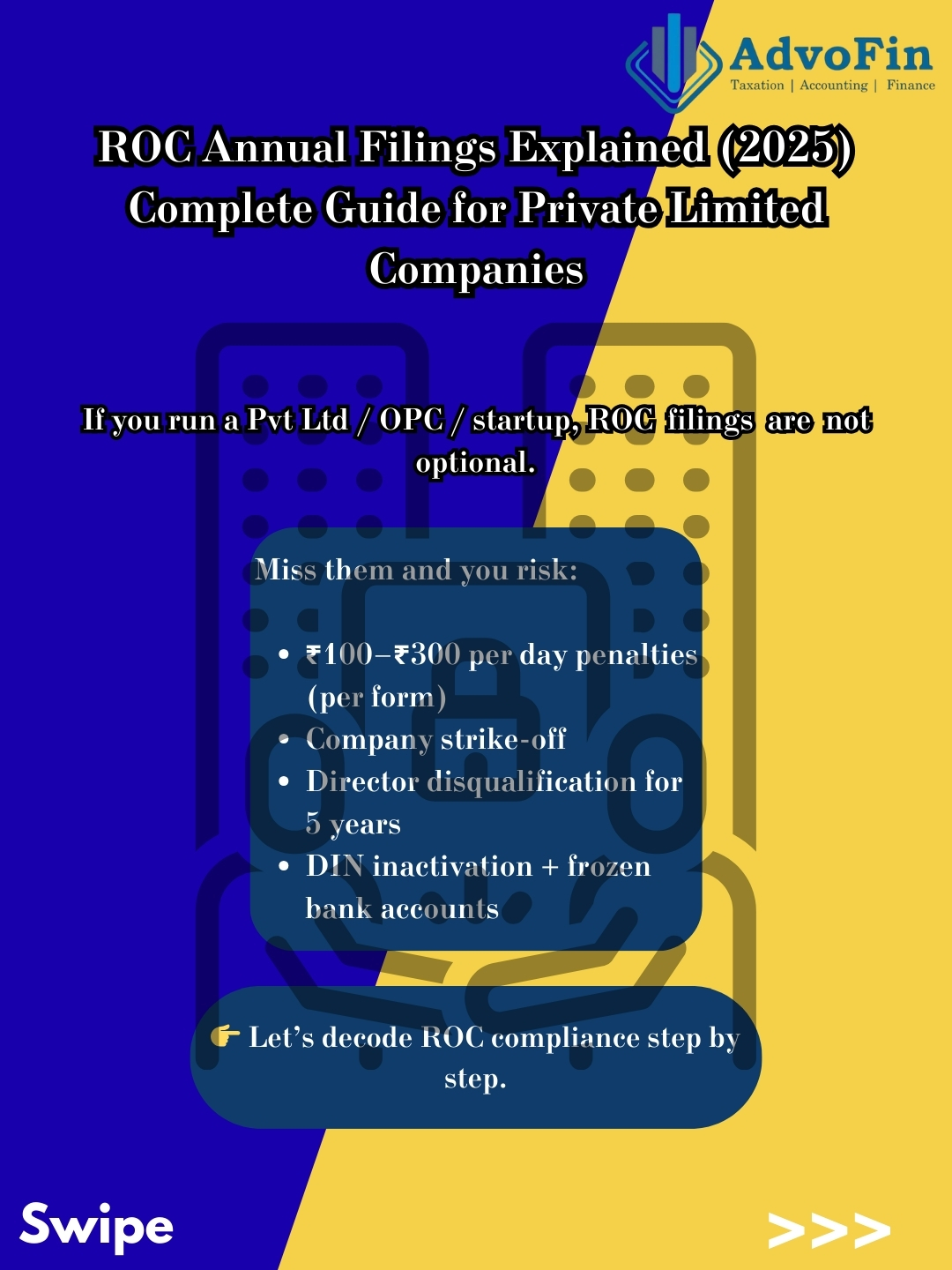
Introduction: Why ROC Filings Are Non-Negotiable
If you run a Private Limited Company in India, you’ve probably heard these terms thrown around: AOC-4, MGT-7, ADT-1, AGM, DPT-3, DIR-3 KYC.
Most founders know they’re “important filings” but don’t fully understand:
- What each form actually means
- Why each is required
- When exactly to file them
- What happens if you miss deadlines
- What the Ministry of Corporate Affairs (MCA) scrutinizes
- How to maintain “clean” company records
Here’s the reality:
ROC (Registrar of Companies) annual filings are not suggestions – they’re mandatory legal obligations under the Companies Act, 2013. Every Private Limited Company, OPC (One Person Company), and other registered entities must file annual returns with MCA.
Even if your company:
- Has zero revenue
- Is dormant or inactive
- Just started operations
- Is pre-revenue startup
You must still file.
The consequences of non-compliance are severe:
❌ Penalties starting at ₹100-200 per day per form (no upper limit)
❌ Company strike-off after 2-3 years of non-filing
❌ Director disqualification for 5 years
❌ DIN (Director Identification Number) marked inactive
❌ Personal liability on directors
❌ Difficulty in raising funding or getting bank loans
❌ Damaged corporate governance reputation
❌ Increased scrutiny from regulatory authorities
The good news: ROC compliance is entirely manageable with the right system and timeline.
This comprehensive guide breaks down every ROC annual filing requirement for Private Limited Companies in 2025 – what they are, when to file them, what documents you need, and how to build a compliance system that prevents last-minute chaos.
What Are ROC Annual Filings? (The Basics)
ROC = Registrar of Companies, the regulatory body under the Ministry of Corporate Affairs that oversees all registered companies in India.
Annual filings are mandatory documents and returns that every company must submit to ROC each financial year, reporting:
- Financial performance and position
- Shareholding structure and changes
- Director and Key Managerial Personnel (KMP) details
- Board and shareholder meeting records
- Auditor information
- Compliance declarations
- Loans, deposits, and related party transactions
Think of ROC filings as your company’s annual report card to the government.
They serve multiple purposes:
- Regulatory compliance – Legal requirement under Companies Act
- Transparency – Public disclosure of company information
- Governance – Demonstrates proper corporate management
- Due diligence – Used by investors, banks, partners to verify company status
- Director protection – Establishes compliance record for directors
Why ROC Filings Matter (Beyond Just Compliance)
1. Legal Obligation with Personal Liability
Directors are personally responsible for ensuring ROC filings. Non-compliance leads to director disqualification and penalties on individual directors, not just the company.
2. Investor and Funding Readiness
Every investor or VC conducts ROC verification first:
- Checks if all annual returns filed on time
- Reviews financial statements for accuracy
- Verifies shareholding structure
- Looks for compliance gaps
Late or missing filings = immediate red flag = funding rejected
3. Bank Loan Eligibility
Banks check ROC compliance before approving business loans. Clean filing record improves:
- Loan approval chances
- Credit limits
- Interest rates offered
4. Prevents Company Strike-Off
Critical: If you don’t file for 2 consecutive years, MCA issues Section 248(1) notice for company strike-off.
Consequences of strike-off:
- Company ceases to exist legally
- All directors disqualified for 5 years
- Bank accounts frozen
- Assets vest with government
- Revival requires NCLT petition (expensive and time-consuming)
5. Protects Directors from Liability
Proper and timely filings create a defense record for directors, showing:
- Company was properly managed
- All disclosures were made
- Compliance was maintained
- Directors fulfilled their duties
This becomes critical if any disputes or investigations arise later.
6. Maintains Corporate Reputation
Clean ROC records signal:
- Professional management
- Good governance practices
- Reliable business partner
- Serious business operations
Clients, partners, and vendors often verify ROC status before major contracts.
The Complete List of ROC Annual Filings
Here are all the mandatory annual filings for a Private Limited Company:
1. AOC-4 – Financial Statements Filing
What it is: Filing of audited financial statements with MCA
What’s included:
- Balance Sheet
- Profit & Loss Statement
- Cash Flow Statement (for certain companies)
- Director’s Report
- Auditor’s Report
- Notes to Accounts
- Accounting policies
- Related party transactions disclosure
- Ratios and explanatory notes
Who signs: Director + Company Secretary (if appointed) or CFO
Due date: Within 30 days of AGM
For most companies:
- AGM deadline: 30th September
- AOC-4 deadline: 30th October
Form type:
- AOC-4 (for companies requiring audit)
- AOC-4 CFS (for companies filing consolidated financial statements)
Penalty for late filing:
- Company: ₹100 per day of delay
- Every officer in default: ₹100 per day
- No maximum limit (can run into lakhs)
Why it matters: This is your company’s complete financial disclosure. Investors, banks, creditors, and government all review this.
Common mistakes:
- Not matching figures with books
- Missing related party disclosures
- Incorrect director remuneration disclosure
- Not updating accounting policies
- Filing without proper board approval
2. MGT-7 – Annual Return
What it is: A comprehensive snapshot of company status for the entire financial year
What’s included:
- Registered office details
- Principal business activities
- Complete shareholding pattern (category-wise)
- Promoter and promoter group details
- List of top 10 shareholders
- Directors and KMP details
- Meetings held (board meetings, AGM)
- Remuneration of directors
- Penalty or punishment details (if any)
- Share transfer details
- Changes during the year
- Indebtedness details
- Turnover and networth
Who certifies: Practicing Company Secretary (for companies requiring CS) or Director
Due date: Within 60 days of AGM
For most companies:
- MGT-7 deadline: 30th November (if AGM on 30th Sept)
Form type:
- MGT-7 (for most companies)
- MGT-7A (for small companies – simplified version)
Penalty for late filing:
- ₹100 per day (company)
- ₹100 per day (every officer in default)
- No maximum cap
Why it matters: This is the most comprehensive public document about your company. Contains everything someone needs to know about ownership, management, and structure.
Common mistakes:
- Shareholding pattern errors
- Not updating director details
- Missing share transfer entries
- Incorrect meeting details
- Not disclosing changes during year
3. ADT-1 – Auditor Appointment Notification
What it is: Intimation to ROC about appointment/reappointment of statutory auditor
When required:
- First auditor appointment (within 30 days of incorporation)
- Casual vacancy filled
- Auditor reappointed at AGM (though most auditors appointed for 5 years)
Due date: Within 15 days of AGM (if appointment/reappointment happens)
Who signs: Director
Important notes:
- First auditor can be appointed by board
- Subsequent auditors appointed at AGM
- Auditors can be appointed for up to 5 years
- Rotation mandatory for certain class of companies
Penalty: ₹300 per day (on company and every officer)
4. DIR-3 KYC – Annual Director KYC
What it is: Annual “Know Your Customer” verification for every director
Who must file: Every individual holding DIN (Director Identification Number)
Due date: 30th September every year
What’s verified:
- PAN (must be linked and active)
- Aadhaar (must be linked and verified via OTP)
- Mobile number (OTP verification)
- Email ID (OTP verification)
- Current residential address
- Current directorships
Filing process:
- Online through MCA portal
- Requires DSC (Digital Signature Certificate)
- OTP sent to mobile and email
Penalty: ₹5,000 per director for late filing
Critical consequence: If not filed, DIN gets marked as “inactive” – director cannot sign any documents, blocking all company filings.
Important: Even if you’ve resigned from all companies, you must still file DIR-3 KYC to keep DIN active.
5. DPT-3 – Return of Deposits and Particulars of Loans
What it is: Annual return about deposits and loans taken by company
Who must file: Every company (even if no deposits or loans)
Due date: 30th June every year
What’s disclosed:
- All loans and borrowings (secured and unsecured)
- Deposits accepted from members
- Share application money pending allotment
- Trade advances for more than 365 days
- Details of each lender
- Amount, interest rate, purpose, repayment terms
Important categories to disclose:
- Bank loans
- Director loans
- Loans from shareholders/relatives
- Debentures
- Any money accepted from public
- Inter-corporate loans
Penalty:
- Company: ₹2,000 per day (minimum ₹1 lakh, maximum ₹10 lakh)
- Officer in default: ₹1,000 per day (minimum ₹25,000, maximum ₹2 lakh)
Why critical: MCA is very strict about deposits. Non-filing attracts heavy penalties and can lead to prosecution under deposit rules.
Even NIL returns must be filed.
6. MSME Form-1 – Outstanding Payment Details
What it is: Half-yearly return of outstanding payments to MSME (Micro, Small & Medium Enterprises) suppliers
Who must file: Companies with outstanding payments to MSME vendors beyond 45 days
Due dates:
- 30th April (for Oct-March period)
- 31st October (for April-September period)
What’s disclosed:
- MSME vendor details
- Invoice details
- Amount outstanding
- Days overdue
- Reason for delay
Why it exists: To protect MSMEs from payment delays and enforce timely payments
Penalty:
- ₹10,000 initially
- ₹1,000 per day thereafter (capped at ₹2 lakh)
- Plus legal action by MSME vendor possible
Important: If you have no outstanding payments to MSMEs, you may still need to file NIL return or ensure you maintain records proving no liability.
7. DIR-8 – Declaration by Director
What it is: Annual declaration that director is not disqualified under Section 164
When filed: Along with financial statements (part of AOC-4 process)
What director declares:
- Not convicted of any offense
- Not disqualified by court/tribunal
- Company (where director) hasn’t defaulted in filing
- Not an undischarged insolvent
- Paid all calls on shares held
Penalty: Not specifically stated but non-filing can be used against director in disqualification proceedings
8. MBP-1 – Disclosure of Interest by Director
What it is: Disclosure of director’s interest in other entities and potential conflicts
When filed:
- At first board meeting of financial year
- Whenever interests change
What’s disclosed:
- Other directorships
- Partnership in firms
- Shareholding in companies
- Interests in contracts with company
- Related party relationships
Why important: Prevents conflict of interest, establishes transparency, required for related party transaction approvals
Complete ROC Compliance Calendar (2025)
Print this and put it on your wall:
April – June (Q1):
April 30th:
- MSME Form-1 (for Oct-Mar outstanding payments)
June 30th:
- DPT-3 (Return of deposits and loans)
- First board meeting of new FY
- MBP-1 (Director disclosure of interest)
July – August (Q2):
July-August (No fixed date):
- Complete statutory audit
- Finalize financial statements
- Prepare Board Report
- Prepare AGM notice
- Send AGM notice to shareholders (21 days advance)
September (Q3) – BUSIEST MONTH:
By 30th September:
- Conduct Annual General Meeting (AGM)
- DIR-3 KYC for all directors
- Approve financial statements at AGM
- Appoint/reappoint auditor (if applicable)
- Pass all necessary resolutions
October – November (Q4):
By 30th October:
- AOC-4 (Financial Statements) – within 30 days of AGM
By 15th October (if applicable):
- ADT-1 (Auditor appointment) – within 15 days of AGM
By 30th October:
- MSME Form-1 (for April-Sept outstanding payments)
By 30th November:
- MGT-7 (Annual Return) – within 60 days of AGM
Throughout the Year:
Quarterly:
- Board meetings (minimum 4 per year, max 120-day gap)
As needed (event-based):
- Share allotment (PAS-3 within 30 days)
- Director changes (DIR-12 within 30 days)
- Registered office change (INC-22 within 30 days)
- Charge creation (CHG-1 within 30 days)
Documents Required for ROC Annual Filings
From Accounts/Finance Team:
Financial Records:
- Complete trial balance
- Ledger-wise summary
- Balance confirmations (debtors, creditors, loans)
- Fixed asset register with depreciation schedule
- Bank statements (all accounts, full year)
- Stock/inventory statements
- Related party transaction details
- Director remuneration details
- Loan and advance details with terms
Books Closure:
- Opening balances verified
- All transactions recorded
- Bank reconciliation completed
- Inter-company reconciliation (if applicable)
- Provisions and accruals recorded
From Legal/Secretarial Team:
Statutory Documents:
- MOA (Memorandum of Association)
- AOA (Articles of Association)
- Certificate of Incorporation
- Previous year’s filed documents
- Share certificate register
- Shareholder register (updated)
- Minutes book (board and shareholder meetings)
- Attendance registers
- Statutory registers (MBP-1, MBP-2, DIR-8, etc.)
- Contracts and agreements
From Directors:
Personal Documents:
- Valid DSC (Digital Signature Certificate)
- DIN details and KYC status
- PAN and Aadhaar linked
- Current contact details (mobile, email)
- Address proof (if updated)
From Auditor:
Audit Documents:
- Signed audit report
- Auditor’s observations and qualifications (if any)
- Unadjusted audit differences
- Management representation letter
- Auditor independence declaration
Penalties for Non-Compliance (2025 Reality Check)
MCA has significantly increased enforcement and penalties:
Late Filing Penalties:
| Form | Penalty on Company | Penalty on Officer | Cap |
| AOC-4 | ₹100/day | ₹100/day on each officer | None |
| MGT-7 | ₹100/day | ₹100/day on each officer | None |
| ADT-1 | ₹300/day | ₹300/day on each officer | None |
| DIR-3 KYC | N/A | ₹5,000 per director | Fixed |
| DPT-3 | ₹2,000/day (min ₹1L, max ₹10L) | ₹1,000/day (min ₹25K, max ₹2L) | As stated |
| MSME-1 | ₹10,000 + ₹1,000/day | ₹10,000 + ₹1,000/day | ₹2 lakh |
Example penalty calculation:
AOC-4 filed 100 days late:
- Company penalty: ₹100 × 100 days = ₹10,000
- 2 directors penalty: ₹100 × 100 × 2 = ₹20,000
- Total: ₹30,000 (for single form, single year)
Non-Filing for Multiple Years:
Year 1 delay: Penalties start accumulating
Year 2 delay:
- Penalties multiply
- Company status becomes “Active Non-Compliant”
- Difficult to conduct business
Year 3 delay:
- MCA issues Section 248(1) strike-off notice
- Company faces removal from register
- Directors face disqualification for 5 years
Strike-off consequences:
- Company ceases to exist
- All assets vest with government
- Directors disqualified from all present and future directorships
- Bank accounts frozen
- Revival requires NCLT petition (₹50,000-2,00,000 cost + 6-12 months time)
What MCA Scrutinizes During Review
MCA now uses AI-powered data matching and analytics:
1. Cross-Database Verification:
ROC vs GST:
- Turnover in financial statements should align with GST annual return (GSTR-9)
- Major mismatches trigger notices
ROC vs Income Tax:
- Income shown in ITR should match financial statements
- Related party transactions cross-verified
ROC vs TDS:
- Director remuneration in ROC should match TDS deducted (Form 24Q)
- Employee count verification
2. Common Red Flags:
Financial Statement Issues:
- Abnormal profit margins (too high or persistent losses)
- Current ratio below 1 (liquidity concerns)
- Debt-equity ratio issues
- Unexplained large expenses
- Revenue recognition inconsistencies
Disclosure Issues:
- Missing related party transactions
- Undisclosed director remuneration
- Share capital changes not properly disclosed
- Beneficial ownership gaps (UBO not disclosed)
Governance Issues:
- Board meetings not held as per law (less than 4, or gaps > 120 days)
- AGM delayed or not held
- Audit qualifications not addressed
- Director rotations not followed (where applicable)
3. Automated Flags:
System automatically flags:
- Companies with turnover > ₹1 crore but showing losses for 3+ years
- Director serving in 15+ companies
- Share transfers at abnormal valuations
- Large loans from directors/relatives without proper documentation
- Companies with multiple auditor changes
How to Stay ROC Compliant (Founder’s Action Plan)
System 1: Close Books Early
Don’t wait until August/September:
May-June:
- Complete all March transactions
- Bank reconciliation
- Physical stock verification
- Creditor/debtor confirmations
- Fixed asset verification
- Close books by June 15th
Why it matters: Early closure gives time for audit, corrections, and quality filing. Last-minute rush leads to errors.
System 2: Maintain Statutory Registers Throughout Year
Don’t create registers at year-end:
Registers to maintain:
- Register of members (shareholders)
- Register of directors
- Register of charges
- Minutes book (board meetings)
- Minutes book (shareholder meetings)
- Register of loans/deposits
- Register of investments
- Register of contracts (related parties)
Update immediately when changes occur, not annually.
System 3: Conduct Minimum 4 Board Meetings
Never skip board meetings or maintain fake minutes:
Quarterly board meetings should:
- Review financials
- Discuss business performance
- Approve major decisions
- Maintain proper minutes
- Ensure all directors attend (or note absence with leave)
Minutes must be:
- Prepared within 30 days
- Signed by chairman
- Entered in minutes book
- Genuine (MCA can investigate fake minutes)
System 4: File DIR-3 KYC Proactively
Set reminder for August 1st:
Directors should file by mid-August to avoid:
- September rush
- Technical issues
- OTP problems
- Last-minute DSC expiry discovery
System 5: Conduct AGM on Time
Plan AGM by August:
AGM checklist:
- Send notice 21 days in advance
- Prepare all documents (accounts, reports, resolutions)
- Ensure quorum present
- Record proceedings properly
- Pass all necessary resolutions
- Prepare and sign minutes
Never conduct “paper AGM” – MCA can investigate.
System 6: File AOC-4 and MGT-7 Together
Don’t wait for last date:
File both forms within 7-10 days of AGM to avoid:
- Deadline stress
- Technical issues
- DSC problems
- Document errors
System 7: File DPT-3 by June 15th
Don’t wait until June 30th:
- Early filing avoids penalties
- Gives time to correct errors
- June-end has server congestion
Even if NIL, file the return.
System 8: Keep DSC Updated Always
DSC is valid for 2 years only:
- Set reminder 1 month before expiry
- Renew immediately
- Test DSC every quarter
- Keep backup DSC (for partners)
Expired DSC stops all filings.
System 9: Engage Compliance Professional
Don’t try to manage alone:
Hire:
- Company Secretary for ROC compliance
- Chartered Accountant for audit and tax
- Both should coordinate
Get quarterly compliance reports:
- Status of all filings
- Upcoming deadlines
- Pending actions
- Risk areas
System 10: Annual Compliance Audit
Every December, conduct internal compliance audit:
Review:
- All filings done on time?
- All registers updated?
- Board meetings held properly?
- Statutory payments (PF, ESI, TDS) on time?
- GST compliance clean?
- Any notices pending response?
Fix gaps before year-end.
Key Takeaways
ROC compliance is not a once-a-year activity – it’s continuous corporate governance.
Companies with clean ROC records: ✅ Close books by June
✅ Maintain registers monthly
✅ Hold board meetings quarterly
✅ File DIR-3 KYC by August
✅ Conduct AGM by September
✅ File AOC-4 and MGT-7 within 10 days of AGM
✅ Never miss DPT-3 (June 30th)
✅ Keep DSC always valid
✅ Engage professional advisors
✅ Review compliance quarterly
Companies with ROC problems: ❌ Start audit in September
❌ Create registers at year-end
❌ Skip or fake board meetings
❌ File DIR-3 KYC on September 30th
❌ Delay AGM until last day
❌ File returns on last date with errors
❌ Forget DPT-3 completely
❌ Discover DSC expired when filing
❌ Try DIY without professional help
❌ Ignore compliance until notice comes
The choice determines:
- Clean company vs strike-off risk
- Investor readiness vs funding rejection
- Director protection vs personal liability
- Growth enabler vs growth blocker
Frequently Asked Questions (FAQs)
Q1: Can I file ROC returns myself without a CA or CS?
Technically yes, the MCA portal allows directors to file directly. However:
- Forms are complex with specific technical requirements
- Errors can lead to rejection and re-filing penalties
- Professional knowledge needed for financial statements
- Audit mandatory (requires CA)
- Risk of incorrect disclosures
Recommendation: For AOC-4, MGT-7, engage professionals. For DIR-3 KYC, you can file yourself if comfortable.
Q2: What if my company has zero turnover? Do I still need to file?
Yes, absolutely. Even companies with:
- No revenue
- No operations
- No transactions
- Just incorporated
Must file annual returns. You’ll file financial statements showing nil operations, but filing is mandatory.
Alternative: If genuinely inactive, file for “Dormant Company Status” (Form MSC-1) to reduce compliance burden.
Q3: Can late filing penalties be waived or reduced?
Rarely. MCA occasionally launches Compliance Window or LLP Settlement Scheme allowing companies to file delayed returns with reduced penalties, but:
- These are time-bound windows (not always open)
- Penalties still apply (though reduced from accumulated amount)
- No guarantee future windows will open
Best approach: File on time to avoid penalties entirely.
Q4: What if I discover errors in already-filed ROC returns?
You have options:
- Minor errors: File correction through Form GNL-2 (General form for noting information)
- Financial statement errors: File revised financials (within time limit) or addendum
- Material misstatements: May require board resolution explaining and correcting
Critical: Don’t ignore errors hoping they won’t be noticed. Proactive correction is better than investigation.
Q5: How long does it take to revive a struck-off company?
NCLT Revival Process:
- File petition under Section 252
- Costs: ₹50,000 – ₹2,00,000 (legal + professional fees)
- Time: 6-12 months (if no complications)
- Must clear all pending filings and penalties
- Not guaranteed (NCLT may refuse)
Prevention is infinitely better than revival.
Q6: Can I close my company to avoid annual filings?
Yes, but through proper process:
Two options:
- Strike-off (for dormant companies):
- File Form STK-2
- No liabilities pending
- Process takes 3-6 months
- Cheaper option
- Voluntary winding up:
- Special resolution required
- Appoint liquidator
- More formal process
- Costs ₹50,000+
Never just “stop filing” hoping company will automatically close – it won’t, and you’ll face disqualification.
Q7: What is the difference between AOC-4 and MGT-7?
AOC-4 (Financial Statements):
- Financial position – Balance Sheet, P&L
- How company performed financially
- Prepared by accountants/CA
- Audited by statutory auditor
MGT-7 (Annual Return):
- Corporate governance details
- Who owns company (shareholding)
- Who manages company (directors)
- What happened during year (changes, meetings)
- Prepared by Company Secretary or Director
Think of it as: AOC-4 = Financial health report; MGT-7 = Corporate structure report
Both are mandatory and complementary.
Q8: Do I need a Company Secretary to file ROC returns?
Not mandatory for most Private Limited Companies.
Company Secretary appointment is mandatory only for:
- Public companies
- Private companies with paid-up capital > ₹10 crore
- Private companies with turnover > ₹50 crore
However:
- CS can certify MGT-7 (giving it more credibility)
- Many companies engage CS on retainer for ROC compliance
- For complex companies, CS ensures compliance quality
Q9: What happens if auditor gives qualified report?
Qualified audit report (auditor expresses reservations about certain items):
Impact:
- Company must file financial statements with qualification
- Board must respond to qualifications in Board Report
- May affect loan applications
- Investors scrutinize carefully
- MCA may seek clarification
Action:
- Understand auditor’s concerns
- Provide detailed explanations in Board Report
- Rectify issues for next year
- Don’t pressurize auditor to remove qualification
Q10: Can I change auditor mid-year?
Yes, but with restrictions:
Casual vacancy (auditor resigns/dies):
- Board can fill vacancy immediately
- File ADT-1 and ADT-3
Removal of auditor:
- Requires special resolution
- Can only remove “for sufficient cause”
- Prior approval from Central Government needed (except certain cases)
- File ADT-2 (intimation to Registrar)
Frequent auditor changes raise red flags.
Q11: What is the penalty for not holding AGM?
Section 99 penalties:
- Company: ₹1,00,000 + ₹5,000 per day of delay
- Every officer in default: ₹25,000 + ₹500 per day
Plus:
- Financial statements can’t be filed without AGM
- Creates cascade of compliance failures
- Director disqualification risk
AGM is non-negotiable – must be held.
Q12: Can board meetings be conducted over video conference?
Yes, under certain conditions:
- AOA must allow it
- Participants must be visible and audible
- Minutes record it was VC meeting
- Items requiring physical presence (like signing) handled separately
However: At least one meeting per year should be physical (best practice).
Q13: What if GST turnover doesn’t match ROC financial statement turnover?
This is now a major red flag.
Reasons for mismatch:
- Different accounting periods (unlikely to be major)
- Cash sales not recorded in GST
- Sales shown in GST but not in books
- Different classification (exempt vs taxable)
MCA action:
- Automated notice for explanation
- May trigger GST investigation too
- Can lead to tax demand from both sides
Solution:
- Ensure single set of books for both GST and ITR
- Maintain reconciliation explaining any legitimate differences
- Never show different turnover intentionally
Q14: Can I appoint same person as Director and Auditor?
No, absolutely not.
Section 141 explicitly disqualifies a person from being auditor if they:
- Are director or their partner
- Are indebted to company
- Hold securities of company
- Have business relationship with company
Independence is fundamental to audit.
Q15: What should I do if I receive MCA scrutiny notice?
Don’t panic, follow this process:
- Read notice carefully:
- What specific information is asked?
- What is the deadline (usually 15-30 days)?
- Which section of law cited?
- Gather documents:
- Whatever specifically asked for
- Supporting evidence
- Explanatory notes
- Prepare response:
- Address each query specifically
- Provide complete information
- Be truthful (never provide false information)
- Include all supporting documents
- File response on time:
- Use MCA portal
- Upload all documents
- Keep acknowledgment
- Follow up:
- Check for further queries
- Respond promptly to any clarifications
- Engage professional:
- For complex notices, consult CS or corporate lawyer
- They know what MCA looks for
Never ignore MCA notices – this escalates the issue dramatically.
Final Word:
ROC compliance isn’t rocket science – it’s discipline. The companies that struggle are those that treat it as a once-a-year panic activity instead of building it into their governance rhythm.
Build these three habits:
- Monthly: Update statutory registers and books
- Quarterly: Conduct board meeting and review compliance
- Annually: Close books early, conduct AGM on time, file within days
Do this, and ROC compliance becomes a non-issue. Skip this, and you’ll spend more time and money fixing problems than preventing them ever would have cost.
Your choice determines whether ROC compliance is your business foundation or your business nightmare.
Still have questions? Contact AdvoFin Consulting for consultation.
📧 Email: info@advofinconsulting.com
📞 Phone: +91-92116-76467
🌐 Website: www.advofinconsulting.com
Disclaimer: This blog is for educational purposes only and does not constitute professional tax advice. Consult a qualified professional for specific situations.