
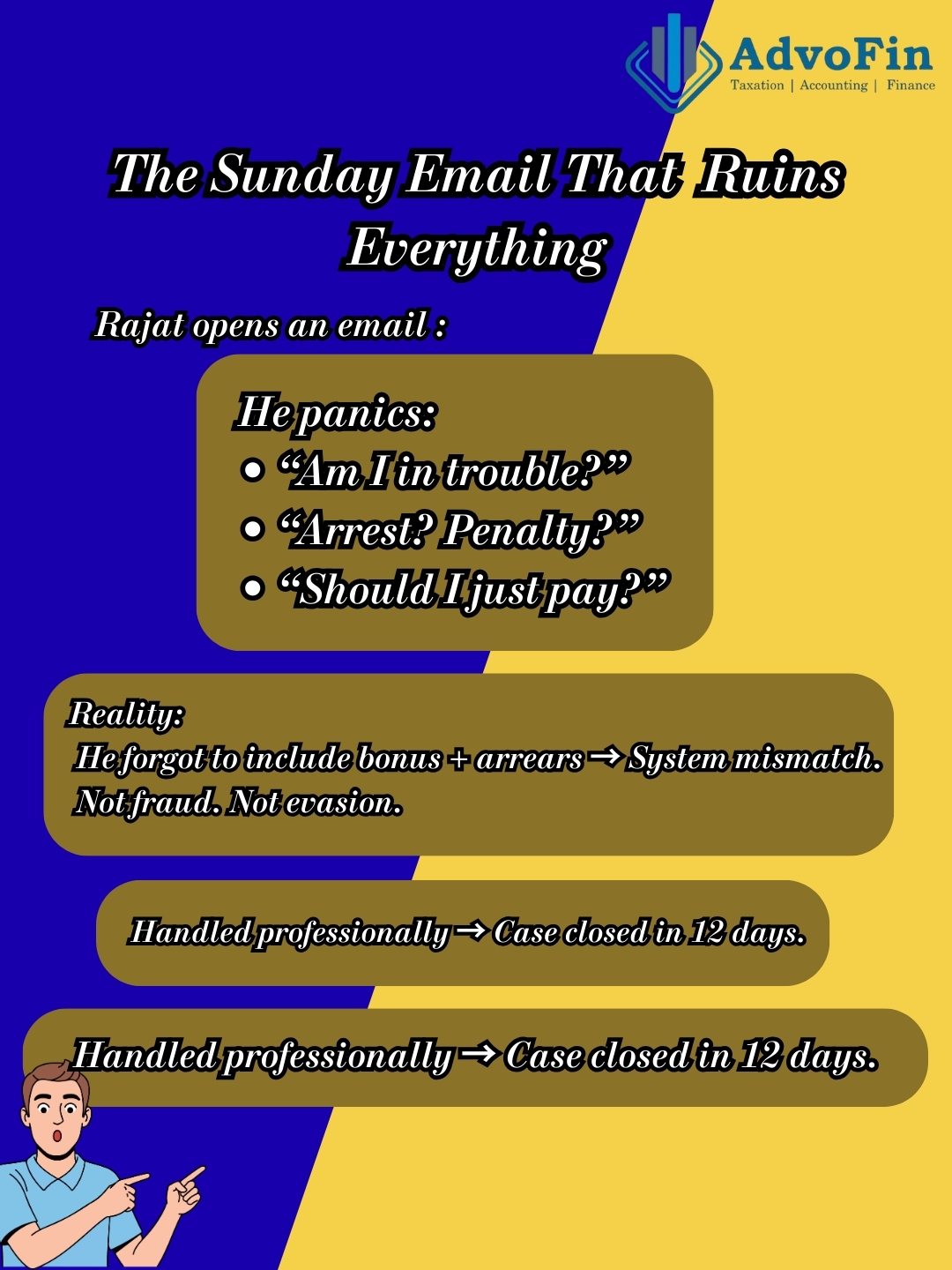
Introduction: The Sunday Morning Email That Ruins Your Week
Rajat’s story (real case, name changed):
Sunday, 9:30 AM
Rajat, founder of a ₹8-crore e-commerce business, opens his email while having breakfast.
Subject: “Income Tax Notice u/s 143(1) – Discrepancy in Return – Action Required”
His heart sinks. Questions flood:
- Did I evade tax?
- Will they arrest me?
- Is my business in trouble?
- Should I pay whatever they’re asking?
He spends the entire Sunday Googling, reading horror stories on forums, imagining worst-case scenarios.
By Monday morning, he’s convinced his business is doomed.
The reality (after we reviewed):
Rajat’s “crime”:
- He filed ITR showing salary income: ₹8.5 lakhs
- But his Form 26AS (TDS statement) showed salary TDS of ₹1.2 lakhs (matching ₹12 lakhs gross salary)
- Mismatch: ₹3.5 lakhs income not reported (he forgot to add bonus + arrears paid in March)
- System-generated notice: Asking him to explain + pay tax on ₹3.5L
Not fraud. Not evasion. Just a data mismatch.
After professional handling:
- Reviewed his salary slips (found bonus ₹2.5L + arrears ₹1L)
- Filed revised return (within deadline)
- Explained in notice reply: “Income inadvertently omitted; revised return filed; additional tax paid with interest”
- Submitted Form 16, salary slips, bank statements
- Case closed in 12 days with automated intimation: “Return processed. No further action.”
Tax paid: ₹1.05 lakhs (on ₹3.5L @ 30%) + ₹3,500 interest
Penalty: NIL (because corrected before department issued demand)
But here’s what could have gone horribly wrong (if Rajat panicked):
❌ Ignored the notice → Ex-parte assessment → Penalty ₹1.05L additional → Prosecution proceedings
❌ Paid demanded amount without checking → Overpaid (notice calculation was wrong) → Refund stuck for 2 years
❌ Hired random “agent” → Filed incorrect reply → Case escalated to scrutiny → 3-year litigation
❌ Argued with department → “This is harassment!” → Officer became strict → Full audit ordered
This scenario plays out 50,000+ times every month across India.
Income Tax Notices have become commonplace in 2024-25 due to:
- 🤖 Advanced data integration (GST ↔ TDS ↔ AIS ↔ Banking ↔ Property ↔ Securities)
- 📊 AI-driven mismatch detection (automated risk scoring for every taxpayer)
- 🔗 PAN-Aadhaar linkage (360° financial visibility)
- 💰 High-value transaction tracking (cash deposits, property, foreign remittances)
- 🎯 System-generated notices (90%+ are auto-generated, not human-initiated)
Yet, the truth:
85-90% of Income Tax Notices are routine, system-generated queries—not accusations of fraud, but requests for clarification on:
- Data mismatches (AIS vs. ITR)
- Missing information (incomplete return)
- Mathematical errors (wrong calculations)
- TDS discrepancies (credit claimed vs. deducted)
Only 10-15% involve serious investigation (scrutiny, reassessment, evasion).
This comprehensive guide covers:
- Why Income Tax Notices are rising (2025 context)
- Types of Income Tax Notices (8 major sections explained)
- Why SMEs/founders receive notices (15 common triggers)
- How to respond professionally (step-by-step action plan)
- Notice-wise response strategy (what each section requires)
- Common mistakes that escalate matters
- How to avoid notices proactively (prevention checklist)
- When to engage professionals
- Real case studies (good vs. bad responses)
1. Why Income Tax Notices Are Rising (2025 Context)
The New Tax Surveillance Ecosystem:
India’s tax system is now hyper-integrated:
GST Portal ←→ Income Tax Portal
     ↕              ↕
TDS System ←→ AIS (Annual Information Statement)
     ↕              ↕
Banking System ←→ Securities/MF Transactions
     ↕              ↕
Property Registrations ←→ High-Value Transaction Reports
Result: Every financial transaction leaves a digital footprint.
Key Integration Points:
1. AIS (Annual Information Statement)
Most powerful tool (introduced 2020-21, enhanced every year).
AIS shows:
- ✅ All TDS/TCS deducted on your PAN
- ✅ Interest from all banks (savings, FDs)
- ✅ Dividend income
- ✅ Securities transactions (shares, MF, bonds)
- ✅ Property purchases/sales (registration data)
- ✅ Foreign remittances
- ✅ Cash deposits >₹10 lakhs
- ✅ Credit card spends (high-value)
- ✅ Mutual fund transactions
- ✅ GST turnover (if you have GSTIN)
Pre-filled in your ITR.
If you don’t match: Auto-notice triggered.
2. GST ↔ Income Tax Integration
System compares:
- GST turnover (from GSTR-1, GSTR-3B)
- Income Tax turnover (from Profit & Loss in ITR)
Mismatch = Red flag.
Example:
GST shows ₹1.5 crore sales.
ITR shows ₹1.2 crore revenue.
System alert: ₹30 lakh income suppression?
3. TDS Matching
System cross-checks:
- TDS deducted (per Form 26AS/AIS)
- TDS claimed in ITR
Mismatch triggers: Section 143(1) intimation (most common notice).
4. Banking & Cash Transaction Monitoring
AIR (Annual Information Report) from banks:
- Cash deposits >₹10 lakhs in a year
- Cash withdrawals >₹20 lakhs/year (₹1 lakh+ in a day)
- Foreign remittances >₹10 lakhs
- Credit card payments >₹10 lakhs
System asks: Where did this cash come from? Is it taxed income?
5. Property Transaction Tracking
Registrar offices report:
- Stamp duty >₹30 lakhs
- TDS u/s 194-IA (property purchase—buyer deducts 1% TDS from seller)
System verifies: Did buyer/seller report in ITR?
6. AI Risk Scoring
Every PAN gets a risk score (0-100) based on:
- Past compliance (filing history)
- Mismatch frequency
- High-value transactions
- Sector risk (cash-intensive businesses)
- Income volatility (sudden spikes/drops)
High score = Auto-selection for scrutiny.
Statistics (2024-25 Trends):
- 50+ lakh notices issued annually (10x increase since 2015)
- 80%+ are Section 143(1) (simple intimations, auto-generated)
- 12-15% are Section 143(2) (scrutiny—detailed inquiry)
- Response rate: 60% (40% don’t respond = ex-parte orders)
- Average resolution time: 45-90 days (if responded properly)
2. Types of Income Tax Notices (8 Major Sections Explained)
Understanding the section determines seriousness + response strategy.
Notice Type 1: Section 142(1) — Inquiry Before Assessment
What it is: Request for information/documents before completing assessment.
Issued when:
- Return filed but additional clarification needed
- Books of accounts required
- Specific transactions need explanation
Example notice text:
“Submit details of sale of property at [address] and explain capital gains computation.”
Seriousness: 🟡 Medium (not accusatory, just inquiry)
Response required:
- Documents (invoices, agreements, bank statements)
- Written explanation
- Books of accounts (if requested)
Deadline: Usually 15-30 days
Consequences of ignoring: Penalty ₹10,000 + best judgment assessment.
Notice Type 2: Section 143(1) — Intimation Notice ⭐ (Most Common)
What it is: System-generated intimation after processing your ITR.
Issued when:
- ✅ Mathematical errors (addition mistakes in ITR)
- ✅ TDS mismatch (claimed ₹50K TDS, but 26AS shows ₹40K)
- ✅ Incorrect deduction claims (claimed 80C ₹1.5L but eligible only ₹1L)
- ✅ Income mismatch (AIS shows interest ₹80K, you showed ₹50K)
Example scenarios:
Scenario A: Refund reduced
“Original refund claimed: ₹45,000. Adjusted refund: ₹32,000. Reason: TDS mismatch.”
Scenario B: Additional tax demand
“Tax computed: ₹1,20,000. Tax paid: ₹90,000. Pay ₹30,000 + interest.”
Seriousness: 🟢 Low to Medium (mostly data correction)
Response required (if you disagree):
- File rectification request u/s 154 (online on e-filing portal)
- Submit proof (Form 16, 26AS, bank statement, investment proof)
Deadline: 30 days from receipt
If ignored: Demand becomes final → Recovery proceedings.
Notice Type 3: Section 143(2) — Scrutiny Notice 🚨 (Serious)
What it is: Full scrutiny of your return (detailed assessment).
Issued when:
- High-value transactions unexplained
- Large cash flows
- GST-ITR mismatch
- AIS shows income not reported
- AI risk score high
- Random selection (CASS—Computer Assisted Scrutiny Selection)
Example notice text:
“Your case has been selected for scrutiny. You are required to appear on [date] with books of accounts, bank statements, invoices…”
Seriousness: 🔴 High (detailed examination, personal appearance/authorized rep)
Response required:
- Mandatory compliance (ignoring = ex-parte assessment + penalty)
- Detailed documents (books, vouchers, contracts, proof of all income/expenses)
- Personal hearing (you or CA/lawyer)
- Questionnaire responses (officer asks specific questions)
Deadline: Issued within 6 months from end of FY (e.g., for FY 2023-24, by Sept 30, 2024)
Consequences of ignoring: Best judgment assessment + 100-300% penalty + prosecution (if income >₹25 lakhs hidden).
Notice Type 4: Section 148 — Reassessment Notice (Income Escaped Assessment) 🔥
What it is: Department believes you under-reported income or made false claims.
Issued when:
- Income escaped assessment (not disclosed/wrongly disclosed)
- Information received (AIR, informant, investigation)
- Mismatch discovered post-assessment
Example text:
“I have reason to believe that income of ₹[amount] chargeable to tax has escaped assessment for AY [year]. You are required to file return.”
Seriousness: 🔴🔴 Very High (accusation of income concealment)
Time limit:
- Within 3 years: If income escaped >₹50 lakhs (no fraud)
- Within 10 years: If income escaped >₹50 lakhs (fraud/willful default)
Response required:
- File return (showing correct income)
- Detailed explanation (why income was not shown earlier)
- Documents (proof that income was actually disclosed OR not taxable)
- Professional representation mandatory
Deadline: Usually 30-60 days
Consequences of ignoring: Ex-parte reassessment + 50-200% penalty + prosecution.
Notice Type 5: Section 139(9) — Defective Return Notice
What it is: Your return has defects (incomplete/incorrect filing).
Issued when:
- ❌ Wrong ITR form used (ITR-1 instead of ITR-2)
- ❌ Balance sheet figures don’t match
- ❌ Mandatory fields missing (Aadhaar, bank account)
- ❌ Wrong schedule used
- ❌ Digital signature missing (for ITR-5, 6, 7)
Example:
“Defect: Capital gains from property sale reported in ITR-1. Correct form: ITR-2.”
Seriousness: 🟡 Medium (administrative, but must correct)
Response required:
- File corrected return (within deadline)
- OR submit explanation (if you believe no defect exists)
Deadline: 15 days from notice date
Consequences of ignoring: Return treated as invalid/not filed → Late filing penalty + interest from original due date.
Notice Type 6: Section 156 — Tax Demand Notice
What it is: Demand for payment of tax/interest/penalty.
Issued when:
- After assessment completion (143(3), 147, etc.)
- After intimation u/s 143(1) if you didn’t pay
- Penalty imposed
Example:
“Total demand: ₹2,45,000 (Tax: ₹1,50,000 + Interest: ₹45,000 + Penalty: ₹50,000). Pay within 30 days.”
Seriousness: 🔴 High (payment demand, recovery proceedings if ignored)
Response options:
- Pay: If demand is correct
- Appeal: If demand is wrong (CIT(A) within 30 days)
- Part payment + stay: Pay 20%, file appeal, apply for stay of recovery
Deadline: 30 days (interest continues beyond)
Consequences of ignoring: Recovery through salary attachment, bank account attachment, property seizure.
Notice Type 7: Section 131 — Summons
What it is: Order to appear for examination under oath (like court testimony).
Issued when:
- Investigation ongoing (serious evasion suspected)
- Evidence/documents needed
- Third-party involvement (your transactions linked to someone under investigation)
Example:
“You are hereby summoned to appear before the undersigned on [date] at [time] for examination under oath regarding…”
Seriousness: 🔴🔴🔴 Very High (quasi-judicial, can lead to prosecution)
Response required:
- Mandatory attendance (you + lawyer/CA recommended)
- Documents as requested
- Statement on oath
Consequences of ignoring: Penalty ₹10,000 + possible arrest warrant.
Notice Type 8: Section 133(6) / 133C — Information Request
What it is: Request to third parties (banks, companies) OR to you for specific information.
Issued when:
- Verification needed (transaction details)
- Cross-verification (bank statement, investment details)
Example:
“Provide details of all mutual fund transactions during FY 2023-24.”
Seriousness: 🟢 Low (routine, information-gathering)
Response: Provide requested info within 15-30 days.
Quick Reference Table:
| Section | Notice Type | Seriousness | Typical Deadline | Can Ignore? |
|---|---|---|---|---|
| 142(1) | Inquiry | Medium | 15-30 days | No (₹10K penalty) |
| 143(1) | Intimation | Low-Medium | 30 days | No (demand final) |
| 143(2) | Scrutiny | High | 6 months from FY end | Never (severe penalty) |
| 148 | Reassessment | Very High | 30-60 days | Never (prosecution risk) |
| 139(9) | Defective return | Medium | 15 days | No (return invalid) |
| 156 | Demand | High | 30 days | No (recovery starts) |
| 131 | Summons | Very High | As specified | Never (arrest risk) |
| 133(6) | Info request | Low | 15-30 days | Not advisable |
3. Why SMEs/Founders Receive Income Tax Notices (15 Common Triggers)
Understanding triggers = Prevention.
Trigger 1: AIS (Annual Information Statement) Mismatch ⭐
Most common (60%+ of 143(1) notices).
What happens:
- AIS pre-fills your ITR with data from banks, TDS, securities, property
- You file ITR showing different figures
- System flags mismatch
Examples:
Example A:
AIS shows: Interest income ₹1,20,000
Your ITR shows: Interest income ₹80,000
Mismatch: ₹40,000 → Notice: “Explain difference OR file revised return.”
Example B:
AIS shows: Dividend ₹45,000
You didn’t report it (forgot about small MF dividend)
Notice: Pay tax on ₹45,000.
Trigger 2: GST Turnover vs. Income Tax Turnover Mismatch
Critical for businesses.
What system checks:
- Your GSTR-1 (sales declared to GST)
- Your ITR (revenue in P&L)
- Should match (with adjustments for exports, exempted supplies, B2C)
Example:
GST turnover (GSTR-1): ₹2.5 crores
ITR revenue: ₹1.8 crores
Mismatch: ₹70 lakhs → Notice: “Explain ₹70L difference. Are you suppressing sales?”
Genuine reasons:
- GST turnover includes exempt supplies (not in ITR revenue)
- Reverse charge purchases (GST liability but no corresponding revenue)
- Credit notes issued (GST turnover shown gross, ITR revenue net)
Your defense: Prepare detailed reconciliation.
Trigger 3: TDS Mismatch (Credit Claimed vs. Actually Deducted)
What happens:
- You claim TDS credit of ₹2,00,000 in ITR
- But Form 26AS shows only ₹1,60,000 deducted
- Mismatch: ₹40,000 excess claimed → Notice
Common reasons:
- TDS deducted but deductor didn’t deposit to govt
- TDS deducted under wrong PAN
- Quarter mismatch (TDS deducted in Q4, but you claimed in earlier year)
Trigger 4: High Cash Deposits (AIR Reporting)
Banks report to Income Tax:
- Cash deposits >₹10 lakhs in a FY (across all branches/accounts)
- Single cash deposit >₹50,000
Notice asks: Source of cash?
If not explained: Treated as unexplained income → Taxed @60% + penalty.
Genuine explanations:
- Cash sales (retail business—must match books)
- Loan repayment received in cash (need loan agreement)
- Gift from family (need gift deed + family bank statement)
Trigger 5: Property Purchase/Sale Not Reported
Registrar reports to Income Tax:
- Every property transaction where stamp duty >₹30 lakhs
- Every property sale where TDS u/s 194-IA deducted
Notice if:
- You bought property but didn’t show source of funds in ITR
- You sold property but didn’t file capital gains
- Buyer deducted TDS (Form 26QB) but you didn’t report in ITR
Trigger 6: Large Expenses Not Matching Income
Red flag:
Your ITR shows income: ₹6 lakhs/year
But AIS/AIR shows:
- Credit card spends: ₹8 lakhs
- Foreign travel: ₹3 lakhs
- Property purchase: ₹50 lakhs (loan ₹35L, own funds ₹15L)
Notice: How are you funding ₹15L+ expenses with ₹6L income?
Trigger 7: High GSTR-1 But Low Profit/Taxable Income
Example:
Business turnover: ₹5 crores
Net profit shown: ₹5 lakhs (1%)
Tax paid: ~₹15,000
System alert: 1% profit margin unrealistic → Possible income suppression.
Sector benchmarks:
- Trading: 5-8% net margin
- Manufacturing: 8-12%
- Services: 15-25%
If significantly below: Scrutiny likely.
Trigger 8: Foreign Remittances (LRS/TCS)
Every remittance >$250K/year reported.
Notice if:
- You sent ₹50 lakhs abroad (education/investment)
- But ITR shows income ₹8 lakhs
- Question: Source of ₹50L?
Trigger 9: Non-Filing or Very Late Filing
Auto-notice if:
- You didn’t file ITR (despite high-value transactions in AIS)
- Filed 2 years late (belated return)
Trigger 10: Claiming Wrong/Excess Deductions
Examples:
- Claimed 80C: ₹1.5L (but proof only ₹80K)
- Claimed home loan interest: ₹3L (actual: ₹2L)
- Claimed HRA exemption (but you own the house—not allowed)
System auto-disallows → Demand notice.
Trigger 11: Crypto/Digital Asset Transactions
New in 2024-25:
- Foreign exchanges (Binance, Coinbase) report to Indian govt (FATCA/CRS)
- P2P crypto trades flagged
Notice: Show source of funds for crypto purchase + tax on gains.
Trigger 12: High Intra-Group Transactions
If you have:
- Related party transactions (family businesses)
- Loans from directors
- Unsecured loans from friends/relatives >₹2 lakhs
System checks: Are these genuine or income disguised as loans?
Trigger 13: Claiming Losses Repeatedly
Example:
- Business loss for 3 consecutive years
- Claiming carry-forward losses
- Set-off against other income
Scrutiny: Is business genuine or a tax avoidance scheme?
Trigger 14: High Medical/Donation Claims
80D (medical): >₹1L claimed (system verifies with insurance companies)
80G (donation): >₹1L (system verifies with recipient trusts)
Trigger 15: PAN-Aadhaar Mismatch / Multiple PANs
If:
- Name spelling differs (PAN: RAJESH vs Aadhaar: RAJEESH)
- DOB differs
- You unknowingly have 2 PANs
System can’t match → Transactions don’t reflect → Notice.
4. How to Respond to Income Tax Notice (Step-by-Step Action Plan)
Your response quality determines outcome.
Phase 1: Initial Assessment (Day 0-1)
Step 1: Don’t Panic
Remember:
- 90% notices are routine queries (not accusations)
- Most are resolvable with proper documentation
- Even serious notices have appeal mechanisms
Step 2: Read the Notice CAREFULLY
Note:
- Section number (determines type/seriousness)
- Assessment Year (which FY is in question)
- Specific issue mentioned (TDS mismatch? Capital gains? AIS difference?)
- Documents requested
- Deadline (usually 15-30 days)
- Response mode (e-filing portal? Physical submission?)
Step 3: Download All Relevant Data
From Income Tax e-filing portal:
✅ ITR filed (for the AY in question)
✅ Form 26AS (TDS/TCS statement)
✅ AIS (Annual Information Statement)
✅ TIS (Taxpayer Information Summary) (your feedback-adjusted AIS)
✅ Intimation u/s 143(1) (if already issued)
✅ Assessment orders (if any past orders)
From your records:
✅ Books of accounts (if business)
✅ Bank statements (all accounts)
✅ Investment proofs (80C, 80D, etc.)
✅ Form 16 (if salaried)
✅ Property documents (if capital gains involved)
✅ GST returns (if GST-ITR mismatch)
Phase 2: Data Reconciliation (Day 2-5)
Step 4: 3-Way Matching Exercise
Sit with your CA/accountant:
Match 1: AIS vs. ITR
| Income Head | As per AIS | As per ITR | Difference | Reason |
|---|---|---|---|---|
| Salary | ₹12,00,000 | ₹8,50,000 | ₹3,50,000 | Bonus not included |
| Interest | ₹1,20,000 | ₹1,20,000 | Nil | Matched ✅ |
| Dividend | ₹45,000 | Nil | ₹45,000 | Forgot to include |
| Capital Gains | ₹2,00,000 | ₹2,00,000 | Nil | Matched ✅ |
Action: If mismatch found, verify source (bank statement, Form 16, MF statement).
Match 2: TDS Claimed vs. 26AS
| TDS Type | Claimed in ITR | As per 26AS | Difference |
|---|---|---|---|
| Salary TDS | ₹1,50,000 | ₹1,50,000 | Nil ✅ |
| TDS on FD | ₹12,000 | ₹8,000 | ₹4,000 excess |
Action: Check if ₹4K TDS was deducted but not deposited by bank → Contact bank → Get correction.
Match 3: GST Turnover vs. ITR Revenue (if business)
GST turnover (GSTR-1): ₹2,50,00,000
ITR revenue: ₹2,35,00,000
Difference: ₹15,00,000
Reconciliation:
| Item | Amount |
|---|---|
| GSTR-1 turnover | ₹2,50,00,000 |
| Less: Exempt supplies (healthcare services) | ₹8,00,000 |
| Less: Exports (shown in GSTR-1 but separately in ITR) | ₹7,00,000 |
| Adjusted turnover | ₹2,35,00,000 |
| ITR revenue | ₹2,35,00,000 |
| Difference | Nil ✅ |
Action: Prepare this reconciliation statement as attachment to notice reply.
Step 5: Identify if Error is Yours or Department’s
If error is yours:
- Missing income (forgot to include)
- Wrong deduction claimed
- Calculation mistake
Action: File revised return (if within deadline) OR admit in reply + pay additional tax with interest.
If error is department’s/system’s:
- TDS wrongly not credited (but 26AS shows it)
- AIS data incorrect (wrong PAN, wrong amount)
- Mathematical error in their calculation
Action: File rectification u/s 154 with proof.
Phase 3: Drafting Response (Day 6-10)
Step 6: Draft Professional Reply
Format:
Subject: Response to Notice u/s [Section] for AY [Year]
To: The Income Tax Officer, [Ward/Circle]
PAN: [Your PAN]
Assessment Year: [AY]
Notice Reference No.: [Notice No. & Date]
Respected Sir/Madam,
I am in receipt of the notice dated [date] u/s [section] regarding [brief subject].
I respectfully submit the following response:
1. Background:
[Brief description of your case—who you are, nature of income]2. Issue Raised in Notice:
[State the specific issue—e.g., “TDS mismatch of ₹40,000” or “Capital gains from property sale not explained”]3. Our Submission/Explanation:
[Factual, detailed explanation]Example:
“The TDS mismatch of ₹40,000 arose because TDS of ₹40,000 was deducted by [Name] under my PAN in Q4 FY 2023-24, but was deposited to the government in Q1 FY 2024-25 (April 2024). Hence, it reflects in Form 26AS for AY 2025-26, not AY 2024-25. I have attached the TDS certificate showing deduction date and deposit date.”4. Corrective Action Taken (if applicable):
“I have filed a revised return on [date] including the omitted income of ₹45,000 (dividend from mutual funds). Additional tax of ₹13,500 has been paid along with interest of ₹500 vide Challan No. [___] dated [date].”5. Documents Enclosed:
- Form 26AS for AY [Year]
- TDS Certificate (Form 16A)
- Bank statement showing [relevant transaction]
- Copy of revised ITR acknowledgment
- Challan for payment of additional tax
6. Prayer:
“In light of the above explanation and supporting documents, I humbly request that the notice may be treated as duly complied with and the matter may kindly be closed.”7. Contact Details:
Email: [Your email]
Phone: [Your mobile]
Authorized Representative (if any): CA [Name], Email: [], Phone: []I remain available for any further clarification.
Thanking you,
Yours faithfully,[Your Name]
[Date]
Key Elements:
✅ Professional tone (respectful, not defensive)
✅ Factual (no emotional language—”this is unfair,” “harassment,” etc.)
✅ Specific (cite exact amounts, dates, documents)
✅ Proactive (if error is yours, admit + corrected + paid tax)
✅ Complete (attach all supporting docs)
✅ Concise (2-3 pages max for simple notice; 5-10 pages for complex)
Phase 4: Submission (Day 11-13)
Step 7: Upload Response on E-Proceedings Portal
Process:
- Login: incometax.gov.in → E-File → e-Proceedings
- Navigate: Dashboard → Pending Actions → Select Notice
- Upload Reply:
- Main reply (PDF—max 5MB)
- Supporting documents (PDFs—max 10MB total)
- Ensure all docs are clearly named (“TDS_Certificate_FY2023-24.pdf” not “Document1.pdf”)
- Submit: Click Submit → Receive acknowledgment number
- Download: Acknowledgment receipt → Keep for records
CRITICAL: Submit before deadline. Even 1 day late = Penalties + adverse inferences.
Step 8: Confirmation
Send email to assessing officer (optional but recommended):
“Sir, I have uploaded the response to notice dated [date] on the e-proceedings portal on [date]. Acknowledgment No.: [___]. Kindly confirm receipt. Please let me know if any further information is required.”
Phase 5: Follow-Up (Day 14-60)
Step 9: Track Status
Check e-proceedings portal every week:
- Status: “Response submitted” → “Under review” → “Closed” / “Further action required”
Step 10: Respond to Follow-Up Queries (if any)
If officer asks for more documents:
- Respond within 7 days
- Don’t delay (delays = suspicion)
Step 11: Final Outcome
Possible outcomes:
A) Case Closed ✅
“Response accepted. No further action required.”
→ Download closure letter → Keep in records.
B) Revised Intimation u/s 143(1) 🟡
“After considering your reply, revised demand: ₹X [reduced from original].”
→ If acceptable, pay. If not, file rectification.
C) Scrutiny Notice u/s 143(2) 🔴
“Matter requires detailed inquiry. You are required to appear on [date] with books…”
→ Engage CA/lawyer immediately → Prepare for full scrutiny.
D) Assessment Order 🔴🔴
“After considering reply, assessed income: ₹X. Pay demand of ₹Y.”
→ If disagree, file appeal to CIT(A) within 30 days.
5. Notice-Wise Response Strategy (Quick Guide)
For Section 143(1) (Intimation):
If demand is correct:
→ Pay online (Challan 280) → No further action needed.
If demand is wrong:
→ File rectification u/s 154 → Attach proof → Usually resolved in 30-60 days.
For Section 143(2) (Scrutiny):
Mandatory steps:
- Engage CA/lawyer (don’t go alone)
- Prepare comprehensive document set (books, vouchers, contracts, bank statements)
- Attend hearing (personal/authorized rep)
- Answer questionnaire factually
- Submit documents on time
- Track assessment order
Timeline: Scrutiny can take 6-12 months.
For Section 148 (Reassessment):
Immediate actions:
- Engage tax litigation lawyer (this is serious)
- Understand department’s basis (why they think income escaped)
- Gather evidence (prove income was disclosed OR not taxable)
- File return (within deadline given—usually 30 days)
- Request reasons (you have right to know why reassessment)
- Object to reassessment (if time-barred or baseless)
- Detailed hearing (present full case)
High stakes: Can go up to High Court if wrongly issued.
For Section 139(9) (Defective Return):
Steps:
- Identify defect (check notice—usually specific)
- File corrected return (same form, mark as “defect removal”)
- Submit on e-filing portal within 15 days
- System auto-validates → Defect removed.
For Section 156 (Demand):
Options:
- Pay (if correct): Pay within 30 days → Interest stops.
- Part pay + Appeal: Pay 20% → File appeal → Apply for stay of balance.
- Full appeal: If totally wrong → Appeal immediately → Request stay.
Don’t ignore: Recovery proceedings start after 30 days (salary attachment, bank account freeze).
6. Common Mistakes That Escalate Matters (10 Critical Errors)
❌ Mistake 1: Ignoring the Notice
Thought: “It’s auto-generated, will disappear on its own.”
Reality: Notice becomes demand → Demand becomes recovery → Account attached.
❌ Mistake 2: Paying Without Verifying
Thought: “Just pay and get rid of it.”
Risk: You may overpay (demand calculation could be wrong) → Refund takes 2+ years.
❌ Mistake 3: Responding Emotionally
Wrong reply:
“This is harassment! I am a taxpayer for 20 years! You have no right to question me!”
Result: Officer becomes strict → Full scrutiny ordered.
❌ Mistake 4: Incomplete Documentation
Submitting:
Half-documents, unclear photocopies, unsigned statements.
Result: Officer can’t verify → Asks for more → Delays case → You miss deadline → Ex-parte order.
❌ Mistake 5: Using Generic Templates
Downloaded reply from internet:
“I hereby submit that the notice is wrongly issued…” (no specifics)
Result: Rejected (doesn’t address actual issue).
❌ Mistake 6: Not Filing Revised Return (When You Should)
Your mistake:
You really did forget to include ₹2L dividend income.
Wrong approach:
Argue with department: “This is wrong!”
Right approach:
Admit: “Income inadvertently omitted. Revised return filed. Tax paid with interest.”
❌ Mistake 7: Hiring Unqualified “Agents”
“Agent” promises:
“₹5,000 me kaam ho jayega, main manage kar lunga” (I’ll manage it for ₹5K)
Reality: Agent doesn’t understand tax law → Files incorrect reply → Case escalates → Now you need ₹50K lawyer to fix.
❌ Mistake 8: Missing Deadlines
“I’ll reply next week…” (deadline passes)
Result: Ex-parte assessment + penalty.
❌ Mistake 9: Not Taking Scrutiny/148 Seriously
Thought: “My CA will handle routine notice.”
Reality: Scrutiny/148 = Litigation stage → Need tax lawyer, not just accountant.
❌ Mistake 10: Not Maintaining Proper Books
During scrutiny, officer asks:
“Show me purchase register, sales register, stock register.”
You: “We don’t maintain those… we just file ITR at year-end.”
Result: Best judgment assessment (officer estimates income arbitrarily) → Huge demand.
7. How to Avoid Income Tax Notices Proactively (Prevention Checklist)
Prevention is 100x easier than cure.
☑️ Prevention #1: Monthly GST-Books-TDS Reconciliation
Most critical habit.
Process:
- Every month: Match books with GST returns
- Quarterly: Match TDS deducted with 26AS
- Before filing ITR: Full reconciliation (AIS, 26AS, books, GST)
This single practice prevents 70%+ notices.
☑️ Prevention #2: Review AIS Before Filing ITR
Login to e-filing portal → View AIS (available after June each year)
Check:
- All income sources showing (banks, MF, dividends, property, etc.)
- Click “Provide Feedback” if any data is wrong (e.g., wrong PAN, duplicate entry)
- Download TIS (Taxpayer Information Summary—your corrected version)
- File ITR matching TIS (not raw AIS)
Why: Pre-empts mismatch notices.
☑️ Prevention #3: Use Correct ITR Form
| Your Profile | Correct Form |
|---|---|
| Salaried, one house, no capital gains | ITR-1 |
| Salaried + capital gains/multiple properties | ITR-2 |
| Business/professional income (proprietor/partner) | ITR-3 |
| Presumptive taxation (small business/professional) | ITR-4 |
| Firms/LLPs | ITR-5 |
| Companies | ITR-6 |
Wrong form = Defective return notice.
☑️ Prevention #4: Maintain Clean Documentation (Digital)
For every transaction >₹50,000:
- Invoice/bill
- Payment proof (bank transfer)
- Contract/agreement (if applicable)
Store digitally:
- Google Drive / Dropbox (organized by FY, then by type)
- Maintain for 6 years (assessment can reopen up to 10 years in fraud cases, but 6 is safe minimum)
☑️ Prevention #5: Avoid Unexplained Cash
Minimize cash transactions:
- Pay/receive via bank for amounts >₹10,000
- If cash unavoidable (rural business, vendor preference): Document source (cash from bank withdrawal, cash sales—maintained in cash book)
☑️ Prevention #6: File on Time
Due dates:
- Individuals (non-audit): July 31
- Audit cases: October 31
- Companies: September 30/October 31
File even if no tax liability (if income >basic exemption OR high-value transactions in AIS).
☑️ Prevention #7: For Businesses—Maintain Books Monthly
Not just year-end data dump.
Monthly:
- Enter all invoices (purchase, sales)
- Reconcile bank
- Close books (trial balance)
- Compare with GST returns
Benefits:
- Errors caught early (can be corrected before ITR)
- Scrutiny-ready (books available anytime)
☑️ Prevention #8: Declare All Income (Even if Taxable or Not)
Philosophy: “Disclose first, claim exemption later.”
Example:
- Received gift of ₹2 lakhs from father (exempt under Section 56)
- Disclose in ITR in gift schedule → Mark as exempt → Attach gift deed
Why: If you don’t disclose and it shows in AIS/bank statement, department assumes it’s undisclosed taxable income.
☑️ Prevention #9: Sector-Specific Benchmarks
If your profit margin is far below sector average:
- System flags as suspicious
- Prepare explanation (genuine reasons: competition, new business, heavy capex, etc.)
- Include in ITR filing notes (some ITR forms have “notes” field—use it)
☑️ Prevention #10: Hire Qualified CA/Tax Advisor
Penny-wise, pound-foolish:
- Saving ₹5,000 on CA fees → Leads to notice → Costs ₹50,000 to resolve.
Invest in:
- Monthly bookkeeping (₹3,000-10,000/month)
- Quarterly GST-ITR reconciliation
- Annual ITR filing (₹5,000-25,000 depending on complexity)
- Preventive audit (annual health check—₹10,000-30,000)
ROI: Avoid notices (peace of mind) + Tax optimization (legal savings).
8. When to Engage Professionals (Decision Matrix)
✅ DIY (Self-Handle) for:
- Section 143(1) with simple TDS mismatch (<₹10,000 difference, clear proof available)
- Section 139(9) defective return (obvious defect like wrong form used)
If:
- You understand tax basics
- You have all documents
- Issue is straightforward
🟡 Engage CA for:
- Section 143(1) with multiple mismatches (AIS differences, deduction errors)
- Section 142(1) inquiry
- GST-ITR reconciliation issues
- First-time notice (even if simple—guidance needed)
Cost: ₹5,000 – ₹25,000 (depending on complexity)
🔴 Engage Tax Lawyer for:
- Section 143(2) scrutiny
- Section 148 reassessment
- Section 131 summons
- High-stakes cases (demand >₹5 lakhs)
- Penalty proceedings
- Appeals (CIT(A), ITAT, High Court)
Cost: ₹25,000 – ₹5,00,000+ (depending on stage, complexity, amount involved)
🚨 Engage Immediately If:
Scenario 1: Notice mentions prosecution, penalty >100%
Scenario 2: Amount involved >₹10 lakhs
Scenario 3: Past non-compliance (multiple years unfiled, previous demands)
Scenario 4: You don’t understand the notice (even after reading twice)
Scenario 5: Multiple income sources (salary + business + capital gains + foreign income)
9. Real Case Studies (Good vs. Bad Responses)
Case Study A: Freelancer (Good Response) ✅
Profile:
Freelance graphic designer, ₹12L income, clients TDS u/s 194J.
Notice: Section 143(1) — TDS credit mismatch of ₹45,000.
Issue:
Claimed TDS ₹1,80,000 (per Form 16A from clients).
But 26AS showed only ₹1,35,000.
Mismatch: ₹45,000.
Response:
- Reviewed all Form 16A certificates
- Found: One client deducted ₹45K TDS but deposited it 5 days after quarter-end → Reflected in next FY’s 26AS
- Action:
- Contacted client → Got confirmation letter
- Filed rectification u/s 154 explaining timing issue
- Attached: Form 16A from client, client’s TDS payment challan, email from client confirming date
Outcome:
Case closed in 25 days. ₹45K TDS credit adjusted in subsequent AY.
Why it worked: Factual, documented, proactive.
Case Study B: Trader (Bad Response) ❌
Profile:
Textile trader, ₹3Cr turnover.
Notice: Section 143(2) scrutiny — GST turnover ₹3Cr, ITR turnover ₹2.3Cr.
Issue: Explain ₹70L difference.
Response (initial):
- Ignored first reminder (thought it’s routine)
- When second notice came, submitted generic reply: “Difference due to accounting reasons. Please close the matter.”
- No reconciliation statement provided
- No GST return copies attached
Department’s reaction:
- Issued questionnaire: 25 questions (explain each month’s difference, top 50 customers, top 20 vendors, stock register, etc.)
- When he couldn’t provide (maintained books only at year-end): Best judgment assessment
- Deemed income: ₹70L + ₹20L addition (suppressed purchases) = ₹90L
- Tax demand: ₹27L + ₹5L penalty = ₹32L
Now: In appeal (2 years ongoing, spent ₹2L on lawyer, still unresolved).
Why it failed: Unprepared, non-responsive, no documentation, ignored seriousness.
Case Study C: Salaried (Mixed Response) ⚠️
Profile:
IT professional, ₹18L salary, sold ancestral property (₹80L).
Notice: Section 143(1) — Capital gains not reported.
Issue:
Form 26QB (TDS by buyer) shows ₹80,000 TDS deducted on ₹80L property sale.
But capital gains not shown in ITR.
Initial response (Wrong):
- Panicked
- Paid demanded tax without calculating actual liability
- Paid ₹16L (20% of ₹80L)
After consulting CA (Right):
- CA calculated: Property bought in 1995 for ₹5L
- Indexed cost (2024): ₹5L × (363/259) = ₹7L (approx)
- Sale: ₹80L
- Expenses: ₹2L (brokerage, legal)
- LTCG: ₹80L – ₹7L – ₹2L = ₹71L
- Tax @20%: ₹14.2L (not ₹16L)
- Plus: Claimed Section 54 exemption (reinvested ₹50L in new house within 2 years)
- Taxable LTCG: ₹71L – ₹50L = ₹21L
- Actual tax: ₹4.2L
Filed rectification + refund claim:
Overpaid: ₹16L – ₹4.2L = ₹11.8L refund claimed.
Outcome:
Refund processed in 8 months (with interest).
Lesson: Don’t panic-pay; calculate correctly; use exemptions.
10. Conclusion: Notices Are Data Signals, Not Threats
Key Takeaways:
- ✅ 90% notices are routine queries (system-generated, resolvable)
- ✅ Know the section (143(1) = simple; 143(2)/148 = serious)
- ✅ Never ignore (even small notices escalate if ignored)
- ✅ Reconcile before filing ITR (AIS, 26AS, GST, books—prevents 70% notices)
- ✅ Respond professionally (factual, documented, respectful)
- ✅ Admit genuine errors proactively (file revised return + pay tax = lower/no penalty)
- ✅ Fight wrong demands (rectification, appeal—don’t pay blindly)
- ✅ Engage professionals (CA for routine, lawyer for serious)
- ✅ Monthly compliance (not year-end rush) = Notice-free life
- ✅ Documentation is king (maintain 6 years, digital, organized)
What proper handling gives you:
- ✅ Cases resolved quickly (15-60 days for routine notices)
- ✅ Clean tax record
- ✅ No penalties (if corrected proactively)
- ✅ Peace of mind
- ✅ Refunds claimed (if overpaid)
What improper handling costs:
- ❌ Ex-parte assessments (arbitrary income additions)
- ❌ Heavy penalties (50-200% of tax)
- ❌ Prosecution (if income >₹25L hidden)
- ❌ Years of litigation + stress
- ❌ Legal costs (₹50K – ₹5L+)
- ❌ Business reputation damage
Final word:
India’s tax system is now data-driven, integrated, and AI-powered. But it’s also process-driven and appeal-friendly.
Your best defense: Clean books + Timely filing + Proactive reconciliation + Professional response.
Remember: Compliance + Documentation + Professional Handling = Notice-Free Future.
FAQs: Income Tax Notices (30 Most-Asked Questions)
Q1: What is an Income Tax notice?
A: An Income Tax notice is an official communication from the Income Tax Department asking for information, clarification, payment, or informing you about discrepancies in your return. It’s issued under various sections (142(1), 143(1), 143(2), 148, etc.) depending on the purpose. 90% are system-generated queries, not accusations of fraud.
Q2: Is receiving an Income Tax notice serious?
A: Depends on the section:
- 143(1) intimation: Low-medium seriousness (routine data correction)
- 143(2) scrutiny: High seriousness (detailed inquiry)
- 148 reassessment: Very high (suspected income concealment)
- 131 summons: Very high (investigation)
Most common (143(1)) is routine and resolvable in 15-30 days.
Q3: Why did I receive an Income Tax notice?
A: Common reasons:
- AIS (Annual Information Statement) mismatch with your ITR
- TDS claimed doesn’t match Form 26AS
- GST turnover ≠ Income Tax turnover
- High cash deposits (>₹10L/year)
- Property transaction not reported
- Capital gains not shown
- Wrong deductions claimed (80C, 80D, etc.)
- Non-filing or very late filing
- Mathematical errors in return
- High-value transactions not explained
Check the notice—it usually specifies the issue.
Q4: What is the difference between Section 143(1) and 143(2) notice?
A:
| Aspect | 143(1) Intimation | 143(2) Scrutiny |
|---|---|---|
| Nature | System-generated adjustment notice | Full scrutiny of return |
| Seriousness | Low-Medium | High |
| Response | Written reply/rectification | Detailed documents + hearing |
| Timeline | 30 days to respond | Can take 6-12 months |
| Attendance | Not required | Personal/authorized rep required |
| Outcome | Adjusted demand/refund | Full assessment order |
143(1) is automatic (computer processing); 143(2) is manual (officer examines your case).
Q5: How much time do I have to respond to an Income Tax notice?
A: Typical deadlines:
- 143(1) intimation: 30 days (rectification)
- 142(1) inquiry: 15-30 days
- 143(2) scrutiny: As specified (usually 7-15 days per hearing)
- 148 reassessment: 30-60 days (to file return)
- 139(9) defective return: 15 days
CRITICAL: Even 1 day delay = Ex-parte proceedings + penalty. If you need extension, request formally via e-proceedings portal before deadline.
Q6: What happens if I ignore an Income Tax notice?
A: Consequences (escalating severity):
Stage 1: Second reminder notice
Stage 2: Ex-parte assessment (officer decides without your input—usually unfavorable)
Stage 3: Demand order (tax + interest + penalty—often inflated)
Stage 4: Recovery proceedings (bank account attachment, salary deduction, property seizure)
Stage 5: Prosecution (if tax evaded >₹25 lakhs)
Never ignore, even if you think the notice is wrong—respond formally.
Q7: Can I respond to Income Tax notice online?
A: Yes, mandatory for most notices.
Process:
- Login: incometax.gov.in
- Navigate: e-File → e-Proceedings
- Select pending notice
- Upload response (PDF) + supporting documents
- Submit → Receive acknowledgment
Physical submission: Not accepted for e-proceedings portal notices (post-2021 system).
Q8: What is AIS and why is it causing notices?
A: AIS (Annual Information Statement) = Comprehensive financial data statement about you (available on e-filing portal).
Contains:
- TDS/TCS on your PAN
- Bank interest, dividends
- Securities transactions (shares, MF)
- Property transactions
- Foreign remittances
- High-value transactions
Pre-filled in your ITR. If you file different figures → Mismatch → Notice.
Prevention: Review AIS before filing ITR → Provide feedback (if wrong data) → File matching TIS (Taxpayer Information Summary—your corrected AIS).
Q9: My GST turnover and Income Tax turnover are different. Will I get a notice?
A: Very likely if difference is >10-15% and unexplained.
System compares:
- GSTR-1/3B turnover (GST)
- Revenue in P&L (Income Tax)
Legitimate reasons for difference:
- Exempt supplies (not in GST but in ITR)
- Exports (shown separately)
- Reverse charge purchases
- Credit notes adjustment
Solution: Prepare GST-ITR Reconciliation Statement showing exact reasons for difference → Attach when filing ITR (proactive) → Avoids notice.
Q10: I received Section 148 notice for 6-year-old assessment. Is this legal?
A: Depends on amount and nature:
Time limits for Section 148 reassessment:
- Within 3 years: If income escaped >₹50 lakhs (no fraud required)
- Within 10 years: If income escaped >₹50 lakhs AND evidence of concealment/fraud/willful default
If notice issued beyond these limits: You can object (file response stating time-barred).
If within limits but baseless: You can challenge (provide evidence that income was disclosed OR not taxable).
Engage lawyer immediately—148 notices are serious.
Q11: What is Form 26AS and how to check it?
A: Form 26AS = Tax credit statement showing:
- TDS deducted by all payers on your PAN
- TCS collected
- Advance tax/self-assessment tax paid
- Refunds received
How to check:
- Login: incometax.gov.in
- e-File → Income Tax Returns → View Form 26AS
- Select Assessment Year
- Download (PDF/view online)
Critical: Match 26AS with ITR before filing—most 143(1) notices are due to 26AS mismatch.
Q12: Can I file revised return after receiving notice?
A: Depends on notice type:
Yes, you can file revised return:
- Before original due date (July 31) → Anytime
- After original due date → Only if within 3 months of end of relevant FY (i.e., by December 31)
After notice:
- If 143(1) intimation received: File rectification u/s 154 (not revised return—too late)
- If 143(2) scrutiny issued: Cannot file revised return; must respond to scrutiny
- If 148 reassessment issued: File fresh return (as directed in notice)
Best practice: File revised return before notice comes (if you discover error).
Q13: How do I file rectification u/s 154?
A: Process:
- Login: incometax.gov.in → e-File → Rectification Request
- Select Assessment Year + Notice Reference
- Describe error (dropdown + explanation box)
- Upload supporting documents (26AS, bank statement, Form 16, etc.)
- Submit → Receive acknowledgment
Timeline: Usually processed in 30-60 days (auto-approved if prima facie correct; else, referred to officer).
Use for: Mistakes apparent from record (TDS wrongly not credited, wrong calculation, wrong TDS amount).
Q14: What is Section 139(9) defective return notice?
A: Issued when your return has technical defects:
Common defects:
- Wrong ITR form used (e.g., ITR-1 instead of ITR-2 for capital gains)
- Balance sheet doesn’t tally
- Mandatory fields missing (Aadhaar, bank account IFSC)
- Annexure/schedule missing
Action: File corrected return within 15 days (same form, mark “Response to defective return notice”).
Consequence of ignoring: Return treated as not filed → Late filing penalty + interest from original due date.
Q15: Can Income Tax department arrest me for receiving a notice?
A: Generally NO, but possible in extreme cases.
Arrest can happen (Section 132) if:
- Tax evasion >₹5 crores
- Evidence of concealment/fraud
- Reasonable belief you’ll abscond or destroy evidence
For routine notices (143(1), 143(2)): No arrest risk if you cooperate.
For summons (Section 131) + evasion suspected: Attend with lawyer, don’t skip—repeated non-compliance can lead to arrest warrant.
Q16: What is the penalty for late response to Income Tax notice?
A: Depends on notice type:
For non-response to 142(1) inquiry: ₹10,000 penalty
For defective return (139(9)) not corrected: Return invalid → Late filing penalty (₹5,000 if income >₹5L, else ₹1,000)
For scrutiny (143(2)) non-compliance: Ex-parte assessment + best judgment addition (arbitrary income estimation) + penalty 50-200% of tax
For summons (131) non-compliance: ₹10,000 + possible arrest
Q17: How to appeal against Income Tax notice or demand?
A: Appeal hierarchy:
Step 1: Rectification u/s 154
If mistake in order → File rectification (free, online, 30-60 days)
Step 2: Appeal to CIT(A) – Commissioner (Appeals)
If rectification rejected/unsatisfactory → File appeal within 30 days of order
Fee: ₹1,000 (if demand <₹50L), ₹2,500 (if ≥₹50L)
Step 3: Appeal to ITAT (Income Tax Appellate Tribunal)
If CIT(A) order unsatisfactory → File within 60 days
Step 4: High Court
Substantial question of law → Appeal within 120 days
Step 5: Supreme Court
Final appeal.
Tip: File appeal within deadline (even 1 day late needs condonation petition + valid reason).
Q18: Should I pay the demanded amount before appealing?
A: Not always necessary.
Options:
Option 1: Pay 20% + Appeal
Pay 20% of disputed demand → File appeal → Apply for stay of balance 80% recovery
(Most common approach—prevents recovery during appeal)
Option 2: Appeal without paying
Risky—department can start recovery (though usually waits for first appellate order)
Option 3: Pay full amount + Appeal
If you can afford, pays → Appeal for refund → Get refund with interest if you win
(Safest, but locks capital)
Q19: What is the success rate of appeals against Income Tax orders?
A: Statistics (approximate):
CIT(A) level: 30-40% taxpayer wins fully; 30% partial relief; 30% no relief
ITAT level: 40-50% taxpayer wins (ITAT is relatively taxpayer-friendly)
High Court/Supreme Court: Higher success if substantial legal question involved
Key: Quality of documentation + legal arguments matters more than level.
Q20: Can I claim refund of excess tax paid via Income Tax notice response?
A: Yes.
Scenario: You panic-paid ₹50,000 demanded in 143(1) notice. Later CA calculated actual liability: only ₹30,000.
Action:
- File rectification u/s 154 explaining correct calculation
- Attach proof (deduction proofs, TDS certificates, computation)
- Request refund of excess ₹20,000
Timeline: Refund processed in 60-120 days (with interest from date of payment).
Q21: What is TDS mismatch and how to resolve it?
A: TDS mismatch = TDS claimed in ITR ≠ TDS shown in Form 26AS.
Common reasons:
Reason 1: Employer/payer deducted TDS but didn’t deposit to govt
Solution: Contact payer → Ensure they deposit + file correction statement
Reason 2: TDS deducted under wrong PAN
Solution: Contact payer → File TDS correction (Form 26QC for rent, 26QB for property, etc.)
Reason 3: Timing mismatch (TDS deducted in March, deposited in April—shows in next FY’s 26AS)
Solution: Show proof (TDS certificate with deduction date) → File rectification
Q22: How to handle notice if my CA made a mistake while filing ITR?
A: Your responsibility ultimately, but CA has professional liability.
Immediate action:
- Inform CA about notice
- CA should review + admit error (if genuine)
- File rectification/revised return (as applicable)
- Pay additional tax + interest
CA’s liability:
- If CA is negligent (gross error, didn’t follow your instructions) → You can claim professional indemnity from CA
- Most CAs have professional indemnity insurance (₹10L-1Cr)
Prevention: Always review ITR before CA files (don’t blindly sign).
Q23: What is best judgment assessment?
A: Best judgment assessment = Officer estimates your income arbitrarily (without your cooperation).
Happens when:
- You don’t respond to scrutiny notice
- You don’t provide books/documents
- Records are incomplete/unreliable
Typical: Officer adds 10-30% to disclosed income arbitrarily + disallows deductions → Inflated demand.
Example:
- Your ITR: Income ₹10L, expenses ₹8L, profit ₹2L
- Best judgment: Officer assumes expenses inflated → Disallows ₹3L expenses → Profit ₹5L → Tax on ₹3L extra
Avoid: Always respond + provide documents.
Q24: Can Income Tax department access my bank account without notice?
A: Yes and no.
Can access data:
- Annual Information Report (AIR) from banks (deposits/withdrawals >threshold)
- They don’t see every transaction, but summary
Can freeze/attach:
- Only after issuing demand notice (Section 156) + you don’t pay
- Then can attach bank account (they directly deduct from your balance)
Cannot: Access account details without your knowledge (requires due process—notice → assessment → demand → recovery).
Q25: What is scrutiny assessment and how long does it take?
A: Scrutiny assessment (Section 143(3)) = Detailed examination of your return.
Process:
- Notice u/s 143(2) issued (within 6 months of FY end)
- Questionnaire sent (explain specific transactions, provide documents)
- Hearings (3-5 hearings typical—you/CA attends)
- Books verification
- Officer prepares draft assessment order
- You get opportunity to respond (DIN—Draft Intimation Notice, if applicable)
- Final assessment order passed
Timeline: 6-12 months (can extend up to 24 months in complex cases).
Outcome: Assessed income determined → Tax demand (if additional tax due) → You can appeal.
Q26: How to prove source of cash deposits in bank account?
A: Officer asks: “You deposited ₹15 lakhs cash. Source?”
Acceptable sources (with proof):
Source 1: Cash sales (business)
Proof: Day-wise cash book, sales register, GST returns showing cash sales, stock register (to verify sales happened)
Source 2: Cash withdrawal from another bank
Proof: Bank statement showing withdrawal → Then deposit (timing should match)
Source 3: Loan received in cash
Proof: Loan agreement, lender’s bank statement (showing they withdrew cash), lender’s ITR (proving capacity to lend)
Source 4: Gift from family
Proof: Gift deed, donor’s bank statement, donor’s ITR, donor’s relationship proof
Source 5: Sale of assets (gold, vehicle)
Proof: Sale bill, buyer details
If no proof: Treated as unexplained cash credit (Section 68) → Taxed @60% + penalty.
Q27: What is Section 68 (unexplained cash credit)?
A: Section 68: If you receive money (cash/bank) and can’t explain source → Treated as your income → Taxed.
Tax rate: 60% (Clause (i) of Explanation to Section 115BBE) + 25% surcharge = Effective ~75% + cess.
Plus: Penalty possible.
Applies to:
- Unexplained cash deposits
- Unexplained bank credits
- Unsecured loans (if lender identity/capacity not proved)
How to avoid: Document every inflow >₹50,000 (source, proof).
Q28: Can I get notice for previous years if I’ve already received refund?
A: Yes, receiving refund ≠ case closed.
Timeline:
Normal assessment (no fraud): Can be reopened within 3 years from end of relevant AY.
Example: For FY 2021-22 (AY 2022-23), can reopen until March 31, 2026.
Fraud/concealment: Can reopen within 10 years (if income escaped >₹50 lakhs).
So: Even if you got refund in 2022, you can receive 148 reassessment notice in 2025 for that year.
Q29: What happens if I file nil return but AIS shows income?
A: Notice inevitable.
Scenario: You filed ITR showing “No income” (nil return), but AIS shows:
- Interest: ₹1,20,000
- Dividend: ₹40,000
- Capital gains: ₹2,00,000
Department issues 143(1) or 142(1): “Explain why income not shown.”
Your options:
Option 1 (Income is taxable):
File revised return including income → Pay tax + interest → Respond to notice with revised ITR acknowledgment.
Option 2 (Income is exempt, e.g., agricultural income):
File explanation with proof (land records for agricultural income, LTCG exempt under Section 10(38) for shares, etc.).
If you ignore: Ex-parte assessment on full AIS income → High demand.
Contact AdvoFin Consulting the moment you receive an Income Tax notice—early professional response prevents escalation and saves 10x the cost.
Disclaimer: This blog is for informational purposes only and does not constitute legal or tax advice. Income Tax laws, rules, and procedures are subject to frequent changes and amendments. Each notice situation is unique based on specific facts, assessment year, and individual circumstances. The response strategy depends on notice type, amount involved, past compliance history, and documentation availability. Please consult a qualified Chartered Accountant or Tax Lawyer for personalized guidance on your specific notice. AdvoFin Consulting is not liable for actions taken based solely on this content.