
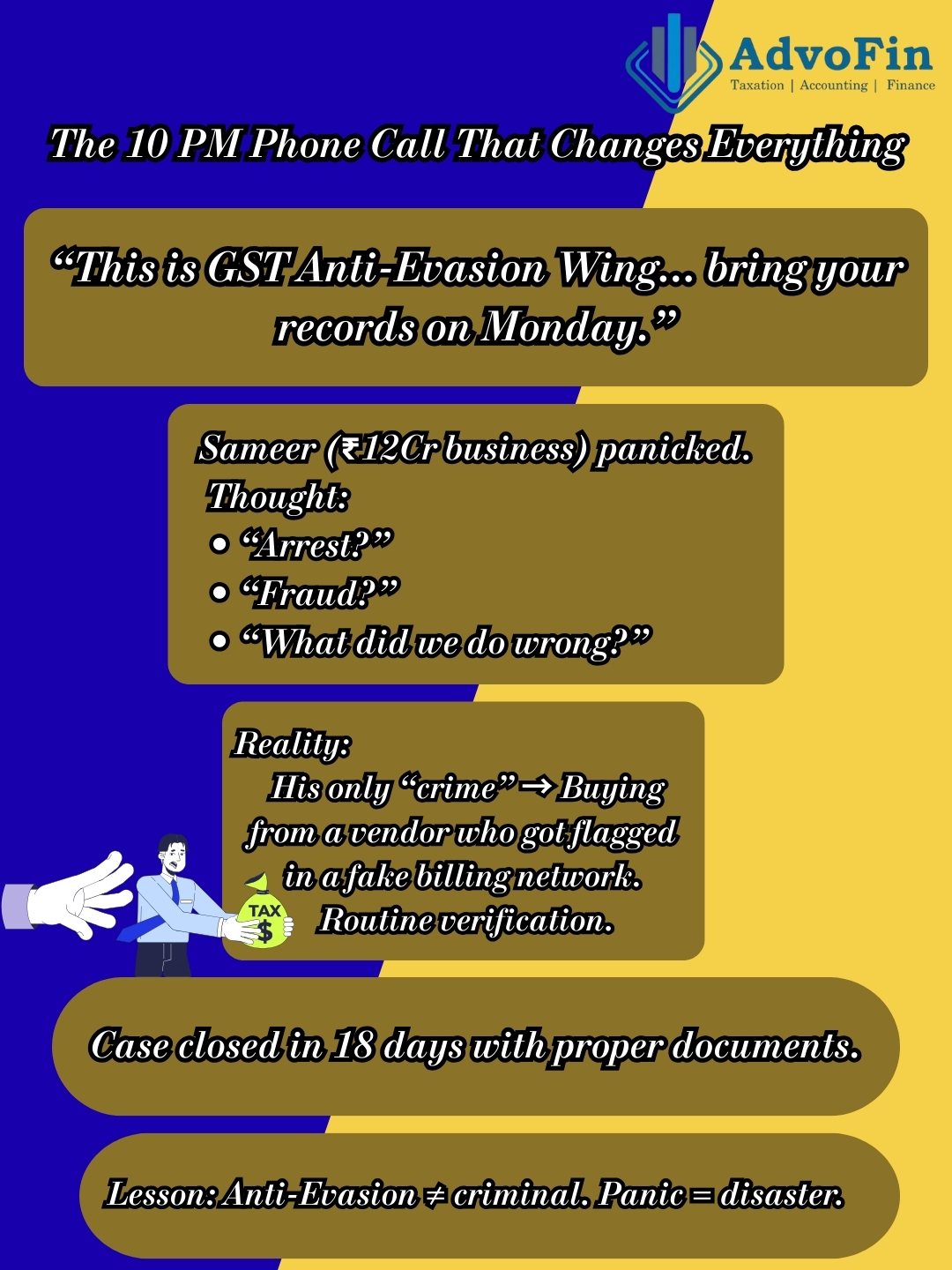
Introduction: The 10 PM Phone Call That Changed Everything
Sameer’s story (real case, name changed):
10:15 PM, Friday
Sameer, founder of a ₹12-crore manufacturing business, receives a call from an unknown Delhi number.
Caller: “This is GST Anti-Evasion Wing. We need to verify some transactions. Can you come to our office on Monday with all your records?”
Sameer’s mind races:
- Anti-Evasion? That’s for criminals, right?
- What did we do wrong?
- Are they going to arrest me?
- Should I delete records? Run away?
He doesn’t sleep all weekend. By Monday morning, he’s on the verge of a breakdown.
The reality when we investigated:
Sameer’s “crime”:
- One of his vendors (a steel trader from Gujarat) was flagged in a fake billing network
- That vendor supplied to 50+ businesses (including Sameer)
- Anti-Evasion was verifying all 50 businesses (routine)
- Sameer’s purchases from this vendor: ₹8.5 lakhs (out of ₹12 crore total purchases = <1%)
- Sameer had legitimate invoices, e-way bills, GRN, payments via bank
After professional handling:
- Submitted indexed documents (invoices, GRN, transport docs, payment proofs)
- Prepared vendor-wise reconciliation
- Showed goods actually received and used in production
- Demonstrated due diligence (GST verification done at time of onboarding)
- Case closed in 18 days with a letter: “Verification complete. No further action.”
But here’s what could have gone disastrously wrong (if Sameer panicked):
❌ Avoided the call → Officer thinks he’s absconding → Summons → Arrest warrant
❌ Went unprepared → Couldn’t answer questions → Officer suspects involvement → Full investigation
❌ Said “vendor ne fraud kiya” → Implied he did no due diligence → ITC disallowed
❌ Submitted messy docs → Officer can’t verify → Prolonged investigation → Business disruption
❌ Got aggressive → “This is harassment!” → Officer becomes hostile → Harsher scrutiny
This scenario plays out 5,000+ times every month across India.
GST Anti-Evasion Wing has become hyperactive in 2024-25 due to:
- 🤖 Advanced AI/ML analytics (detecting patterns humans miss)
- 📊 Real-time data matching (2B vs. 3B, e-way bills, bank statements)
- 🕵️ Fake invoice crackdowns (₹50,000+ crore fake ITC detected in 2023-24)
- 🔗 Vendor chain analysis (your vendor’s vendor’s vendor flagged = you get called)
- 🎯 High-risk sector targeting (scrap, construction, trading, transport)
Yet, the truth:
80-85% of Anti-Evasion inquiries are routine verification—not because you committed fraud, but because:
- Your vendor is under scanner
- System flagged a mismatch (often innocent)
- You’re in a high-risk sector
- Random selection for compliance check
Only 15-20% involve actual evasion/fraud.
This comprehensive guide covers:
- What is GST Anti-Evasion (vs. audit vs. investigation)
- Why businesses are selected (12 real triggers)
- How Anti-Evasion actually works (process flow)
- Common questions they ask (and safe answers)
- Documents they request (complete checklist)
- How to respond professionally (step-by-step)
- Mistakes that escalate matters (10 critical don’ts)
- Risk signals officers check (what raises red flags)
- Preparation checklist (Anti-Evasion Shield System)
- When to engage professionals
- Real case studies (good vs. bad responses)
1. What is GST Anti-Evasion? (Clear Definition)
Official Definition:
GST Anti-Evasion Wing = Specialized enforcement department focused on detecting and preventing tax evasion through:
- Fake billing
- Bogus ITC claims
- Pass-through entities (paper companies)
- Suppression of turnover
- Mismatch exploitation
- GST fraud networks
Key Characteristics:
✅ Proactive, not reactive (they initiate based on data analytics)
✅ Intelligence-driven (use AI, ML, data mining)
✅ Focus on high-risk cases (fake ITC, fraud chains)
✅ Powers under Section 67 (investigation powers)
✅ Can arrest (if evasion >₹5 crores under Section 132)
✅ Multi-state coordination (DGGI coordinates across states)
Anti-Evasion vs. Audit vs. Investigation:
| Aspect | Anti-Evasion | GST Audit (Section 65) | Investigation (Section 67) |
|---|---|---|---|
| Purpose | Detect & prevent evasion | Verify return accuracy | Deep probe into suspected evasion |
| Trigger | Risk-based system flags | Random/turnover-based | Credible information of fraud |
| Conducted by | Anti-Evasion officers | Audit officers | Investigation wing / DGGI |
| Risk level | Medium to High | Low to Medium | High to Very High |
| Powers | Summons, document verification | Summons, audit inquiry | Search, seizure, arrest (if >₹5Cr) |
| Arrest possible? | Yes (if evasion substantial) | No | Yes |
| Example | Vendor flagged, verify all buyers | Check if your GSTR-3B matches books | Suspected fake billing racket |
Who Conducts Anti-Evasion?
State Level:
- State GST Anti-Evasion units
- Superintendents, Inspectors, Officers
Central Level:
- DGGI (Directorate General of GST Intelligence)—most powerful
- Handles inter-state, organized fraud, large evasion (₹5Cr+)
2. Why Are Businesses Selected by Anti-Evasion? (12 Real Triggers)
Understanding triggers helps you assess your risk.
Trigger 1: GSTR-2B vs. GSTR-3B ITC Mismatch
Most common trigger (60%+ of Anti-Evasion cases).
What happens:
- You claimed ₹15 lakhs ITC in GSTR-3B
- GSTR-2B (auto-populated) shows only ₹12 lakhs
- Mismatch: ₹3 lakhs excess claimed
Why flagged:
- System assumes fake/excess ITC
- Anti-Evasion verifies: Is the ₹3L genuine? Or fabricated?
Genuine reasons:
- Vendor filed GSTR-1 late (after you filed 3B)
- Invoice upload error by vendor
- Wrong GSTIN mentioned
Trigger 2: Vendor Identified in Fake Billing Network
What happens:
- Your vendor (or vendor’s vendor) caught in fake ITC chain
- They issued invoices without actual supply (accommodation entries)
- You bought from them → You’re now part of investigation
Even if you’re innocent:
- Anti-Evasion verifies if YOUR transaction was real
- Need to prove goods/services actually received
Common sectors:
- Scrap trading (iron, steel, e-waste)
- Construction materials
- Trading businesses with multiple layers
Trigger 3: Sudden Spike in Turnover or ITC
What happens:
- Average monthly turnover: ₹2 crores
- Suddenly one month: ₹15 crores (7.5x spike)
- Or: ITC jumps from ₹2L/month to ₹20L
Why flagged:
- AI-driven anomaly detection
- Suspicion: Fake invoicing for ITC/turnover manipulation
Genuine reasons:
- Large one-time order
- Project completion billing
- Seasonal business
Your defense: Document the spike (purchase orders, contracts, delivery proofs).
Trigger 4: GSTR-1 Higher, GSTR-3B Lower (Outward Supply Mismatch)
What happens:
- GSTR-1 (sales declared): ₹50 lakhs
- GSTR-3B (tax paid on): ₹40 lakhs
- Mismatch: ₹10 lakhs sales declared but tax not paid
Why flagged:
- Suggests tax suppression
- Or data entry error (but system can’t tell)
Genuine reasons:
- Amendments in GSTR-1 not reflected in 3B
- Credit notes adjusted incorrectly
- Nil-rated sales included in wrong table
Trigger 5: High-Risk Business Sector
Sectors under constant Anti-Evasion scanner:
🔴 Scrap trading (iron, steel, copper, e-waste)
🔴 Construction & real estate
🔴 Transport & logistics
🔴 Commission agents (high cash, low documentation)
🔴 Mobile & electronics trading
🔴 Bullion & jewelry
🔴 Textiles (yarn, fabric)
🔴 Manpower supply (contract labor)
Why: Historical high evasion rates.
If you’re in these sectors: Extra documentation, extra caution.
Trigger 6: E-way Bill vs. Invoice Mismatches
What happens:
- E-way bill shows goods from Delhi to Mumbai
- But invoice shows delivery to Pune
- Or: E-way bill value ₹5L, invoice value ₹3L
Why flagged:
- Goods diversion
- Under-invoicing
- Fake billing
Trigger 7: Vendor Non-Filing or Registration Cancellation
What happens:
- Your top 3 vendors haven’t filed GSTR-1 for 6+ months
- Or their GST registration gets cancelled retrospectively
Why flagged:
- ITC you claimed from them becomes doubtful
- Anti-Evasion verifies if vendors are real or shell companies
Trigger 8: Cash Transactions Flagged by AIR/Income Tax Data
What happens:
- Your business shows ₹2 crore cash sales
- Bank shows ₹3 crore cash deposits
- Or: Large cash withdrawals around GST payment dates
Why flagged:
- Suspicion: Paying GST liability via unaccounted cash (suggesting undeclared income)
- Or: Cash sales suppression
Cross-verification: Income Tax AIR (Annual Information Report) + GST portal data.
Trigger 9: ISD (Input Service Distributor) Misuse
What happens:
- Head office uses ISD mechanism to distribute ITC to branches
- Distribution is disproportionate or to ineligible branches
Why flagged:
- ISD misuse to pass ITC to entities that shouldn’t receive it
Trigger 10: E-invoice Non-Generation (For Eligible Businesses)
If turnover >₹5 crores:
- E-invoicing mandatory
- Not generating = non-compliance
Why flagged:
- Suspicion: Avoiding e-invoice to hide transactions
Trigger 11: Refund Claims (Especially Zero-Rated Supply)
High refunds:
- Export refunds (frequent, high-value)
- Inverted duty structure refunds
Why flagged:
- Historically prone to fraud (fake exports, inflated ITC)
Trigger 12: Informant/Tip-Off
What happens:
- Competitor, ex-employee, disgruntled customer reports you
- Anonymous complaint
Anti-Evasion verifies the tip.
3. How Anti-Evasion Actually Works (Process Flow)
Understanding the process reduces fear.
Stage 1: Data Analytics & Risk Profiling
System flags businesses based on:
- Mismatches (2B vs. 3B, 1 vs. 3B)
- Vendor risk scores
- Sector risk
- Transaction patterns
Output: Risk score assigned (high/medium/low).
Stage 2: Initial Inquiry (Soft Touch)
Officer contacts you:
- Phone call (like Sameer’s case)
- Email: “Please explain [mismatch/issue]”
- Letter: “Submit documents by [date]”
This is NOT formal investigation yet—it’s verification.
Your response here determines if it escalates.
Stage 3: Document Verification
If initial response unsatisfactory:
- Summons issued (Section 70)
- Request: Purchase registers, invoices, GRN, bank statements, etc.
- You submit documents
Officer verifies:
- Are invoices genuine?
- Do vendors exist?
- Were goods/services actually received?
- Are payments via banking channels?
Stage 4: Physical Verification (If Needed)
Officer may:
- Visit your premises
- Check stock
- Interview staff
- Inspect production/warehouse
Stage 5: Outcome Decision
Possible outcomes:
A) Case Closed:
Verification complete, no evasion found → Case closed letter.
B) Show Cause Notice (SCN):
Evidence of evasion found → SCN proposing demand/penalty → You get opportunity to reply.
C) Investigation (Section 67):
Serious fraud suspected → Full-blown investigation → Search, seizure, arrest possible.
4. Common Questions Anti-Evasion Asks (And Safe Answers)
Preparation is everything.
Category A: Business Verification
Q1: “What is your business activity?”
Safe Answer:
“We manufacture/trade in [product]. Our main customers are [type], and we source from [type of vendors]. Our average monthly turnover is ₹[amount].”
Keep it factual, concise.
Q2: “Who are your top 10 suppliers and customers?”
Safe Answer:
“I have prepared a list with their name, GSTIN, address, and transaction value. Please find it enclosed.”
Pro Tip: Submit in Excel format, sorted by transaction value (highest first).
Category B: Vendor Verification
Q3: “How did you select this vendor [flagged one]?”
❌ Bad Answer:
“I don’t know, my purchase manager handles this.” (Shows no control)
✅ Good Answer:
“We selected based on [price quote/reference/past relationship]. We verified their GST registration on the portal at the time of onboarding and confirmed they were active and filing returns regularly.”
Q4: “Did you physically receive goods from this vendor?”
✅ Good Answer:
“Yes. Goods were received at our [warehouse/factory] on [date]. We have GRN (Goods Receipt Note) signed by our receiving staff. Material was inspected and used in our production/resale. I have submitted GRN copies and stock register entries.”
Q5: “How did you make payment to this vendor?”
✅ Good Answer:
“All payments were made via bank transfer [NEFT/RTGS/cheque]. I have submitted bank statements highlighting these payments. No cash payments were made.”
Why this matters: Cash payments = Red flag (possible unaccounted dealings).
Category C: ITC & Mismatch
Q6: “Why is there a ₹5 lakh mismatch between GSTR-2B and your claimed ITC?”
✅ Good Answer:
“We reconcile GSTR-2B monthly. The ₹5L mismatch appears due to: [Option 1: Vendor filed GSTR-1 late / Option 2: Invoice upload error by vendor / Option 3: Wrong GSTIN mentioned]. I have submitted the reconciliation statement showing invoice-wise details. The invoices are genuine, goods were received, and payments made. I have also contacted the vendors to ensure they file/correct their returns.”
Q7: “Have you claimed ITC on fake invoices?”
❌ Never say “yes” or “maybe.”
✅ Safe Answer:
“No. All invoices are genuine. We maintain due diligence on vendors, verify GST registration, ensure goods/services are received, and make payments via banking channels. If there are specific invoices you’d like me to substantiate further, please specify, and I’ll provide additional documentation.”
Category D: Books vs. Portal
Q8: “Reconcile your GSTR-1 with your sales register.”
✅ Good Answer:
“I have prepared a reconciliation statement showing month-wise sales as per books and GSTR-1. [If matched:] Both are aligned. [If mismatch:] The difference of ₹[amount] is due to [credit notes/amendments/timing differences], which I have explained in the attached note.”
Category E: Documentation
Q9: “Provide purchase invoices for top 20 vendors.”
✅ Good Answer:
“I have compiled invoices for top 20 vendors (by value) in an indexed file. Each vendor’s invoices are separated with index tabs for easy reference. Total: [number] invoices worth ₹[amount].”
Indexed, organized submission = Professional impression = Officer trusts you more.
5. Documents Anti-Evasion Typically Requests (Complete Checklist)
Have these ready BEFORE they ask.
☑️ Category 1: GST Registration & Returns
- GST Registration Certificate
- GSTR-1 (all relevant months—usually 12 months)
- GSTR-3B (same period)
- GSTR-2B (downloaded from portal)
- GSTR-9 (Annual Return, if filed)
☑️ Category 2: Books of Accounts
- Purchase Register (vendor-wise, month-wise)
- Sales Register (customer-wise, month-wise)
- ITC Ledger (electronic credit ledger from GST portal)
- Cash Book / Bank Book
- Trial Balance (for the period)
- Balance Sheet & P&L (if year-end)
☑️ Category 3: Reconciliation Statements
Most critical—prepare these meticulously:
- GSTR-2B vs. GSTR-3B ITC Reconciliation
Format: Invoice-wise listing showing:- Invoice no., date, vendor GSTIN, amount, ITC
- Whether in 2B (Yes/No)
- If not in 2B, reason (vendor late filing/error/ineligible)
- Books vs. GSTR-1 Reconciliation
Format: Month-wise sales as per books vs. GSTR-1, differences explained. - GSTR-1 vs. GSTR-3B Reconciliation
Outward supply comparison.
☑️ Category 4: Vendor Documents
- Vendor List (Name, GSTIN, Address, Mobile, Total purchase value)
- Top 10-20 Vendors’ Invoices (sample or full, as requested)
- Vendor GST Compliance Proof
Screenshots from GST portal showing vendor’s GSTR-1/3B filing status - Vendor Agreements / Purchase Orders
- Vendor KYC (GST certificate copy, PAN, if available)
☑️ Category 5: Goods/Service Receipt Proof
- GRN (Goods Receipt Note) — Critical!
For every invoice, show goods were received (date, quantity, signature) - Service Completion Certificates (for services)
- Delivery Challans
- Transport Documents (LR, consignment notes, truck receipts)
☑️ Category 6: Payment Proofs
- Bank Statements (showing payments to vendors)
- NEFT/RTGS/Cheque copies
- Payment ledger (vendor-wise)
Highlight/mark relevant payments for easy officer reference.
☑️ Category 7: E-way Bills & E-invoices
- E-way Bill Register (all generated bills)
- E-invoice JSON files (if applicable)
- E-way bill vs. Invoice reconciliation
☑️ Category 8: Stock & Inventory
- Stock Register (opening stock, purchases, production, sales, closing stock)
- Physical stock verification report (if available)
Why matters: To prove goods purchased were actually used/sold (not paper transactions).
☑️ Category 9: Financial Cross-Verification
- Income Tax Returns (for same period—to check consistency)
- Tax Audit Report (Form 3CD, if applicable—turnover >₹1 crore/₹5 crore)
- TDS Certificates (26AS showing TDS credits)
☑️ Category 10: Miscellaneous
- PAN Card, Aadhaar (of proprietor/partners/directors)
- Premises Proof (rent agreement, utility bills—proves physical presence)
- Employee details (if requested—to verify business operations)
Pro Tip: Maintain a “Anti-Evasion Ready Binder” with all these documents updated monthly. When called, just photocopy/email—saves panic.
6. How to Respond Professionally (Step-by-Step Strategy)
Your response tone & quality determines outcome.
Phase 1: Initial Contact (Day 0)
Step 1: Receive call/email/letter from Anti-Evasion
Step 2: Stay calm. Do NOT panic, argue, or show fear.
Step 3: Note down:
- Officer’s name, designation
- Office location
- Subject matter (if mentioned)
- Documents requested
- Deadline
Step 4: Politely ask (if not clear):
“Sir, could you kindly specify in writing the exact documents required so I can prepare them accurately?”
Why: Prevents misunderstanding, shows professionalism.
Phase 2: Internal Assessment (Day 0-1)
Step 5: Inform your GST advisor/CA immediately
Step 6: Internal meeting:
- Review the period/issue in question
- Identify potential risks (vendor non-filing? mismatch?)
- Assess if you’re genuinely at fault or it’s vendor/system issue
Step 7: Risk assessment:
- Low risk: Routine vendor check, small mismatch → Handle with CA
- High risk: Large mismatch, fraud allegation, DGGI involved → Engage lawyer
Phase 3: Document Preparation (Day 1-5)
Step 8: Gather all documents (as per checklist above)
Step 9: Create INDEX for documents:
Index of Documents Submitted
Re: Anti-Evasion Inquiry [Reference Number]
- GST Registration Certificate — Page 1
- GSTR-1 (Apr-Dec 2024) — Pages 2-15
- GSTR-3B (Apr-Dec 2024) — Pages 16-30
- GSTR-2B vs. 3B Reconciliation — Pages 31-40
- Purchase Register — Pages 41-100
…
Indexed = Professional = Trusted.
Step 10: Prepare One-Page Summary Note:
Compliance Summary
Re: Anti-Evasion Verification [Your GSTIN]Business Nature: Manufacturing of [product]
Turnover (FY 2023-24): ₹12 crores
GST Compliance: All returns filed up to [month/year]Subject Matter (as understood):
Verification of purchases from vendor [Name, GSTIN] flagged in inquiry.Our Position:
- Vendor was verified on GST portal at time of onboarding (active, filing returns).
- Goods were physically received (GRN attached).
- Payments made via bank (statements attached).
- We were unaware of any issues with vendor’s compliance at time of transaction.
- We have conducted all reasonable due diligence.
Documents Enclosed: [As per index]
Contact: [Name, Phone, Email]
This summary sets professional tone, shows transparency.
Phase 4: Submission & Follow-Up (Day 6-7)
Step 11: Submit documents:
- In person: Best (shows seriousness)
- By email: With read receipt + delivery receipt
- By post: Registered AD, speed post
Step 12: Obtain acknowledgment:
“Sir, kindly provide acknowledgment for documents submitted.”
Step 13: Follow-up email (1 week later if no response):
“Dear Sir,
This is further to documents submitted on [date] regarding [inquiry reference]. Kindly let us know if any additional information is required.
We remain available for any clarification.
Regards, [Name]”
Phase 5: Attend Summons / Meeting (If Called)
Step 14: If summons issued or meeting called:
- Attend with CA/lawyer
- Carry 2 sets of documents (one for officer, one for you)
- Answer precisely, factually
- Don’t volunteer extra information
- Don’t admit “fault” (say “apparent discrepancy which we are addressing”)
Step 15: If asked questions you don’t know:
“I need to verify records; I’ll submit a written reply within [X] days.”
Phase 6: Closure (Ongoing)
Step 16: Track status:
- Call/email every 2 weeks
- “Any update on our submission?”
Step 17: If case closed:
- Obtain closure letter (in writing)
- Keep in your compliance records
Step 18: If SCN issued:
- Engage lawyer immediately
- Reply within deadline (30-90 days typically)
- Prepare detailed defense
7. Mistakes That Escalate Anti-Evasion Matters (10 Critical Don’ts)
Avoid these at all costs.
❌ Mistake 1: “Mera Accountant Dekh Lega” (My Accountant Will Handle)
Why wrong:
Shows you don’t know your own business → Officer suspects you’re a front for someone else.
Right approach:
“I work closely with my CA, and we’ve prepared all documents together. I’m here to clarify any questions.”
❌ Mistake 2: “Sab Genuine Hai Sir” (Everything is Genuine, Sir)
Why wrong:
Generic defense = No substance = Officer remains unconvinced.
Right approach:
“Our transactions are genuine. Here’s specific proof: invoices, GRN, payments, stock usage—please verify.”
❌ Mistake 3: Delayed Response / Missing Deadline
Why wrong:
Delay = Suspicion (“What are they hiding? Fabricating records?”)
Right approach:
Respond within deadline. If genuinely need extension, ask politely with reason before deadline.
❌ Mistake 4: Submitting Half/Incomplete Documents
Why wrong:
Officer can’t verify → Keeps asking for more → Prolongs case → Raises suspicion.
Right approach:
Submit everything in one go, comprehensively, indexed.
❌ Mistake 5: Blaming Vendor Aggressively
Wrong statement:
“Sir, vo vendor ne fraud kiya, humko phas diya!” (That vendor did fraud, trapped us!)
Why wrong:
Implies you did ZERO due diligence → Makes you look negligent → ITC disallowed.
Right approach:
“We conducted reasonable due diligence [GST verification, past relationship]. Vendor’s subsequent non-compliance was beyond our control. Our transaction was genuine [proof attached].”
❌ Mistake 6: No Reconciliation Prepared
Why wrong:
Officer asks: “Reconcile 2B vs. 3B.”
You: “I don’t have that.”
→ Officer thinks you don’t track ITC properly → High evasion risk.
Right approach:
Have reconciliations ready BEFORE they ask.
❌ Mistake 7: Arguing or Getting Defensive
Wrong tone:
“Why are you targeting us? We’ve done nothing wrong! This is harassment!”
Why wrong:
Officer becomes defensive too → Harsher scrutiny → No cooperation.
Right approach:
“We understand your concerns. We’re happy to provide any clarification needed. Here are our documents.”
❌ Mistake 8: Saying “We Made a Mistake”
Even if true, avoid this phrase.
Why wrong:
“Mistake” = Admission of wrong = Legal liability.
Right approach:
“There appears to be a discrepancy which we are investigating. If any corrective action is required, we will take it as per law.”
❌ Mistake 9: Cash Payment Trail
If significant vendor payments via cash:
Red flag = Unaccounted dealings = Suspicion.
Right approach (if you did pay cash):
Show: (1) Cash withdrawal from bank, (2) Receipt from vendor, (3) Why cash was necessary (vendor preference, remote area, etc.).
❌ Mistake 10: Not Attending Summons
Worst mistake.
Consequence:
Penalty + Arrest warrant (if evasion high) + Ex-parte proceedings.
Right approach:
ALWAYS attend (you or authorized rep with proper authorization letter).
8. Risk Signals Anti-Evasion Officers Check (What Raises Red Flags)
Understanding what they look for helps you stay compliant.
🚩 Red Flag 1: Vendor Has Same Address as 10 Other Businesses
Indicates: Shell company, accommodation entry provider.
🚩 Red Flag 2: Vendor Registered <3 Months Ago, Huge Transactions Immediately
Indicates: Possible fake dealer created for ITC passing.
🚩 Red Flag 3: Vendor’s Business Nature Doesn’t Match Invoice
Example: Vendor GST says “mobile trading,” but invoice is for “construction services.”
🚩 Red Flag 4: Round-Figure Invoices
Example: ₹5,00,000 exactly, ₹10,00,000 exactly.
Indicates: Fabricated invoices (genuine invoices usually have specific amounts like ₹4,87,350).
🚩 Red Flag 5: No E-way Bill for High-Value Interstate Transactions
Mandatory for >₹50,000 interstate.
If missing: Suspicion goods never moved.
🚩 Red Flag 6: Payment Immediately Followed by Withdrawal
Example:
You paid vendor ₹10L on 5th.
Vendor withdrew ₹9.8L cash on 6th.
Indicates: Circular transaction (money comes back to you via cash).
🚩 Red Flag 7: No Stock Movement
Purchase register shows ₹50L goods bought.
Stock register shows no increase.
Sales register shows no outward movement.
Indicates: Paper transaction (goods never existed).
🚩 Red Flag 8: ITC Claimed >90% of Purchases
Unusually high ITC %.
Normal: 60-80% (some purchases ineligible, some under RCM, etc.)
If 95%+: Officer checks if ineligible ITC claimed.
🚩 Red Flag 9: Frequent Amendments in GSTR-1
Multiple amendments = Trying to match 2B retroactively?
🚩 Red Flag 10: Business Premises Not Traceable
Officer visits address on GST certificate → No office/factory found.
Indicates: Fake registration.
9. Anti-Evasion Shield System (Proactive Compliance Checklist)
Prevention is 100x easier than defense.
☑️ Shield #1: Monthly GSTR-2B vs. 3B Reconciliation
Process:
- Download 2B (available from 14th of next month)
- Compare with ITC claimed in 3B (filed by 20th)
- Identify mismatches
- Follow up with vendors immediately if they didn’t upload
Tool: Use GST software (Tally, Busy, ClearTax, GSTN reconciliation tool)
Frequency: EVERY MONTH without fail.
☑️ Shield #2: Vendor Compliance Screening (Before Onboarding)
Before adding new vendor:
Check 1: Verify GSTIN on GST portal (check active status)
Check 2: Download their GST certificate (verify name, address matches)
Check 3: Check filing history (have they filed last 3 months’ returns?)
Check 4: Verify address (Google Maps, site visit for high-value vendors)
Check 5: PAN verification (cross-check with GST)
Check 6: Business nature matches your purchase (don’t buy steel from mobile dealer)
Red flags:
- New registration (<6 months)
- Never filed returns
- Multiple businesses at same address
- Business nature unrelated to your purchase
If red flags: Avoid or conduct extra due diligence.
☑️ Shield #3: Maintain GRN for EVERY Purchase
GRN = Goods Receipt Note
For every invoice:
- Date of receipt
- Quantity received
- Quality check (OK/damaged)
- Receiving staff signature
- Storage location
Why critical: Proves goods were actually received (not paper transaction).
Even for services: Maintain service completion certificate, email confirmations, work logs.
☑️ Shield #4: Banking Channel Discipline
Rule: ALL payments >₹10,000 via bank (NEFT/RTGS/cheque).
Avoid:
- Cash payments (raises suspicion)
- Payment to vendor’s personal account (should be business account)
- Round-tripping (vendor pays you back via cash)
Maintain:
- Clear narration in bank transfers (“Payment for Invoice No. ABC123 dated 01-01-2024”)
- Vendor bank account matches their GST records
☑️ Shield #5: E-way Bill Discipline
For every interstate movement >₹50,000:
- Generate e-way bill BEFORE dispatch
- Ensure vehicle number, transporter details correct
- Update Part-B if transporter changes
- Cancel if goods not moved
- Match invoice value with e-way bill value exactly
☑️ Shield #6: Stock Register Maintenance
Monthly:
- Opening stock
- Add: Purchases
- Add: Production (if manufacturing)
- Less: Sales
- Less: Consumption (if used in production)
- = Closing stock
Physical verification: Quarterly (compare physical stock with register)
Why matters: Proves goods purchased were actually used/sold (not fake transactions).
☑️ Shield #7: Books vs. Portal Reconciliation
Monthly:
- Books purchase total = GSTR-2B total?
- Books sales total = GSTR-1 total?
- ITC in books = Electronic credit ledger?
Differences: Investigate immediately, don’t let them accumulate.
☑️ Shield #8: Avoid Risky Vendors
Even if price is attractive, avoid vendors who:
- Offer prices 20%+ below market (too good to be true)
- Refuse to provide proper documentation
- Insist on cash payments
- Have suspicious registration details
- Are flagged by your CA/industry peers
Remember: One risky vendor can land you in Anti-Evasion mess.
☑️ Shield #9: Periodic GST Health Check
Quarterly audit by CA:
- Review last 3 months’ returns
- Check ITC eligibility (any wrong claims?)
- Vendor compliance review
- E-way bill audit
- Reconciliation review
- Identify risks early
Cost: ₹10,000 – ₹25,000 per quarter
Benefit: Avoids ₹5 lakh+ penalty/interest later + Anti-Evasion hassle.
☑️ Shield #10: Staff Training
Your accounts team must know:
- GSTR-2B reconciliation process
- ITC eligibility rules (what’s eligible, what’s not)
- Vendor due diligence checklist
- E-way bill generation
- Red flags to watch for
Investment: 1-day GST training workshop (₹5,000 – ₹15,000)
Return: Prevents compliance gaps that trigger Anti-Evasion.
10. When to Engage Professionals (Decision Tree)
DIY works for low-risk cases. But engage CA/lawyer immediately if:
🚨 Engage Immediately If:
Scenario 1: Amount involved >₹10 lakhs
Scenario 2: Officer mentions “investigation” or “evasion”
Scenario 3: Multiple vendors flagged
Scenario 4: DGGI (not state officer) contacts you
Scenario 5: Past non-compliance issues (pending demands, late filings)
Scenario 6: You receive summons (not just email inquiry)
Scenario 7: Officer visits your premises unannounced
Scenario 8: Arrest mentioned or threatened
Scenario 9: High-risk sector (scrap, construction, trading)
Scenario 10: You’re unsure how to respond
What Professional Help Gets You:
✅ Risk assessment (how serious is this?)
✅ Document preparation (indexed, reconciled, professional)
✅ Legal language (safe answers, no admissions)
✅ Representation (CA/lawyer attends with you)
✅ Negotiation (with officer, if needed)
✅ Defense strategy (if SCN issued)
✅ Peace of mind (you’re not alone)
Cost Benchmarks:
| Service | Cost |
|---|---|
| Initial consultation + risk assessment | ₹5,000 – ₹10,000 |
| Document preparation + submission | ₹15,000 – ₹30,000 |
| Representation at summons/meeting | ₹10,000 – ₹25,000 per appearance |
| SCN reply drafting | ₹30,000 – ₹1,00,000 |
| Full defense (investigation stage) | ₹1,00,000 – ₹5,00,000 |
ROI: Saves ₹5-50 lakhs in penalties + business disruption + stress.
11. Real Case Studies (Good vs. Bad Responses)
Case Study A: Textile Trader (Good Response) ✅
Situation:
- ₹8 crore turnover
- 3 vendors flagged in fake billing network
- Purchases from these vendors: ₹40 lakhs total
Response:
- Submitted indexed documents within 5 days
- Prepared vendor-wise reconciliation (invoice, GRN, payment proof)
- Showed goods received at warehouse (GRN with photos)
- Demonstrated goods were used in production (stock register, finished goods sales)
- Payments via bank (highlighted in statements)
- Vendor due diligence done (GST verification screenshots at time of onboarding)
Outcome:
Case closed in 20 days. Letter: “Verification complete. Transactions found genuine.”
Why it worked: Professional, documented, transparent.
Case Study B: Construction Company (Bad Response) ❌
Situation:
- ₹15 crore turnover
- 5 vendors flagged
- Purchases: ₹1.2 crores
Response:
- Ignored initial email (thought it would go away)
- When summons issued, went alone (no CA)
- Submitted messy documents (unorganized, incomplete)
- Said: “Vendor ne fraud kiya, humara koi fault nahi” (Vendor did fraud, not our fault)
- Couldn’t produce GRN (said “we don’t maintain”)
- Some payments via cash (couldn’t explain why)
Outcome:
SCN issued demanding ₹21.6 lakhs (₹1.2Cr ITC + 80% penalty).
Now in appeal (2 years ongoing, still unresolved).
Why it failed: Unprofessional, unprepared, defensive, no documentation.
Case Study C: E-commerce Seller (Mixed Response) ⚠️
Situation:
- ₹3 crore turnover
- Sudden 400% spike in one month (Diwali sales)
- Flagged for anomaly
Initial Response (Wrong):
- Panicked
- Submitted generic explanation (“business increased”)
- No supporting documents
After Engaging CA (Right):
- Submitted platform data (Amazon/Flipkart sales reports)
- Showed advertising spends (Google Ads, Facebook Ads invoices)
- Demonstrated inventory buildup (stock register before Diwali)
- Explained seasonal nature (past year Diwali also had spike, though smaller)
Outcome:
Case closed after 45 days (longer than needed due to initial poor response, but ultimately resolved).
Lesson: Even genuine businesses need proper documentation to prove genuineness.
12. Conclusion: Anti-Evasion is Manageable with Preparation
Key Takeaways:
- ✅ Anti-Evasion ≠ guilt (80%+ are routine verifications)
- ✅ Your response determines outcome (professional = closed quickly; panicked = escalates)
- ✅ Documentation is king (indexed, reconciled, comprehensive)
- ✅ Monthly 2B reconciliation (prevents 60% of Anti-Evasion cases)
- ✅ Vendor due diligence (screen before onboarding, track compliance)
- ✅ GRN + banking discipline (proves transactions are real)
- ✅ Never admit “mistake” or “fraud” (use “discrepancy being investigated”)
- ✅ Engage professional for high-risk cases (saves 10x the cost)
- ✅ Proactive compliance (Anti-Evasion Shield System) = Best defense
- ✅ Stay calm, factual, respectful (officer is not your enemy)
What proper handling gives you:
- ✅ Case closed without demand/penalty
- ✅ Clean GST record
- ✅ Business continuity (no disruption)
- ✅ Officer’s goodwill (future interactions easier)
- ✅ Peace of mind
What improper handling costs:
- ❌ Demand orders (ITC disallowed + 80-200% penalty)
- ❌ Investigation escalation (search, seizure if >₹5Cr evasion)
- ❌ Arrest (in extreme cases)
- ❌ Business disruption (account blocking, ITC freeze)
- ❌ Years of litigation + stress
- ❌ Reputational damage
Final word:
GST Anti-Evasion is data-driven, intelligence-based, and increasingly proactive. But it’s also process-driven and verification-focused (not a witch hunt).
Your best defense: Clean records + Transparent operations + Professional response.
Remember: Compliance + Documentation + Preparation = Safety.
FAQs: GST Anti-Evasion (30 Most-Asked Questions)
Q1: What is GST Anti-Evasion?
A: GST Anti-Evasion is a specialized enforcement wing that investigates tax evasion, fake billing, bogus ITC claims, and GST fraud networks using data analytics, intelligence, and investigation powers under Section 67 of CGST Act. It’s proactive (they initiate based on system flags), not reactive.
Q2: Is Anti-Evasion the same as GST audit?
A: No. Audit (Section 65) is routine compliance verification (random/turnover-based). Anti-Evasion is targeted investigation when system detects potential evasion/fraud. Anti-Evasion is more serious, has broader powers (search, seizure, arrest if evasion >₹5Cr).
Q3: Why was I selected by Anti-Evasion?
A: Common reasons:
- GSTR-2B vs. 3B ITC mismatch (most common—60%+ cases)
- Your vendor flagged in fake billing network
- Sudden spike in turnover/ITC
- GSTR-1 vs. 3B outward mismatch
- High-risk sector (scrap, construction, trading)
- E-way bill discrepancies
- Vendor non-filing/registration cancelled
- Cash transaction flags
- Informant tip-off
Often: Not because YOU did fraud, but because your vendor or system flagged you for verification.
Q4: Does Anti-Evasion inquiry mean I’m guilty?
A: No. 80-85% of Anti-Evasion inquiries are routine verification—checking if your transactions are genuine, especially if your vendor is under scanner. Only 15-20% involve actual evasion. Your professional response determines if it closes quickly or escalates.
Q5: Can Anti-Evasion arrest me?
A: Arrest possible if:
- Tax evasion involved >₹5 crores (Section 132)
- Officer has “reason to believe” you’ll abscond or destroy evidence
- Repeated non-cooperation
For routine inquiries (vendor verification, ITC mismatch <₹5Cr): No arrest risk if you cooperate.
Q6: What is the difference between Anti-Evasion and DGGI?
A:
- State Anti-Evasion: Handles state-level cases, smaller evasion
- DGGI (Directorate General of GST Intelligence): Central agency handling large-scale evasion (>₹5Cr), inter-state fraud networks, organized fake billing
DGGI = More serious. If DGGI contacts you, engage lawyer immediately.
Q7: What happens if I ignore Anti-Evasion inquiry?
A: Consequences:
- Case escalates from inquiry to formal investigation
- Summons issued (must attend, penalty ₹25K if ignored)
- Possible arrest warrant (if evasion high)
- Ex-parte proceedings (demand order without your version)
- Business disruption (ITC blocked, account attached)
Never ignore. Even if you think inquiry is wrong, respond formally.
Q8: How long does Anti-Evasion inquiry take?
A: Depends on:
- Simple verification (vendor check): 15-30 days
- ITC mismatch with documentation: 1-3 months
- Complex fraud investigation: 6-12+ months
Your cooperation speed matters. Faster, better documentation = quicker closure.
Q9: What documents should I submit to Anti-Evasion?
A: Core documents:
- GST registration, GSTR-1/2B/3B
- Purchase & sales registers
- GSTR-2B vs. 3B reconciliation (critical!)
- Top vendors’ invoices + GRN (Goods Receipt Notes)
- Payment proofs (bank statements)
- E-way bills
- Stock register
- Vendor compliance proof (GST filing status screenshots)
See Section 5 of this blog for complete 35-point checklist.
Q10: What is GSTR-2B vs. 3B reconciliation and why is it important?
A: GSTR-2B = Auto-populated ITC available (based on vendors’ GSTR-1 filings).
GSTR-3B = ITC you actually claimed.
Reconciliation = Invoice-wise comparison showing:
- Invoices in 2B and claimed in 3B ✅
- Invoices in 2B but NOT claimed (with reason) ✅
- Invoices claimed in 3B but NOT in 2B ⚠️ (explain why—vendor late filing/error)
Why critical: 60%+ Anti-Evasion cases stem from this mismatch. Clean reconciliation = Case closes fast.
Q11: My vendor is flagged in fake billing. Am I guilty too?
A: Not automatically. Anti-Evasion checks if YOUR transaction with that vendor was genuine.
Your defense:
- Show goods/services were actually received (GRN, service certificates)
- Payments made via bank (not cash)
- Vendor was verified at onboarding (GST active, filing returns)
- You conducted reasonable due diligence
If proven genuine: No liability on you (vendor’s fraud doesn’t transfer to you if you acted in good faith).
Q12: What is GRN and why do Anti-Evasion officers ask for it?
A: GRN (Goods Receipt Note) = Internal document proving goods were physically received at your warehouse/factory.
Contains: Date, invoice reference, quantity, quality check, receiving staff signature.
Why critical: Proves transaction was real (not just paper invoice). Without GRN, officer suspects fake billing.
For services: Maintain service completion certificates, emails, work logs.
Q13: Can I settle Anti-Evasion matter by paying some amount?
A: Not recommended without knowing exact liability.
Better approach:
- Respond to inquiry with documentation
- If genuine mistake found (e.g., ineligible ITC claimed), voluntarily reverse it + pay interest
- Submit explanation: “Error identified, corrected, tax paid”
- Voluntary correction = Lower/no penalty
Paying upfront = Admission without knowing if you’re actually liable.
Q14: What if I can’t produce GRN or transport documents?
A: Problem: Officer suspects goods never received = Fake transaction.
Mitigation:
- Produce alternative proof: Photos of goods, production records (if used in manufacturing), sales records (if resold)
- Staff statements (receiving staff can attest goods came)
- CCTV footage (if available)
- Explain why GRN missing (small business, didn’t maintain—not criminal, but need other proof)
Lesson: Start maintaining GRN from now on.
Q15: Should I say “my vendor did fraud” to Anti-Evasion?
A: No. Blaming vendor aggressively = Implies you did ZERO due diligence = Your ITC may be disallowed.
Better approach:
“We conducted reasonable due diligence [GST verification, past dealings]. Vendor’s subsequent non-compliance was unknown to us. Our transaction was genuine [GRN, payment proof attached].”
Q16: Can Anti-Evasion visit my business premises?
A: Yes. They can conduct physical verification under Section 67 (investigation) or Section 71 (inspection).
They may:
- Check stock (match with stock register)
- Inspect goods
- Interview staff
- Verify business operations
Your response:
- Cooperate politely
- Allow access to relevant areas
- Have staff available to answer questions
- Don’t obstruct (obstruction = Offense)
But: They need proper authorization (inspection order signed by authorized officer).
Q17: What is the penalty for fake ITC claim?
A: If ITC availed wrongly (fake invoices):
- Tax demand: Full ITC amount must be paid back
- Interest: 18% p.a. from date of wrongful availment
- Penalty: 100% of tax (Section 122) = Can be up to 200% in case of fraud (Section 132)
Total: Tax + Interest + Penalty = 2-3x the wrongful ITC amount.
Example: Fake ITC ₹10L → Demand: ₹10L + ₹1L interest + ₹10-20L penalty = ₹21-31L.
Q18: Can I be criminally prosecuted for GST evasion?
A: Yes, if:
- Evasion >₹5 crores (Section 132)
- Punishment: Imprisonment up to 5 years + fine
For evasion ₹2-5 crores: Imprisonment up to 3 years + fine (compoundable)
For routine mismatches/errors <₹2Cr: Usually civil penalty, not criminal prosecution.
Q19: How do I prove my vendor was genuine?
A: Proof of vendor genuineness:
- ✅ GST verification screenshot (from portal—shows active status at time of transaction)
- ✅ Vendor’s GST certificate copy
- ✅ Vendor’s PAN
- ✅ Vendor filing history (GSTR-3B filed regularly?)
- ✅ Physical address verification (site visit photos, if done)
- ✅ Past relationship (if long-term vendor, show past transactions)
This shows you conducted due diligence.
Q20: What if my ITC mismatch is due to vendor filing late?
A: Common scenario.
Your reconciliation should show:
- Invoice no., date, vendor, amount, ITC
- Status in 2B: “Not present (vendor filed GSTR-1 late)”
- Your action: “Contacted vendor; they filed on [later date]; ITC now reflecting in subsequent 2B”
Submit proof: Vendor’s GSTR-1 filing acknowledgment, email correspondence with vendor.
Officer will verify: Once vendor filed, your ITC becomes legitimate (assuming invoice genuine).
Q21: Can I claim ITC even if invoice is not in GSTR-2B?
A: Technically, yes—but risky and not recommended.
Rule: You can claim ITC based on invoice (Section 16), but practically:
- Anti-Evasion will flag it (system mismatch)
- You’ll need to prove invoice is genuine + vendor will file eventually
- Or reverse it + re-claim when vendor files
Best practice: Claim ITC only on invoices in 2B. If not in 2B, follow up with vendor → file after they upload.
Q22: What is the time limit for Anti-Evasion to investigate?
A: Investigation (Section 67): Can be initiated anytime within 5 years from due date of annual return for that year (for evasion/fraud cases).
Normal assessment (Section 73): 3 years (for non-fraud cases).
So: Even old transactions (3-5 years ago) can be questioned if evasion suspected.
Q23: Should I hire a CA or lawyer for Anti-Evasion inquiry?
A: Depends on risk level:
DIY (Low risk):
- Routine vendor verification
- Small mismatch (<₹2 lakhs)
- You have clean documentation
Hire CA (Medium risk):
- ITC mismatch ₹2-10 lakhs
- Multiple vendors flagged
- Need reconciliation preparation
Hire Lawyer (High risk):
- Amount >₹10 lakhs
- Fraud allegation
- DGGI involved
- Arrest risk
- Investigation (not just inquiry)
Cost: CA: ₹15K-50K; Lawyer: ₹50K-5L (depending on complexity).
Q24: Can Anti-Evasion block my GST registration?
A: Suspension (not full cancellation immediately):
Section 29(2): Registration can be suspended if:
- Non-filing of returns for 6+ months
- Evasion detected
- Fake registration suspected
During suspension:
- Cannot generate e-way bills
- Cannot file returns
- Cannot claim ITC
Full cancellation: After hearing, if evasion confirmed.
Q25: What happens after I submit documents to Anti-Evasion?
A: Typical process:
Week 1-2: Officer reviews documents
Week 2-3: May call for clarifications or additional docs
Week 3-4: Internal verification (cross-check with vendors, system)
Week 4-6: Decision:
- A) Case closed (verification complete letter) ✅
- B) Show Cause Notice (SCN) issued (propose demand/penalty) ⚠️
- C) More investigation needed (escalation) 🚩
Your follow-up: Call/email every 2 weeks for status update.
Q26: Can I use Section 16(2)(c) defense (relied on vendor’s return)?
A: Section 16(2)(c): ITC can be claimed if invoice reflected in vendor’s GSTR-1.
Defense: “We claimed ITC only after verifying invoice was uploaded by vendor in their GSTR-1 [shown in our 2B]. We acted in good faith.”
Courts support this: If invoice was in 2B at time of claiming, and you had no knowledge of vendor’s fraud, your ITC may be protected.
But: Must prove you conducted due diligence.
Q27: What is the role of reconciliation in Anti-Evasion defense?
A: Reconciliation = Your first line of defense.
Shows:
- You track ITC meticulously (not reckless claiming)
- You can explain every difference
- You’re transparent (nothing to hide)
Types of reconciliation:
- GSTR-2B vs. GSTR-3B (ITC)
- Books vs. GSTR-1 (sales)
- GSTR-1 vs. GSTR-3B (outward supply)
- E-way bills vs. Invoices
- Stock register vs. Purchase/sales
Professional reconciliation = Case closes 70% faster.
Q28: Can Anti-Evasion search my home or office?
A: Yes, under Section 67(2) (search & seizure powers) if:
- Reason to believe tax evasion occurred
- Books/documents needed for investigation
- Approval from Commissioner (for search)
They can:
- Search business premises (and residence if business run from home)
- Seize books, documents, cash, goods
- Record statements
Your rights:
- Search should be conducted as per Code of Criminal Procedure
- Panchnama (witness signatures)
- You can have your lawyer/CA present
Rare: Searches usually in high-value fraud cases (₹5Cr+), not routine inquiries.
Q29: How does AI/ML detect Anti-Evasion cases?
A: GSTN uses advanced analytics:
Pattern detection:
- Unusual spikes (turnover, ITC)
- Round-figure transactions (₹5L, ₹10L exactly)
- Multiple entities with same IP, same bank account
- Vendor-buyer networks (if A, B, C all linked)
Mismatch alerts:
- 2B vs. 3B deviations
- E-way bill vs. invoice mismatches
- GSTR-1 vs. 3B differences
Risk scoring:
- Each business gets a risk score (0-100)
- High score = Flagged for Anti-Evasion
Result: System auto-generates inquiry list → Officers verify.
Contact AdvoFin Consulting the moment you receive Anti-Evasion inquiry—early professional intervention prevents escalation and saves 10x the cost.
Disclaimer: This blog is for informational purposes only and does not constitute legal advice. GST Anti-Evasion procedures, powers, and outcomes vary by case, state, and officer. Every situation is unique based on specific facts, documents, and business context. Please consult a qualified Chartered Accountant, GST Practitioner, or Tax Lawyer specializing in GST litigation and Anti-Evasion matters for personalized guidance. AdvoFin Consulting is not liable for actions taken based solely on this content.