
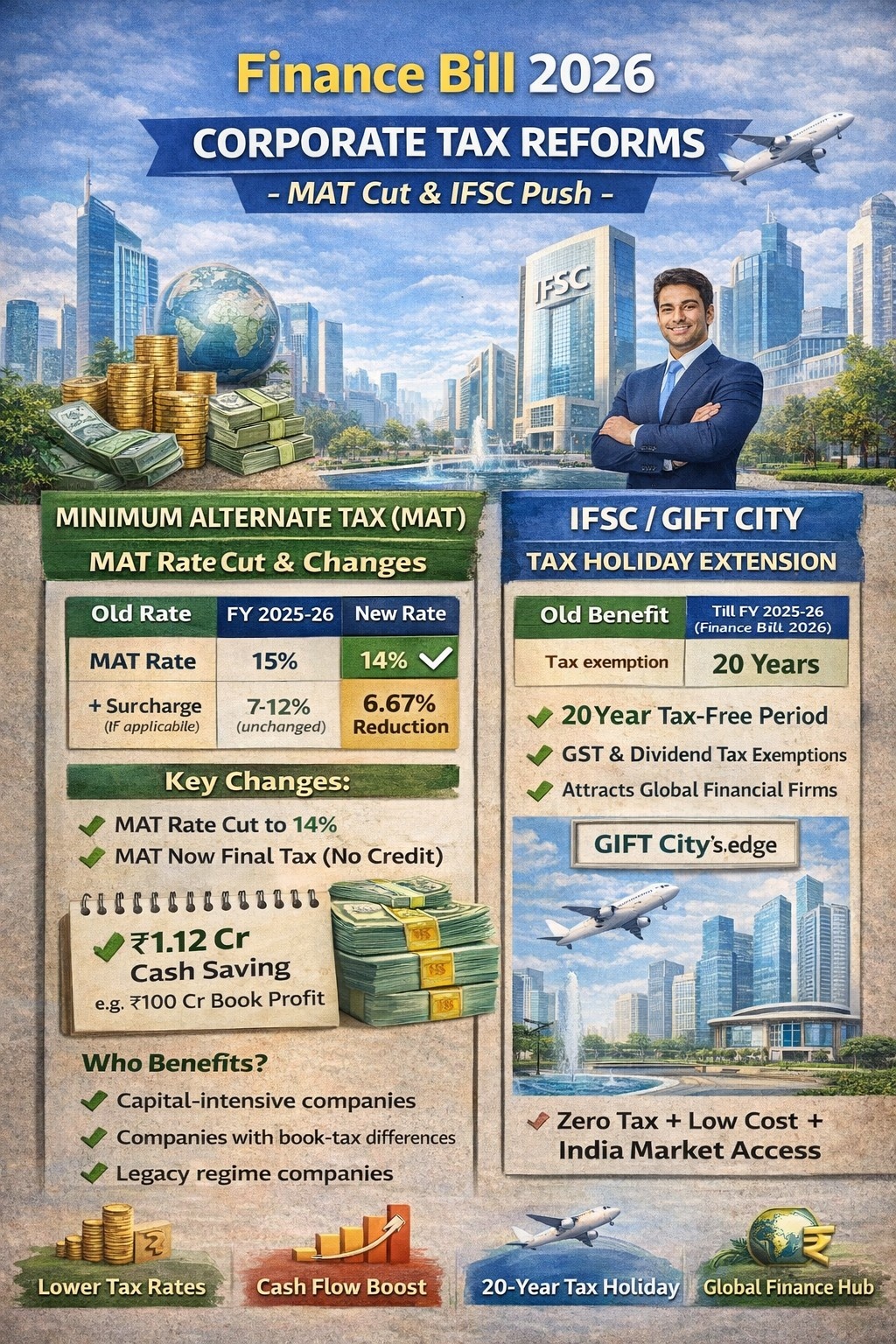
Strategic corporate tax changes focus on competitive rates and positioning India as a global financial hub. Here’s the complete breakdown:
MINIMUM ALTERNATE TAX (MAT) – RATE CUT & STRUCTURAL CHANGE
What is MAT?
Background:
- Companies showing high book profits but low taxable income triggered MAT
- Ensured minimum 15% tax on book profits
- Applicable to companies under old tax regime (Section 115JB)
Not applicable to:
- Companies under new regime (Section 115BAA/115BAB @ 22%/15%)
Key Changes Effective FY 2026-27
1. MAT Rate Reduced
| Parameter | Old Rate (FY 2025-26) | New Rate (FY 2026-27) | Savings |
| MAT Rate | 15% | 14% ✅ | 6.67% reduction |
| + Surcharge (if applicable) | 7-12% | 7-12% (unchanged) | – |
| + Cess | 4% | 4% (unchanged) | – |
| Effective MAT | 15.6-17.5% | 14.6-16.2% | 1% absolute saving |
Example: MAT Calculation
Company: ABC Manufacturing Ltd (Old Regime)
Book Profit (as per Companies Act): ₹100 crore
Taxable Income (as per Income-tax Act): ₹40 crore
Normal corporate tax @ 30%: ₹12 crore
MAT Trigger: Book profit tax > Normal tax
MAT Calculation:
| Component | Old MAT (15%) | New MAT (14%) |
| Book Profit | ₹100 Cr | ₹100 Cr |
| MAT Rate | 15% | 14% |
| MAT Amount | ₹15 Cr | ₹14 Cr |
| Surcharge (assume 7%) | ₹1.05 Cr | ₹0.98 Cr |
| Cess @ 4% | ₹0.64 Cr | ₹0.59 Cr |
| Total Tax Payable | ₹16.69 Cr | ₹15.57 Cr |
| Savings | – | ₹1.12 Cr ✅ |
Impact: ₹1.12 crore cash saving for company
2. MAT Made FINAL TAX (No Credit Mechanism)
BIGGEST STRUCTURAL CHANGE
Old MAT Credit System (Till FY 2025-26):
Step 1: Company pays MAT in Year 1 (₹15 crore on ₹100 Cr book profit)
Step 2: Normal tax in Year 1 would’ve been ₹12 crore
Step 3: MAT Credit created: ₹15 Cr – ₹12 Cr = ₹3 Cr
Step 4: In Year 5, normal tax exceeds MAT
- Book profit: ₹120 Cr → MAT: ₹18 Cr
- Taxable income: ₹100 Cr → Normal tax: ₹30 Cr
- Normal tax > MAT, so pay ₹30 Cr
Step 5: Utilize MAT Credit of ₹3 Cr from Year 1
- Final tax: ₹30 Cr – ₹3 Cr = ₹27 Cr ✅
Benefit: MAT credit recovered over 15 years
New MAT System (From FY 2026-27):
Step 1: Company pays MAT in Year 1 (₹14 crore on ₹100 Cr book profit)
Step 2: Normal tax would’ve been ₹12 crore
Step 3: NO MAT Credit created
Step 4: In Year 5, when normal tax > MAT
- Pay full ₹30 Cr normal tax
- Cannot utilize any credit from past years
Result: MAT is now a final, non-refundable tax
Comparison Table: MAT Credit Impact
| Scenario | Old System | New System (From FY 26-27) |
| MAT paid in Year 1 | ₹15 Cr | ₹14 Cr |
| Normal tax (Year 1) | ₹12 Cr | ₹12 Cr |
| MAT Credit created | ₹3 Cr ✅ | NIL ❌ |
| Carry forward period | 15 years | Not applicable |
| Utilization in future years | Yes (when normal tax > MAT) | No ❌ |
| Effective cost | Timing difference only | Permanent cost |
What About Existing MAT Credits?
Partial Usability When Shifting Regimes
Scenario: Company has ₹10 crore MAT credit accumulated till FY 2025-26
Option 1: Stay in Old Regime
- Continue paying MAT @ 14% (reduced rate)
- Cannot create new MAT credits from FY 26-27 onwards
- Existing ₹10 Cr credit: Can utilize when normal tax > MAT (next 15 years)
Option 2: Shift to New Regime (22%/15%)
- Existing ₹10 Cr credit: Only partially usable (conditions apply)
- Usually capped or time-limited
- Check specific transition rules
Recommendation: Stay in old regime if large MAT credit balance exists
Who Benefits from MAT Rate Cut?
– Capital-intensive companies:
- High depreciation in books (lower taxable income)
- Heavy plant & machinery investments
- Examples: Manufacturing, infrastructure, power
– Companies with Book-Tax Differences:
- Unabsorbed losses (tax books) vs. profits (book accounts)
- Section 43B disallowances
- Provision-based expenses
– Companies preferring old regime:
- Want to claim deductions (Section 80IC, 80IE, etc.)
- Benefit from lower MAT @ 14% vs. new regime @ 22%
Who’s Unaffected?
❌ New regime companies (Section 115BAA/115BAB):
- Pay flat 22% (manufacturing) or 15% (new manufacturing)
- MAT doesn’t apply
- This change irrelevant
❌ Companies with normal tax > MAT:
- Already paying regular corporate tax
- MAT never triggered
- No benefit from rate reduction
Should You Stay in Old Regime or Shift to New?
Decision Matrix (Post Finance Bill 2026):
| Factor | Old Regime | New Regime |
| Tax Rate | 30% (+ surcharge + cess) | 22% (manufacturing) / 15% (new setup) |
| MAT | 14% (if triggered) | Not applicable |
| MAT Credit | Existing usable; new NOT created | N/A |
| Deductions | 80IC, 80IE, 10AA, etc. available | No deductions allowed |
| Depreciation | Higher rates (WDV method) | Lower rates |
| Best for | Capital-heavy, loss-making, SEZ units | Profit-making services/light manufacturing |
Example Decision:
Company A: ₹50 Cr book profit, ₹10 Cr taxable income (high depreciation)
- Old regime MAT: ₹7 Cr (14% of ₹50 Cr)
- New regime tax: ₹2.2 Cr (22% of ₹10 Cr)
- Winner: New regime ✅
Company B: ₹50 Cr book profit, ₹5 Cr taxable income, ₹8 Cr 80IC deduction available
- Old regime: MAT ₹7 Cr (deductions don’t reduce MAT)
- New regime: ₹1.1 Cr (22% of ₹5 Cr, no 80IC)
- Winner: New regime (unless 80IC benefit > ₹5.9 Cr)
Rule of thumb: Most profitable companies benefit from new regime; MAT benefits capital-heavy/loss-making companies
IFSC / GIFT CITY INCENTIVES – TAX HOLIDAY EXTENDED
What is IFSC?
International Financial Services Centre (IFSC):
- India’s first IFSC: GIFT City, Gandhinagar, Gujarat
- Special Economic Zone for financial services
- Competes with Singapore, Dubai, Hong Kong
Activities allowed:
- Banking, insurance, asset management
- Aircraft/ship leasing
- Fund management, pension funds
- Commodity derivatives, bullion trading
Tax Holiday Extension – Section 80LA
Previous Benefit (Till FY 2025-26):
- 100% tax exemption on profits for IFSC units
- Available for 10 consecutive years (out of 15 years)
- Conditions:
- Unit set up before 31 March 2024
- Engaged in specified financial services
Limitation: Short 10-year window discouraged long-term setup
Extended Benefit (From FY 2026-27):
Tax holiday extended to 20 years
| Parameter | Old Benefit | New Benefit (Finance Bill 2026) |
| Tax exemption | 100% | 100% (unchanged) |
| Duration | 10 years (in 15-year block) | 20 years |
| Eligible units | Set up before 31-3-2024 | Set up before 31-3-2030 (likely extension) |
| Sectors covered | Banking, fund management, aircraft leasing, etc. | Expanded list (data centres mentioned separately) |
Example: IFSC Tax Savings
Company: XYZ Fund Management (IFSC Unit, GIFT City)
Annual profit: ₹100 crore
Tax rate (if regular domestic unit): 22% (new regime) = ₹22 crore tax
Tax Savings Over 20 Years:
| Year | Profit | Tax (without IFSC) | Tax (with IFSC exemption) | Annual Savings |
| Year 1-20 | ₹100 Cr/year | ₹22 Cr | ₹0 | ₹22 Cr |
| Total (20 years) | ₹2,000 Cr | ₹440 Cr | ₹0 | ₹440 Cr |
NPV of savings (@ 10% discount): ~₹187 crore
Massive incentive for global financial firms
Additional IFSC Benefits (Beyond Income Tax)
- GST exemption on financial services within IFSC
- No STT on securities traded in IFSC exchanges
- No commodity transaction tax (CTT)
- Simplified KYC norms for foreign clients
- 100% FDI allowed via automatic route
- Dividend distribution tax exemption
- Capital gains exemption for Category III AIFs in IFSC
Data Centre Exemption – NEW (Finance Bill 2026)
Section 10(48C) – Specific to IFSC Data Centres
Benefit:
- Foreign companies setting up/using data centres in IFSC
- 100% exemption on income from data centre services
- Approved Indian data centres under notification
Objective:
- Attract global tech/financial firms
- Build world-class digital infrastructure in GIFT City
- Compete with Singapore, Ireland for data centre hubs
Example:
- Google Cloud sets up data centre in GIFT City
- Revenue from cloud services to foreign clients: Tax-free
- Revenue from domestic clients: Regular tax applies
Who Benefits from IFSC Tax Holiday Extension?
– Global banks:
- HSBC, Standard Chartered, DBS already in GIFT City
- 20-year tax holiday = sustainable India operations
– Asset management companies:
- Offshore funds managed from India
- Tax-free fund management fees
– Aircraft/ship leasing companies:
- Major leasing hubs (competes with Ireland, Singapore)
- GIFT City now offers 20-year tax certainty
– Insurance companies:
- Reinsurance operations
- Captive insurance for global corporations
– Fintech/data firms:
- New data centre exemption
- Digital financial services platform
Comparison: GIFT City vs. Singapore/Dubai
| Factor | GIFT City (India) | Singapore | Dubai (DIFC) |
| Corporate tax | 0% (20 years) ✅ | 17% (some exemptions) | 0% (50 years in DIFC) |
| Regulatory framework | IFSCA (single regulator) | MAS | DFSA |
| Talent pool | Large, English-speaking | Excellent | Good (expat-heavy) |
| Time zone | India (GMT+5:30) | Singapore (GMT+8) | Dubai (GMT+4) |
| Connectivity | Emerging | Excellent | Excellent |
| Cost of operations | Low ✅ | High | Medium-High |
| Ease of doing business | Improving | Excellent | Excellent |
GIFT City’s edge: Zero tax + low cost + India market access
Government’s Vision for GIFT City
Target: Top 5 global financial centres by 2030
Current status: 600+ units registered, ₹6+ lakh crore AUM
Key sectors: Banking (30%), fund management (25%), fintech (20%)
Employment: 75,000+ professionals (target: 1 lakh by 2028)
Recent developments:
- NSE IFSC launched (competes with SGX for derivatives)
- Bullion exchange operational (India’s gold price discovery)
- REITs/InvITs listing framework introduced
COMPARATIVE TAX ANALYSIS
Corporate Tax Rates – Quick Reference (FY 2026-27)
| Company Type | Tax Regime | Rate | MAT Applicable? | Effective Rate |
| Domestic (old regime) | Sec 115BA | 30% | Yes (14%) | 30-34.9% or 14.6-16.2% |
| Domestic (new – manufacturing) | Sec 115BAA | 22% | No | 25.17% (with SC+cess) |
| Domestic (new setup – manuf) | Sec 115BAB | 15% | No | 17.16% (with SC+cess) |
| IFSC unit (GIFT City) | Sec 80LA | 0% | No | 0% ✅ |
| Foreign company (royalty) | – | 10-20% | No | 10-21% |
| Foreign company (data centre) | Sec 10(48C) | 0% (IFSC) | No | 0% ✅ |
STRATEGIC IMPLICATIONS
For CFOs & Tax Planners:
MAT Changes:
✅ Reassess old vs. new regime choice (14% MAT now more competitive)
✅ Stop relying on MAT credit for future tax planning (no new credits)
✅ Existing MAT credit: Utilize before shifting regimes
✅ Capital expenditure planning: Higher depreciation benefits old regime (triggers MAT @ 14%)
Action: Run 5-year projection comparing:
- Old regime (30% or MAT 14%, whichever higher)
- New regime (22%/15% flat)
For Businesses Considering IFSC:
20-year tax holiday = compelling business case:
– Financial services firms: Set up fund management/treasury in GIFT City
– Global banks: Expand IFSC operations (wholesale banking, wealth management)
– Tech companies: Data centre opportunities (new exemption)
– Aircraft/ship leasing: Tax-free lease rentals from global clients
Cost-benefit example:
- Setup cost in GIFT City: ₹10 crore
- Annual profit: ₹50 crore
- Tax saving (20 years): ₹200+ crore (NPV ~₹85 crore @ 10%)
- ROI on IFSC setup: 850% over 20 years ✅
For Foreign Investors:
India now offers:
- Tax-free operations in IFSC (20 years)
- Market access to India’s $3.7 trillion economy
- Lower costs vs. Singapore/Hong Kong (30-40% savings)
- English language, rule of law, skilled talent
Key consideration: Regulatory comfort vs. tax savings trade-off
Running a manufacturing unit with heavy capex?
Planning to set up financial services operations?
Evaluating GIFT City vs. Singapore/Dubai?
Let’s analyze your optimal tax structure.