
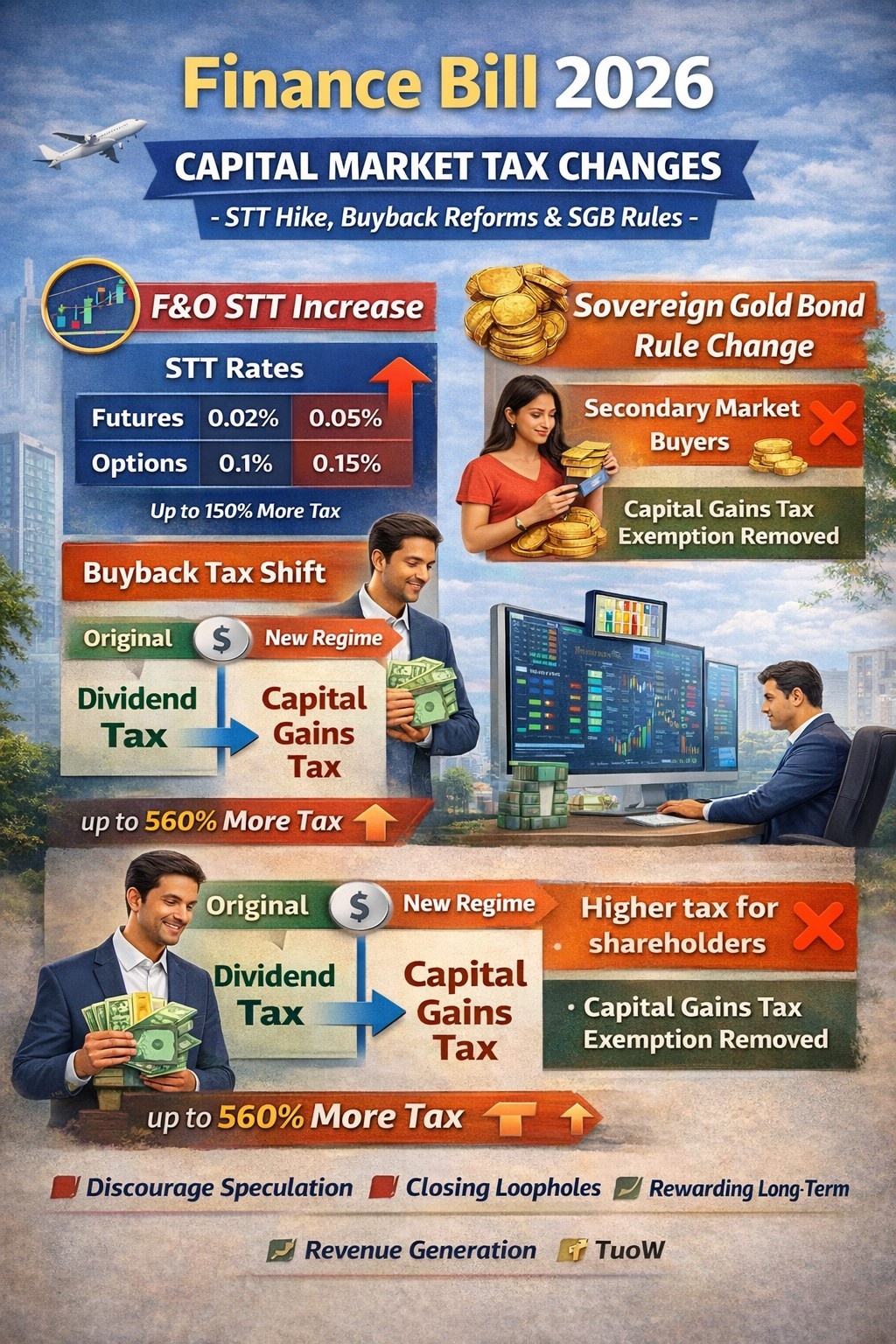
Significant changes in securities taxation aim to curb speculation, close tax arbitrage loopholes, and rationalize gold bond benefits. Here’s the complete breakdown:
SECURITIES TRANSACTION TAX (STT) – STEEP INCREASE ON F&O
Rate Changes Effective FY 2026-27
Major hike targeting speculative trading
| Transaction Type | Old STT Rate | New STT Rate | % Increase |
| Futures – Sale | 0.02% | 0.05% | 150% ↑ |
| Options – Sale of Option (Premium) | 0.1% | 0.15% | 50% ↑ |
| Options – Exercise (on settlement) | 0.125% of intrinsic value | 0.15% of intrinsic value | 20% ↑ |
| Equity Delivery | 0.1% (each side) | 0.1% (unchanged) | – |
| Equity Intraday | 0.025% (sell side) | 0.025% (unchanged) | – |
Impact Analysis – How Much More You Pay
Example 1: Futures Trading
Trade Details:
- Nifty Futures lot size: 25
- Entry: 24,000
- Exit: 24,500
- Contract value: ₹6,12,500
STT Calculation (Sell Side):
| Parameter | Old Regime | New Regime | Extra Cost |
| STT Rate | 0.02% | 0.05% | – |
| STT Amount | ₹122.50 | ₹306.25 | +₹183.75 |
Per lot extra: ₹184
10 lots/day: ₹1,840 extra per day
Monthly (20 days): ₹36,800 extra
Example 2: Options Selling (Premium Collection)
Trade Details:
- Bank Nifty Weekly Options
- Sold 48,000 CE at ₹150 premium
- Lot size: 15
- Premium collected: ₹2,250
STT on Premium (Sell Side):
| Parameter | Old Regime | New Regime | Extra Cost |
| STT Rate | 0.1% | 0.15% | – |
| STT Amount | ₹2.25 | ₹3.38 | +₹1.13 |
Seems small? Let’s scale:
- 100 lots/week: ₹113 extra
- Monthly (4 weeks): ₹452 extra
- Annually: ₹5,400 extra per 100 lots strategy
Example 3: Options Exercise (ITM Settlement)
Trade Details:
- Nifty 24,000 Call Option exercised
- Strike: 24,000 | Spot at expiry: 24,300
- Intrinsic value: ₹300 × 25 lots = ₹7,500
STT on Exercise:
| Parameter | Old Regime | New Regime | Extra Cost |
| STT Rate | 0.125% | 0.15% | – |
| STT on Intrinsic Value | ₹9.38 | ₹11.25 | +₹1.87 |
Who Gets Hit Hardest?
– High-Frequency F&O Traders:
- Intraday futures scalpers
- 150% STT increase = direct hit on thin margins
- Break-even now requires bigger moves
– Options Sellers (Premium Writers):
- Weekly expiry sellers
- 50% STT hike on premium = reduced profitability
- Credit spreads, iron condors more expensive
– Algo/HFT Traders:
- Volume-based strategies
- STT cost now material component of P&L
- May force shift to cash/delivery
– Delivery Investors – Untouched:
- STT on equity delivery: No change
- Long-term investors not impacted
Government’s Stated Objective
Curb Excessive Speculation:
– F&O turnover in India: ₹17,000+ lakh crore/year (FY 2024-25)
– 90% of retail F&O traders lose money (SEBI study)
– STT hike = disincentive for excessive leverage
Policy Intent:
- Reduce retail participation in risky derivatives
- Channel savings toward productive investment
- Increase tax revenue from speculative activity
SHARE BUYBACK TAXATION – FUNDAMENTAL SHIFT
From Dividend Tax to Capital Gains Tax
Effective: FY 2026-27
Old Regime (Till FY 2025-26):
Step 1: Company announces buyback at ₹500/share (face value ₹10)
Step 2: Company pays DDT @ 20% on deemed dividend (₹500 – ₹10 = ₹490)
Step 3: Shareholder receives buyback proceeds tax-free in their hands
Tax burden: Entirely on company
New Regime (From FY 2026-27):
Step 1: Company announces buyback at ₹500/share (no DDT)
Step 2: Shareholder receives ₹500 Step
3: Shareholder pays capital gains tax on (₹500 – acquisition cost)
Tax burden: Shifted to shareholder
Tax Rate Comparison
| Shareholder Type | Holding Period | Tax Rate | Effective Incidence |
| Promoter (Individual) | Any | LTCG/STCG + Special 30% levy | ~30% |
| Promoter (Company) | Any | Capital gains + 22% additional levy | ~22% |
| Non-Promoter (Individual) | >1 year | LTCG @ 12.5% (>₹1.25L) | 12.5% |
| Non-Promoter (Individual) | <1 year | STCG @ 20% | 20% |
| FII/FPI | >1 year | LTCG @ 12.5% | 12.5% |
| Domestic Institution | Any | As per applicable IT rate | Varies |
Example: Buyback Tax Impact
Company: XYZ Ltd announces buyback at ₹1,000/share
Shareholder: Mr. Kapoor (non-promoter individual)
Original purchase price: ₹400 (bought 3 years ago)
Shares tendered: 1,000 shares
Calculation:
Total consideration received: 1,000 × ₹1,000 = ₹10,00,000
Cost of acquisition: 1,000 × ₹400 = ₹4,00,000
Capital gains: ₹10,00,000 – ₹4,00,000 = ₹6,00,000
Tax liability (LTCG):
- Exempt: ₹1,25,000
- Taxable: ₹4,75,000
- Tax @ 12.5%: ₹59,375
Net proceeds: ₹10,00,000 – ₹59,375 = ₹9,40,625
Old Regime (For Comparison):
DDT paid by company: 20% × ₹6,00,000 = ₹1,20,000
Tax on shareholder: Nil
Net proceeds to shareholder: ₹10,00,000 (full amount)
Difference: Shareholder now bears ₹59,375 tax burden directly
Why This Change?
Tax Arbitrage Closure:
Old Loophole:
- Promoter sells shares in open market → pays 12.5% LTCG tax
- Company does buyback → promoter pays 0% tax (company pays DDT)
- Promoters preferred buyback route to extract cash tax-efficiently
New System:
- Buyback and open-market sale both attract capital gains tax
- 30% special levy on promoters makes buyback unattractive for cash extraction
- Levels playing field between dividend and buyback
Impact on Corporate Strategy
Companies may prefer:
– Dividends instead of buybacks (no special levy)
– Special dividends for cash distribution
– Bonus shares for rewarding shareholders
Buybacks will reduce except for genuine capital restructuring
SOVEREIGN GOLD BONDS (SGB) – EXEMPTION RESTRICTED
New Taxation Rules (Effective 1 April 2026)
Amendment: Restricts Capital Gains Exemption
What Are SGBs?
- Government-issued gold-backed securities
- 8-year maturity (exit option from 5th year)
- 2.5% p.a. interest (taxable)
- Tradable on stock exchanges
OLD TAX TREATMENT (Till FY 2025-26):
– Redemption at maturity (8 years): Fully exempt from capital gains tax
– Sold before maturity (secondary market): LTCG @ 12.5% (if held >3 years)
– Interest: Taxable as “income from other sources”
NEW TAX TREATMENT (From FY 2026-27):
Exemption ONLY if ALL conditions met:
- Subscribed at original RBI issue (not bought from secondary market)
- Held continuously from subscription date
- Redeemed at maturity (8 years)
Scenarios Under New Rules
| Scenario | Tax Treatment |
| ✅ Subscribed at RBI issue + held till maturity (8 years) | Fully exempt |
| ❌ Subscribed at issue but sold in 6th year (secondary market) | LTCG @ 12.5% (no exemption) |
| ❌ Bought from secondary market + held till maturity | LTCG @ 12.5% (no exemption) |
| ❌ Premature redemption (5th/6th/7th year via RBI window) | LTCG @ 12.5% (no exemption) |
Example: Impact on Secondary Market Buyers
Investor: Mrs. Gupta
Action: Bought SGB from NSE in 2021 at ₹5,000/unit
Maturity: 2029 (8 years from original issue)
Redemption value at maturity (2029): ₹7,500/unit
Units: 10
Tax Calculation (New Rules):
Capital gains: (₹7,500 – ₹5,000) × 10 = ₹25,000
Exempt: Nil (bought from secondary market)
Taxable LTCG: ₹25,000 – ₹1,25,000 (exemption limit) = Nil
Tax: Nil (falls within basic exemption)
But if gains were ₹2,00,000:
Taxable: ₹2,00,000 – ₹1,25,000 = ₹75,000
Tax @ 12.5% = ₹9,375
Old Rules (For Comparison):
Even secondary market buyers got full exemption at maturity
Tax: Nil
Difference: Now pays ₹9,375 tax on same transaction
Example: Impact on Premature Sellers
Investor: Mr. Joshi
Action: Subscribed SGB in 2020 at ₹4,800/unit
Sold in 2026 (6th year) at ₹6,500/unit
Units: 20
Tax Calculation:
Capital gains: (₹6,500 – ₹4,800) × 20 = ₹34,000
Holding: >3 years = LTCG
Exempt: Nil (sold before maturity)
Taxable: ₹34,000 (within ₹1.25L basic exemption)
Tax: Nil (assuming no other capital gains)
Old rule: Would’ve been exempt if held till maturity
New rule: Must pay tax if sold early
Who Gets Hit?
– Secondary market SGB buyers:
- Bought from exchange/peers
- No exemption even if held till original maturity
- Defeats purpose of buying from secondary market
– Investors needing liquidity:
- Exit in 5th/6th/7th year
- Lose exemption benefit
- Forced to pay LTCG tax
– Estate planning cases:
- SGBs inherited or gifted
- Continuity broken
- No exemption for heirs at maturity
– Original subscribers holding till maturity:
- Fully exempt (unchanged)
- 8-year lock-in gets reward
Policy Rationale
Government’s Logic:
- SGBs meant as long-term gold investment alternative
- Tax benefit should reward patient capital (8-year holders)
- Secondary market trading = speculative activity (shouldn’t get exemption)
- Aligns with original scheme intent (reduce physical gold demand)
COMPARATIVE TAX SUMMARY
Capital Market Instruments – Tax Treatment (FY 2026-27)
| Instrument | Holding Period | Tax Rate | Special Notes |
| Equity (Delivery) | <1 year | STCG @ 20% | + STT (unchanged) |
| Equity (Delivery) | >1 year | LTCG @ 12.5% (>₹1.25L) | + STT (unchanged) |
| Futures (Sale) | Any | Business income / STCG @ 20% | + STT 0.05% (↑150%) |
| Options (Premium) | Any | Business income / STCG @ 20% | + STT 0.15% (↑50%) |
| Buyback (Promoter) | Any | 30% special levy | New regime |
| Buyback (Non-promoter) | >1 year | LTCG @ 12.5% | Shifted from DDT |
| SGB (Original subscriber, maturity) | 8 years | Exempt | Unchanged |
| SGB (Secondary/premature) | >3 years | LTCG @ 12.5% | Exemption removed |
| Physical Gold | >3 years | LTCG @ 12.5% (no indexation) | Unchanged |
INVESTMENT STRATEGY SHIFTS
For F&O Traders:
– What’s Costlier Now:
- High-frequency futures scalping (150% STT hike)
- Weekly options selling (50% STT hike)
- Algo trading with thin margins
– What to Consider:
- Longer-duration options (reduce trade frequency)
- Larger price targets to absorb STT
- Shift partial capital to delivery/positional
- Review breakeven calculations (STT now material)
For Long-Term Equity Investors:
– Good News:
- No impact on delivery trades (STT unchanged)
- LTCG rate unchanged @ 12.5%
- Buyback changes don’t affect minority shareholders much
– Strategy:
- Continue SIP/delivery-based investing
- Avoid F&O speculation (costlier now)
For SGB Investors:
– If you already hold SGBs:
- Original subscribers: Hold till maturity (exemption intact)
- Secondary market buyers: Consider tax liability at maturity (12.5% LTCG)
– Future SGB strategy:
- Avoid secondary market purchase (lose exemption benefit)
- Subscribe only at RBI issue (if planning 8-year hold)
- Consider physical gold/Gold ETF if need liquidity (no false exemption promise)
– Current series:
- SGB 2024-25 Series I, II, III still open periodically
- Subscribe directly from RBI/banks/designated platforms
- Plan for 8-year horizon
For Companies Planning Buyback:
– Buyback now less attractive:
- Shareholders (especially promoters) pay higher tax
- May prefer dividend route for cash distribution
– When buyback still makes sense:
- Capital restructuring (reduce share capital)
- Support stock price (market conditions)
- Not for tax arbitrage (loophole closed)
Finance Bill 2026’s Capital Market Changes Are About:
- Discouraging Speculation – Higher STT makes F&O expensive
- Closing Loopholes – Buyback tax arbitrage eliminated
- Rewarding Long-Term – SGB exemption only for patient capital
- Revenue Generation – Government earns more from speculative activity