
Introduction
E-invoicing isn’t just another compliance checkbox—it’s fundamentally changed how Indian businesses report transactions under GST. What began with enterprises earning ₹500 crore+ has now reached businesses at ₹5 crore turnover, affecting thousands of MSMEs.
If you’re a founder, CFO, or accountant wondering whether e-invoicing applies to you—or how to implement it without breaking your workflow—this guide will walk you through everything in plain language.
No jargon. No confusion. Just actionable steps.
1. What Actually Is an E-Invoice?
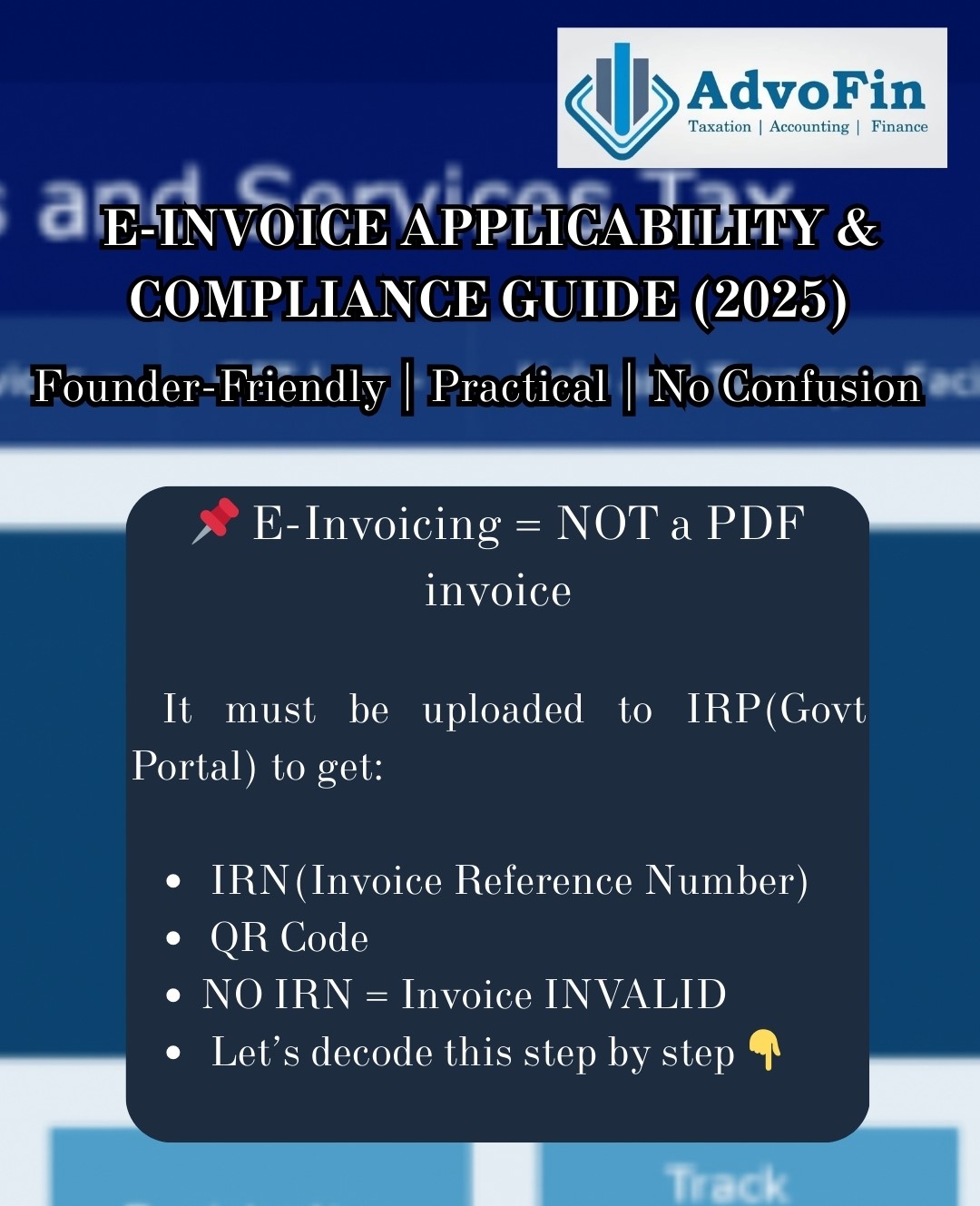
Let’s clear this up first: an e-invoice is NOT just a PDF you generate from Tally or Excel.
Here’s what it actually means:
- Your invoice data gets uploaded to the government’s Invoice Registration Portal (IRP)
- The IRP validates it and generates two critical elements:
- IRN (Invoice Reference Number) – a unique 64-character hash
- QR Code – containing encrypted invoice details
- This IRN-stamped invoice becomes your legally valid GST document
Without IRN:
- Your invoice is technically invalid under GST law
- Your customer may face ITC denial
- You’re exposed to penalties (₹10,000+ per invoice)
Think of IRN as your invoice’s Aadhaar number—without it, the invoice doesn’t officially exist in the GST ecosystem.
2. Does E-Invoicing Apply to You?
Current Rule (as of January 2025):
E-invoicing is mandatory if your aggregate turnover in any financial year from 2017-18 onwards has exceeded ₹5 crore.
Critical Points to Understand:
Turnover calculation is PAN-based, not GSTIN-based
- If you operate in 3 states under the same PAN, combine all turnover
- Even one GSTIN crossing ₹5 crore triggers applicability for all GSTINs under that PAN
“Any year since 2017-18” means:
- If FY 2019-20 turnover was ₹5.2 crore, you needed e-invoicing from FY 2020-21 onwards
- Once you cross the threshold, there’s no going back—even if turnover drops later
Turnover includes:
- Taxable supplies
- Exempt supplies
- Exports
- Inter-state and intra-state sales
Quick Self-Check:
Has your PAN-level turnover ever crossed ₹5 crore since 2017-18? → E-invoicing applies to you
3. When Must You Generate E-Invoices?
E-invoicing is required for:
✅ B2B invoices (sales to registered businesses)
✅ Export invoices (with or without payment of tax)
✅ Credit notes and debit notes
✅ SEZ supplies (to SEZ units/developers)
NOT required for:
❌ B2C transactions (retail sales to consumers)
❌ Bills of supply (for composition dealers or exempt goods)
4. Who Gets a Pass? (Exempted Categories)
Even if turnover exceeds ₹5 crore, these businesses are exempt from e-invoicing:
- SEZ Units (but NOT SEZ Developers)
- Banks, NBFCs, and Financial Institutions
- Insurance companies
- Goods Transport Agencies (GTA)
- Passenger transport services
- Cinema halls (film exhibition)
- OIDAR service providers (selling digital services to non-taxable persons)
If you’re in these categories, continue with regular invoicing—no IRN needed.
5. The E-Invoice Process: Step-by-Step
Step 1: Generate invoice in your accounting software
Use Tally, Zoho Books, Busy, QuickBooks, SAP, or even Excel → export data in JSON format
Step 2: Upload to IRP
Either:
- Automatic: Your software directly pushes data to IRP (preferred method)
- Manual: Upload JSON file on the IRP portal
Step 3: IRP validates and generates
Within seconds, you receive:
- IRN (unique 64-character identifier)
- Signed invoice (digitally signed by IRP)
- QR code (containing invoice details)
Step 4: Issue the final invoice
Download the IRN-stamped invoice with QR code → This is what you send to your customer
Step 5: Auto-population magic
Invoice data automatically flows to GSTR-1, saving you hours of data entry
Pro tip: Test with 2-3 invoices before rolling out company-wide. Iron out software integration issues early.
6. Six Deadly Mistakes That Kill E-Invoice Compliance
❌ Mistake #1: Issuing invoices without QR code
Impact: Invoice becomes invalid; customer can’t claim ITC properly
❌ Mistake #2: Using outdated software with no IRP integration
Impact: Manual JSON uploads lead to errors, delays, and mismatches
❌ Mistake #3: Generating IRN but not sharing the updated invoice
Impact: Customer receives non-compliant invoice; their ITC gets delayed or denied
❌ Mistake #4: Wrong GSTIN or Place of Supply
Impact: Creates automatic mismatches in GSTR-1, GSTR-2B, and GSTR-3B
❌ Mistake #5: E-way bill and e-invoice data mismatch
Impact: Red flag for GST authorities; triggers scrutiny
❌ Mistake #6: Generating multiple IRNs for same invoice
Impact: System rejects; creates cancellation and reconciliation nightmares
7. The Golden Triangle: E-Invoice → GSTR-1 → GSTR-2B
Once you enter the e-invoicing ecosystem, everything connects:
E-invoice data → IRP → Auto-populates GSTR-1 → Reflects in buyer’s GSTR-2B → Enables buyer’s ITC claim
Why this matters:
If there’s a mismatch at ANY point in this chain:
- Your customer can’t claim full ITC
- You face reconciliation nightmares
- GST notices become likely
This auto-population is actually your friend—it reduces manual errors by 90% if you set it up correctly.
8. Building Your E-Invoice SOP (Internal Workflow)
Create a documented process that your team follows religiously:
Step 1: Customer Segmentation
Classify every customer: B2B (needs e-invoice), B2C (doesn’t need e-invoice), Export (needs e-invoice)
Step 2: Invoice Generation Timing
Fix a daily cut-off time (say, 5 PM) for invoice generation and IRN processing. Batch processing reduces errors.
Step 3: QR Code Verification Protocol
No invoice leaves your system without QR code verification. Period.
Step 4: Software Integration
Ensure your accounting software is directly integrated with IRP—no manual uploads unless absolutely necessary
Step 5: Monthly Reconciliation Ritual
Cross-check:
- E-invoice logs from IRP portal
- GSTR-1 data
- Books of accounts
- Customer email confirmations
Step 6: Exception Handling Playbook
Document procedures for:
- Cancelled invoices (within 24 hours only)
- Wrong HSN code corrections
- Wrong GSTIN entries
- Duplicate IRN issues
Step 7: Vendor Education
Your suppliers’ non-compliance becomes YOUR problem. Share this guide with vendors who supply to you.
9. Penalties: The Cost of Non-Compliance
🚨 For not generating IRN when required:
Penalty: ₹10,000 per invoice OR 100% of tax amount (whichever is higher)
Real example: ₹2 lakh invoice with ₹36,000 GST → Penalty = ₹36,000
🚨 For missing QR code:
Penalty: Up to ₹25,000 per instance
🚨 Additional consequences:
- Customer ITC claim gets denied
- GST notices and audits become likely
- Late payment interest if tax mismatch occurs
- Compliance rating takes a hit
Bottom line: The cost of non-compliance far exceeds the effort of setting up proper systems.
10. E-Invoice Success Checklist (Use This Monthly)
Print this out and stick it near your billing desk:
| Check | Status |
| Has turnover crossed ₹5 crore in any FY since 2017-18? | [ ] |
| All B2B invoices routed through IRP? | [ ] |
| IRN generated for credit notes and debit notes? | [ ] |
| QR code printed on every applicable invoice? | [ ] |
| Accounting system integrated with IRP? | [ ] |
| GSTR-1 auto-population verified? | [ ] |
| Monthly reconciliation completed? | [ ] |
| Exception handling SOP documented? | [ ] |
| Team trained on e-invoice protocol? | [ ] |
The more checkmarks, the safer your GST compliance.
11. Founder-Friendly Key Takeaways
- E-invoicing is NOT optional once you cross the ₹5 crore threshold
- IRN + QR code = legally valid invoice—anything else is just paper
- Never issue an invoice without the IRP-generated QR code to B2B customers
- Auto-population in GSTR-1 is a feature, not a bug—embrace it
- Monthly reconciliation (e-invoice vs GSTR-1 vs books) prevents 80% of notices
- Your customer’s ITC depends on your compliance—build trust through accuracy
12. Why E-Invoicing Is Actually Good for Your Business
Most founders resist e-invoicing because it feels like more work. But here’s the reality:
Benefits you’ll actually experience:
Operational efficiency: Reduces manual data entry by 90%
Error reduction: Auto-population eliminates typos and mismatches
Faster payments: Customers can claim ITC immediately, improving their cash flow (and yours)
Lower notice risk: Transparent audit trail reduces GST scrutiny
Investor confidence: Clean GST compliance makes you more fundable
Future-ready: Positions you for further digitization (e-way bills, e-credit notes, etc.)
A business with robust e-invoice systems runs smoother, faster, and cleaner than one stuck in manual billing chaos.
Final Word: Act Now, Not When the Notice Arrives
If your turnover is approaching ₹5 crore—or already crossed it—this month is the time to set up your systems.
E-invoicing is not going away. The threshold might even drop to ₹1 crore in coming years. Early adoption means:
- Less panic when deadlines hit
- Better trained teams
- Cleaner books
- Fewer penalties
Start with 10 test invoices. Iron out the kinks. Document your SOP. Train your team.
Your future self (and your CA) will thank you.
Still have questions? Contact AdvoFin Consulting for consultation.
📧 Email: info@advofinconsulting.com
📞 Phone: +91-92116-76467
🌐 Website: www.advofinconsulting.com
Disclaimer: This blog is for educational purposes only and does not constitute professional tax advice. GST laws are subject to amendments and judicial interpretations. Consult a qualified GST practitioner for specific situations