
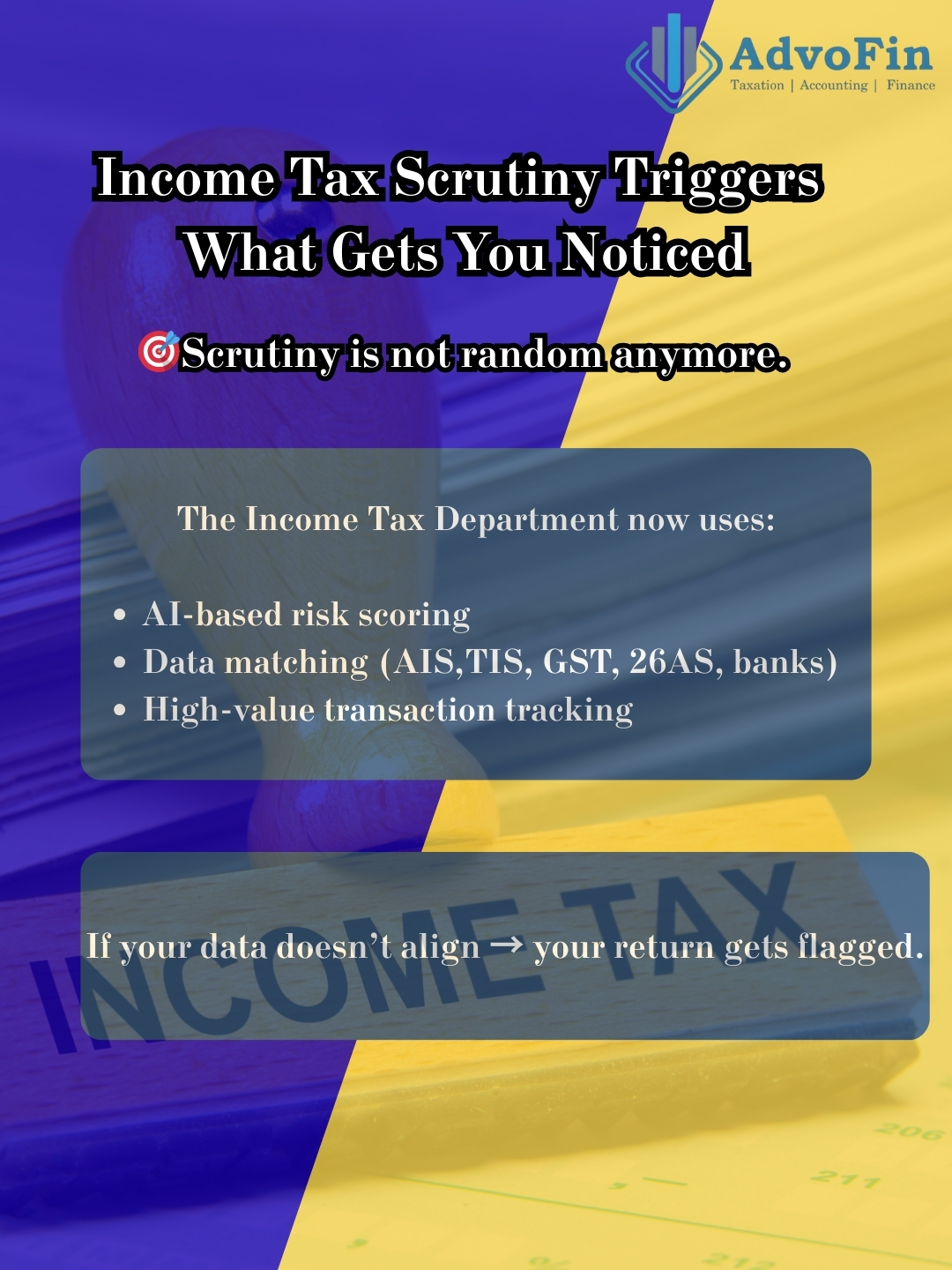
Introduction: Scrutiny Isn’t Random Anymore
Every year, thousands of taxpayers in India – business owners, professionals, freelancers, traders, and salaried individuals with side income – receive income tax scrutiny notices that trigger months of stress, documentation nightmares, and potential tax demands.
Here’s what most people don’t realize: Scrutiny is no longer random.
The Income Tax Department now uses sophisticated technology to automatically flag returns:
- AI-driven risk assessment engines that score every return
- Automated mismatch detection systems comparing multiple data sources
- High-value transaction monitoring across banks, registrars, and exchanges
- Cross-verification algorithms matching GST, TDS, AIS, and banking data
Your return gets a “risk score” based on dozens of parameters. Cross certain thresholds, and you’re selected for scrutiny – automatically, without any human officer reviewing your file first.
The good news? These triggers are predictable and preventable.
If you understand what the system looks for, you can structure your finances, maintain proper records, and file your returns in ways that keep your risk score low.
This guide reveals the exact scrutiny triggers for FY 2024-25, explains what AI flags in your ITR, and gives you practical steps to reduce your scrutiny risk to near zero.
What Is Income Tax Scrutiny? (Plain English)
Scrutiny means the Income Tax Department wants to examine your return in detail.
An assessment officer will ask you to provide:
- Your filed income tax return
- Books of accounts (if applicable)
- Bank statements
- Documentation for income sources
- Proof of expenses and deductions claimed
- Explanations for specific transactions
The department wants to verify:
✅ Income is correctly and completely reported
✅ Deductions claimed are genuine and documented
✅ Expenses are legitimate business expenses
✅ Sources of funds are explainable
✅ Tax paid matches your actual economic activity
Two Types of Scrutiny
1. Limited Scrutiny (Partial Assessment)
Focuses on specific issues only:
- High-value cash deposits
- Mismatch in a particular income source
- Unexplained investment
- Single transaction or claim
Duration: Usually 3-6 months
Documentation: Limited to the specific issue
2. Complete Scrutiny (Full Assessment)
Comprehensive investigation of your entire financial life:
- All income sources
- Complete books of accounts
- All bank accounts
- Every investment and expenditure
- Detailed explanations required
Duration: Can take 12-18 months
Documentation: Extensive – everything gets examined
Complete scrutiny is far more serious and time-consuming.
The 15 Most Common Scrutiny Triggers (2025 Edition)
1. AIS/TIS Mismatch with Your ITR
What It Is:
The Annual Information Statement (AIS) and Tax Information Statement (TIS) capture financial data from:
- All bank accounts
- Mutual fund purchases/redemptions
- Stock market transactions
- Property registrations
- Foreign remittances
- Credit card annual spend
- GST turnover
- TDS credits
- Dividend income
- Interest income
The Trigger:
If AIS shows ₹25,00,000 in total receipts but your ITR shows ₹18,00,000 income → Automatic red flag.
Why It Happens:
- Forgot to report a bank account
- Didn’t include capital gains
- Missed interest income
- Ignored credit card receipts (for businesses)
- Classified taxable income as non-taxable
How to Avoid:
- Always download AIS before filing ITR (available on income tax portal)
- Match every single line item
- If something in AIS is wrong, submit feedback immediately
- If something is correct but not taxable (like loan receipt), mention it in ITR with explanation
2. High Cash Deposits or Withdrawals
The Trigger:
| Transaction Type | Threshold | Risk Level |
| Cash deposit in savings account | > ₹10 lakh/year | High |
| Cash withdrawal from current account | > ₹1 crore/year | High |
| Single cash deposit | > ₹2 lakh | Moderate |
| Regular large cash deposits not matching business pattern | Any amount | Very High |
Why It’s Flagged:
Cash is untraceable. Large cash movements without corresponding income declaration suggest:
- Unaccounted income
- Black money circulation
- Tax evasion
Real Example:
ITR shows ₹8 lakh income, but bank statements show ₹15 lakh cash deposits.
Department’s question: Where did ₹15 lakh come from if your income is only ₹8 lakh?
How to Avoid:
- Minimize cash transactions – use digital payments
- If cash deposits are from legitimate sources (sale of assets, withdrawals from another account, loan receipt), maintain documentation
- Never deposit unexplained cash hoping it won’t be noticed – it will be
3. Credit Card Spending Not Matching Declared Income
The Trigger:
Your ITR shows ₹6 lakh annual income, but AIS shows ₹8 lakh in credit card payments during the year.
Department’s Logic:
How can you spend more than you earn? Either:
- You have undeclared income, OR
- You’re living beyond declared means
Common Scenario:
Salaried person with ₹10 lakh salary but ₹15 lakh credit card spend (including family expenses, vacations, etc.) without showing other income sources.
How to Avoid:
- Ensure total income (salary + business + investments + other sources) can justify your lifestyle expenses
- If expenses are from savings accumulated in earlier years, be ready to explain with documentation
- Don’t use credit cards for personal expenses if running a business (or maintain clear separation)
4. Stock Market, F&O, and Crypto Transactions Not Reported
The Trigger:
The department receives data directly from:
- Stock exchanges (NSE, BSE)
- Depositories (NSDL, CDSL)
- Crypto exchanges
- Brokers
If you traded but didn’t report → Automatic scrutiny
Common Mistakes:
- Intraday trading profits: Not reporting because “I reinvested”
- F&O losses: Not reporting because “it’s a loss anyway”
- Crypto transactions: Thinking they’re not tracked (they are)
- STCG/LTCG on shares: Not reporting because “it’s long-term and exempt” (only up to ₹1.25 lakh exempt)
Example:
You bought shares worth ₹5 lakh and sold for ₹7 lakh (₹2 lakh LTCG). You didn’t report because it’s below threshold. But AIS shows both transactions – red flag for non-reporting.
How to Avoid:
- Report ALL capital market transactions, even if exempt or loss
- Mention in ITR even if tax is zero
- Keep contract notes and transaction statements
- For crypto, report as per current guidelines (taxed at 30% on gains)
5. GST Turnover vs Income Tax Turnover Mismatch
This is now a TOP trigger – especially for SMEs.
The System:
GST and Income Tax systems are now integrated. Your GSTIN and PAN are linked.
The Trigger:
| GST Return Shows | Income Tax Return Shows | Result |
| ₹80 lakh turnover | ₹60 lakh turnover | Why ₹20L missing? |
| ₹5 lakh ITC claimed | ₹2 lakh expenses shown | Where are purchases? |
| ₹1 crore paid as GST | ₹50 lakh profit shown | Numbers don’t match |
Why Mismatch Happens:
- Different accounting periods (GST is monthly, ITR is yearly)
- Cash sales not recorded in GST but shown in ITR (or vice versa)
- Expenses claimed in ITR but no ITC in GST
- Personal expenses mixed with business expenses
How to Avoid:
- Your GST turnover and ITR turnover MUST match
- Maintain single set of books for both GST and Income Tax
- Reconcile monthly, not at year-end
- If there are legitimate differences (exempt supplies, non-GST expenses), document clearly
6. Sudden Unexplained Spike in Turnover or Profit
The Trigger:
Previous year: ₹25 lakh turnover, ₹4 lakh profit
Current year: ₹1.2 crore turnover, ₹50 lakh profit
Why It’s Flagged:
Such dramatic increases without corresponding business expansion indicators (new employees, new assets, new locations, new contracts) appear suspicious.
The Department Asks:
- What changed in your business?
- New contracts/clients?
- New product line?
- One-time order?
- Or is this previously unreported income now being declared?
How to Avoid:
- Document the reason for growth (new client contracts, market expansion, viral product)
- Show corresponding increase in expenses, employees, or assets
- If it’s one-time income (sale of asset, exceptional contract), mention clearly
- Maintain evidence of business development activities
7. High-Value Investments Without Corresponding Income
The Trigger:
AIS shows you made investments during the year:
- ₹10 lakh in mutual funds
- ₹5 lakh in stocks
- ₹20 lakh property down payment
- ₹3 lakh in PPF/insurance
Total: ₹38 lakh invested
But your ITR shows: ₹15 lakh income
Department’s Question:
How did you invest ₹38 lakh when you only earned ₹15 lakh?
Legitimate Explanations (That You Must Document):
- Savings from previous years (show previous year’s balance sheet)
- Loan taken (show loan agreement and receipt)
- Gift received (show gift deed and donor’s source)
- Inherited money (show inheritance documents)
- Maturity proceeds from other investments (show redemption statements)
How to Avoid:
- Maintain a “source of funds” statement for all large investments
- Don’t make investments that significantly exceed your declared income without documentation
- If using savings, show consistent balance sheet trail
8. Large Donations or Exempt Income Claims
The Trigger:
Donations under Section 80G:
- Claiming ₹5 lakh donation on ₹8 lakh income (too high percentage)
- Donating to organizations not approved for 80G
- No donation receipt or invalid receipt
Exempt Income Claims:
- Agricultural income: Claiming ₹10 lakh agricultural income without owning agricultural land
- Foreign income: Claiming it’s exempt without proper documentation
- Tax-free allowances: Claiming amounts that seem unrealistic
Red Flags:
- Donation amount disproportionate to income
- Donating to suspicious or non-registered NGOs
- Agricultural income without corresponding agricultural activity
- Claiming exemptions without proper certificates
How to Avoid:
- Only claim donations to 80G-approved organizations
- Keep official receipts and proof of payment (not cash)
- For agricultural income, maintain land records and proof of cultivation
- For foreign income exemptions, maintain tax residency certificates and proper documentation
9. Claiming Heavy Losses to Reduce Tax Liability
The Trigger:
Large losses claimed in:
- Business operations (₹20 lakh loss shown)
- Capital markets (₹15 lakh F&O loss)
- Speculative transactions
- Crypto trading losses
Why It’s Flagged:
Persistent losses or disproportionate losses appear as tax avoidance strategies.
Department’s Concern:
- Are losses genuine or fabricated?
- If business shows loss for 3-4 consecutive years, is it really a business or a hobby?
- Are F&O losses real trades or created for tax benefit?
How to Avoid:
- Ensure losses are genuine with complete documentation (bills, contracts, market reports)
- For business losses, show genuine business activity and efforts to be profitable
- For capital market losses, maintain trading account statements and contract notes
- Don’t continue declaring losses year after year without reasonable business justification
10. Non-Disclosure of Foreign Assets or Income (Critical for NRIs and Residents)
The Trigger:
The Indian tax department receives information from:
- Foreign Account Tax Compliance Act (FATCA)
- Common Reporting Standard (CRS)
- Automatic Exchange of Information (AEOI)
- Tax treaties with other countries
What Must Be Reported:
- Foreign bank accounts (even with zero balance)
- Foreign property
- Foreign company shares or ownership
- Foreign investments (stocks, bonds, pension funds)
- Income from foreign sources
- Foreign trusts
- Signing authority on foreign accounts
Severe Consequences: Not reporting foreign assets can result in:
- Penalty up to ₹10 lakh under Black Money Act
- Prosecution
- Tax rate of 30% + 90% penalty on undisclosed assets
How to Avoid:
- Disclose ALL foreign assets in Schedule FA of ITR
- Even if no income is generated, disclosure is mandatory
- Maintain FEMA compliance
- If recently returned to India (becoming resident), review your disclosure obligations
11. Salary Mismatch Between Form 16 and ITR
The Trigger:
Your employer reports your salary through:
- Form 16 issued to you
- TDS returns (Form 24Q) filed with the department
If your ITR shows different salary → Mismatch alert
Common Issues:
- Claiming HRA deduction not given by employer
- Showing additional allowances not in Form 16
- Claiming LTA without proper bills
- Deducting professional expenses not allowed
How to Avoid:
- File ITR exactly as per Form 16 for salary section
- If you have additional income or deductions, report them separately (not as salary adjustments)
- Don’t “adjust” Form 16 data to reduce tax
12. TDS Credit Mismatch
The Trigger:
Your claim: ₹2,50,000 TDS credit
Form 26AS shows: ₹1,80,000 TDS
Difference: ₹70,000 → Automatic investigation
Common Causes:
- Vendor/employer deducted TDS but didn’t file return
- Wrong PAN mentioned in TDS deduction
- Duplicate claim of same TDS
- TDS reflected in 26AS but you claimed more
How to Avoid:
- Always download Form 26AS before filing
- Match every TDS entry
- Only claim TDS that appears in 26AS
- For missing TDS, follow up with deductor and claim in subsequent year when it appears
13. Large Loans Taken or Given Without Documentation
The Trigger:
Your bank statement or balance sheet shows:
- ₹10 lakh received from “friend”
- ₹15 lakh given to “relative”
- No loan agreement, no interest, no repayment terms
Department’s Suspicion:
These aren’t loans – they’re:
- Disguised income (if you received money)
- Disguised investment/gift (if you gave money)
- Circular transactions to explain unexplained cash
Critical Requirements:
- Written loan agreement
- Bank transfer (not cash)
- Lender’s source of funds documented
- Interest charged (even if nominal)
- Repayment plan and evidence
How to Avoid:
- Never take or give large loans in cash
- Maintain proper loan documentation
- If receiving loan, document the lender’s source (their bank statement, ITR showing capacity to lend)
- If it’s a gift, execute a proper gift deed
14. Real Estate Transactions Not Matching Stamp Duty Data
The Trigger:
Property transactions are now directly reported to Income Tax with your PAN through:
- Stamp duty authorities
- Sub-registrar offices
Common Mismatches:
- Bought property for ₹50 lakh (per registration), but showed ₹35 lakh in ITR
- Sold property for ₹80 lakh, but didn’t report capital gains
- Property inherited but sale proceeds not reported
Why It’s Serious:
Property transaction data is 100% accurate and verifiable – there’s no scope for “explanation.”
How to Avoid:
- Report property purchases in ITR (Schedule AL – Assets and Liabilities)
- Report property sales with complete capital gains calculation
- If transaction value differs from stamp duty value, be ready to explain (with evidence)
- For inherited property, mention clearly with date of inheritance
15. Not Filing ITR Despite Activity in AIS
The Most Serious Trigger:
AIS shows:
- Bank interest received
- TDS deducted on your PAN
- Mutual fund transactions
- Property purchased
- Salary received
But you didn’t file ITR at all.
Result:
Not just scrutiny – potential penalty, prosecution notice, and mandatory assessment.
How to Avoid:
Always file ITR if:
- Total income exceeds basic exemption limit (₹2.5/3/5 lakh depending on category)
- You have capital gains (even if below exemption)
- You’re claiming refund of TDS
- You have foreign assets
- Required for visa, loan, or business purposes
How to Reduce Your Scrutiny Risk Score (Actionable Steps)
Step 1: Download and Review AIS Before Filing
Action:
- Login to income tax portal
- Go to Services → Annual Information Statement (AIS)
- Download complete AIS for FY 2024-25
- Review EVERY line item
- Match with your records
- If incorrect, provide feedback through portal
- If correct, ensure it’s in your ITR
This single step prevents 40% of scrutiny triggers.
Step 2: Ensure GST and Income Tax Perfect Alignment
Action:
- Download all GSTR-1, GSTR-3B returns
- Extract total turnover from GST
- Match with ITR turnover (Schedule BP or Schedule PGBP)
- If difference exists, document reason clearly
- Maintain single set of books for both
Create a simple reconciliation:
| Particulars | Amount |
| GST Turnover (as per GSTR-1) | ₹XX |
| Add: Exempt supplies | ₹XX |
| Add: Non-GST income | ₹XX |
| Total turnover for ITR | ₹XX |
Step 3: Maintain Monthly Books of Accounts
Action:
- Don’t do bookkeeping only at year-end
- Update books monthly
- Reconcile bank statements monthly
- Review P&L and balance sheet quarterly
Benefit:
Monthly maintenance means:
- Errors caught early
- Complete documentation
- No last-minute surprises
- Audit-ready books
Step 4: Document Source of Funds for All Investments
Action:
Create a “Source of Funds” file containing:
- For investments from current year income: ITR, bank statements
- For investments from savings: Previous balance sheets showing savings
- For investments from loans: Loan agreements, sanction letters, disbursement proof
- For investments from gifts: Gift deeds, donor’s bank statement and ITR
- For investments from inheritance: Will, legal heir certificate, estate valuation
Step 5: Minimize Cash Transactions
Action:
- Avoid cash deposits above ₹2 lakh in any account
- Maintain aggregate annual cash deposits below ₹10 lakh
- Use digital payment modes for all business transactions
- For unavoidable cash receipts, deposit promptly with documentation
The Rule:
Cash is guilty until proven innocent in tax matters.
Step 6: Separate Personal and Business Expenses
Action:
- Maintain separate bank accounts (personal vs business)
- Never claim personal expenses as business expenses:
- Family vacations
- Personal vehicle expenses
- Children’s education
- Home renovation (unless genuine home office)
- If mixed-use items (like phone, internet), claim only proportionate business use
Step 7: File ITR on Time Every Year
Action:
- File before July 31st (even if expecting refund)
- Don’t wait for last-minute rush
- Timely filing reduces scrutiny probability significantly
Statistics show:
Returns filed after deadline face 3x higher scrutiny rates than timely returns.
Your Pre-Filing Scrutiny Risk Checklist
Before you file your ITR, go through this checklist:
Income Reporting:
- All income sources included (salary, business, capital gains, other sources)
- AIS data completely matched and included
- Foreign income/assets disclosed if applicable
- Agricultural income supported by land ownership proof
- Exempt income properly classified and explained
Deductions and Expenses:
- All deductions properly documented
- Business expenses genuine and supported by bills
- No personal expenses claimed as business
- Donations only to 80G approved entities with receipts
- Depreciation calculated correctly
GST Compliance:
- GST turnover matches ITR turnover
- ITC claimed matches expense claims in ITR
- Monthly GST returns filed
Banking and Investments:
- Cash deposits below thresholds or properly explained
- High-value investments matched with income sources
- All bank accounts disclosed
- Credit card spending reasonable compared to income
Capital Transactions:
- All property transactions reported
- All stock market transactions reported
- Capital gains properly calculated
- Exemptions claimed only if eligible (with proof)
TDS and Advance Tax:
- TDS credits match Form 26AS exactly
- Advance tax paid properly if applicable
- No duplicate TDS claims
Documentation:
- All supporting documents filed properly
- Source of funds documented for investments
- Loan agreements for any loans taken/given
- Gift deeds if applicable
If you can check ALL boxes confidently, your scrutiny risk is minimal.
What to Do If Selected for Scrutiny Despite Precautions
Even with perfect compliance, you might be selected (sometimes it’s sector-based or random within low-risk pool).
Don’t Panic:
- Read the notice carefully – Understand what’s being questioned
- Gather all documents – Related to the specific query
- Respond within deadline – Usually 7-30 days
- Be truthful and complete – Never hide or provide false information
- Engage a professional – CA or tax advocate for representation
- Maintain communication records – All correspondence with department
- Attend hearings – Or send authorized representative
Most scrutinies close without additional tax demand if you have proper documentation and genuine transactions.
Key Takeaways
Income tax scrutiny is predictable, not random.
The system automatically flags:
- Data mismatches (AIS vs ITR, GST vs ITR, 26AS vs claimed TDS)
- Unusual patterns (sudden income spike, lifestyle not matching income)
- High-risk transactions (large cash, unexplained investments)
- Non-disclosure (foreign assets, market transactions, property deals)
Your protection strategy:
✅ Match all data sources before filing (AIS, 26AS, GST, Form 16)
✅ Maintain complete documentation (receipts, agreements, statements)
✅ Report ALL income sources (even if exempt or below threshold)
✅ Keep GST and ITR perfectly aligned
✅ Minimize cash transactions
✅ File returns on time
✅ Maintain monthly books
The businesses and individuals who stay audit-free are not lucky – they’re systematic, documented, and proactive.
Frequently Asked Questions (FAQs)
Q1: Is income tax scrutiny completely random or algorithm-based?
Mostly algorithm-based. The CASS (Computer Assisted Scrutiny Selection) system assigns a risk score to every return based on multiple parameters. Returns with high risk scores are selected. Only a very small percentage (less than 5%) are randomly selected for maintaining department presence across all taxpayer categories.
Q2: What percentage of ITRs get selected for scrutiny each year?
Approximately 0.5-1% of all filed returns. However, this percentage is much higher (5-10%) for returns showing:
- Income above ₹50 lakh
- Large refund claims
- Significant data mismatches
- High-risk business sectors
Q3: If I’m selected for scrutiny, does it mean I’ll definitely face tax demand?
No. About 30-40% of scrutinies close with “nil addition” (no additional tax) if your documentation is proper and transactions are genuine. Scrutiny is an examination process, not a penalty process.
Q4: How much time do I have to respond to a scrutiny notice?
Typically 7-15 days for initial response, though extensions can be requested. For complete scrutiny, the entire process can take 12-18 months with multiple hearings and document submissions.
Q5: Can I handle scrutiny myself or do I need a CA/advocate?
For simple limited scrutiny (single issue like TDS mismatch), you can handle it yourself if comfortable. For complete scrutiny or complex issues, professional representation is highly recommended – CAs and tax advocates understand technical nuances and department procedures.
Q6: What if I discover an error in my ITR after filing but before scrutiny?
File a revised return immediately if within the time limit (before the end of the assessment year or before completion of assessment, whichever is earlier). Voluntary correction before scrutiny notice shows good faith and may reduce penalties.
Q7: Does getting one scrutiny notice mean I’ll be scrutinized every year?
Not necessarily. Each year’s selection is independent based on that year’s risk score. However, if previous scrutiny resulted in significant addition, you may face closer monitoring for 2-3 subsequent years.
Q8: What happens if I don’t respond to a scrutiny notice?
The assessment will be completed ex-parte (without your input), usually resulting in:
- Disallowance of all claimed deductions
- Addition of all unexplained items
- Maximum penalty imposition
- Interest charges
- Much higher tax demand than if you had participated
Never ignore notices.
Q9: Can the department scrutinize returns from many years ago?
Generally, returns can be reopened up to:
- 4 years from the end of assessment year (for income escaping assessment up to ₹50 lakh)
- 6 years (if escaped income exceeds ₹50 lakh)
- 10 years (in cases involving foreign assets or serious evasion)
After these time limits, returns are generally safe from reopening.
Q10: If my AIS shows incorrect information, how do I correct it?
Login to income tax portal → Services → AIS → View AIS → For incorrect entries, click “Provide Feedback” → Select the entry → Choose reason (completely incorrect, duplicate, belongs to someone else, etc.) → Submit. The department reviews feedback and corrects if valid.
Q11: What if my GST turnover is genuinely higher than ITR turnover due to business model?
This can happen in legitimate scenarios like:
- B2B services where GST is on gross receipts but ITR is on net commission
- Exempt supplies included in GST but not in taxable turnover
- Different accounting periods
Solution: Maintain a detailed reconciliation statement explaining the difference and keep it ready with documentation.
Q12: Are there specific industries or professions more likely to face scrutiny?
Yes. Higher scrutiny rates in:
- Real estate and construction
- Jewelry and bullion trading
- Cash-intensive businesses (restaurants, retail)
- Stock market traders
- Crypto traders
- High-net-worth professionals (doctors with large practices, etc.)
- Import-export businesses
- Shell companies or startups with minimal operations but high valuations
Q13: Does claiming the new tax regime reduce scrutiny risk compared to old regime?
Not directly. Scrutiny is based on data mismatches and unexplained transactions, not on which regime you choose. However, new regime has fewer deductions, meaning fewer documentation requirements and potentially fewer claim-related queries.
Q14: What documentation should I keep ready in case of scrutiny?
Keep for 7 years:
- All ITRs filed and acknowledgments
- Books of accounts and ledgers
- All invoices (sales and purchase)
- Bank statements (all accounts)
- Investment proofs and statements
- Property documents
- Loan agreements
- TDS certificates and Form 26AS
- GST returns and challans
- Contracts and agreements
- Audited financial statements (if applicable)
Q15: Can I face prosecution for genuine mistakes in ITR?
Prosecution is generally only for:
- Willful tax evasion
- Fraudulent claims
- Fake documents
- Deliberate concealment
Genuine mistakes, calculation errors, or different interpretation of law typically don’t lead to prosecution – they result in additional tax demand with interest and possibly penalty. Always correct errors voluntarily when discovered.
Final Word:
Understanding scrutiny triggers transforms you from reactive to proactive. You stop worrying “Will I get a notice?” and start confidently knowing “My records are clean, documented, and matched – there’s nothing to worry about.”
The tax department isn’t looking to harass compliant taxpayers. They’re looking for data mismatches, unexplained wealth, and suspicious patterns. Stay transparent, maintain documentation, and match all data sources – and you’ll never fear scrutiny season.
Still have questions? Contact AdvoFin Consulting for consultation.
📧 Email: info@advofinconsulting.com
📞 Phone: +91-92116-76467
🌐 Website: www.advofinconsulting.com
Disclaimer: This blog is for educational purposes only and does not constitute professional tax advice. . Consult a qualified professional for specific situations.